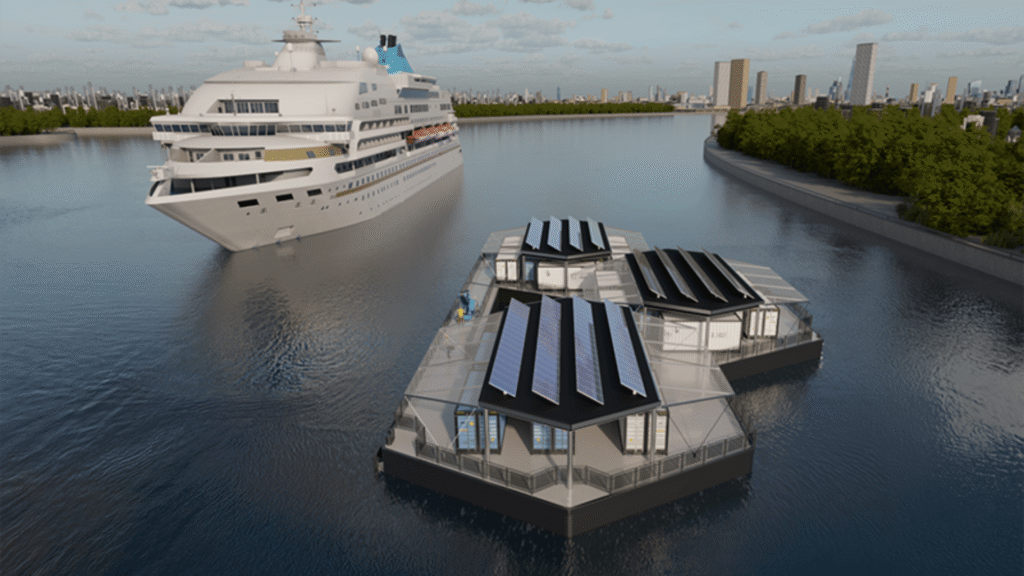
In a groundbreaking development, a UK-supported maritime consortium has introduced a pioneering grid-independent Hydrogen Power Hub aimed at revolutionizing the decarbonization of ports worldwide. This innovation promises to address longstanding challenges in port electrification with its unique design and technology.
The core of this system is comprised of three modular hexagonal floating platforms, covering nearly 12,900 square feet. These platforms are equipped with approximately 45MWh of battery energy storage, modular fuel cell systems, hydrogen-powered generation, renewable energy sources onboard, and advanced grid-forming AC/DC electrical architecture. The entire setup is engineered to provide direct power to vessels.
Validated over six months as part of the UK Research and Innovation Clean Maritime Demonstrator Competition Round 6, and in collaboration with the UK Shipping Office for Reducing Emissions, the project included rigorous hydrodynamic, structural, electrical, and operational testing.
The collaborative effort demonstrated the feasibility of integrating existing hydrogen, battery, fuel-cell, and electrical technologies into a modular floating system capable of powering large ships at berth. This innovation has the potential for global deployment across ports.
Tackling Port Electrification Bottlenecks with 5MW Output
Specifically engineered for large-scale maritime operations, the Hydrogen Power Hub can supply up to 5MW of uninterrupted clean electricity to vessels at berth. It supports both 6.6kV and 11kV shore power connections, sufficient for medium-sized cruise ships and other energy-intensive maritime assets.
The initiative targets a major hurdle in port decarbonization: the availability of reliable electrical infrastructure. Many ports face challenges such as limited grid capacity, prolonged utility connection processes, space constraints, complex permitting requirements, and high costs associated with traditional shore-side power installations.
By operating independently of existing grid systems, the floating platform provides an alternative for ports aiming to cut vessel emissions. Unlike traditional shore power projects, which can take years and require extensive construction, the floating platform simplifies the process, potentially offering a quicker route to emission reductions.
The consortium asserts that the platform is capable of delivering about 91MWh of energy weekly, while facilitating repeated vessel charging operations. This design reduces the need for major construction projects, land reclamation, or expensive upgrades to existing electrical infrastructure.
Reducing the Need for Permanent Port Fuel Infrastructure
To maintain ongoing operations, the platform consumes approximately 16,500 to 17,600 pounds of hydrogen weekly, stored in modular, ISO-compatible low-pressure containers within the floating structure. This system is designed to streamline fuel logistics and offers adaptability for various port settings.
The current setup features seven onboard hydrogen storage tanks, with refueling required about twice a week. This allows ports to implement hydrogen-powered shore power systems without needing to invest in permanent hydrogen infrastructure at the outset, potentially reducing adoption barriers during initial implementation stages.
Instead of relying on large generators, the system employs 1.3MW modular fuel cells to continuously charge onboard batteries, enabling rapid energy delivery when ships dock. It also includes 146kW of onboard solar capacity to help decrease hydrogen usage.
Additional tests by the University of Strathclyde validated the platform’s stability, structural integrity, motion characteristics, and multi-platform connectivity under various sea conditions, confirming its viability for long-term maritime operations.
Original Story at interestingengineering.com