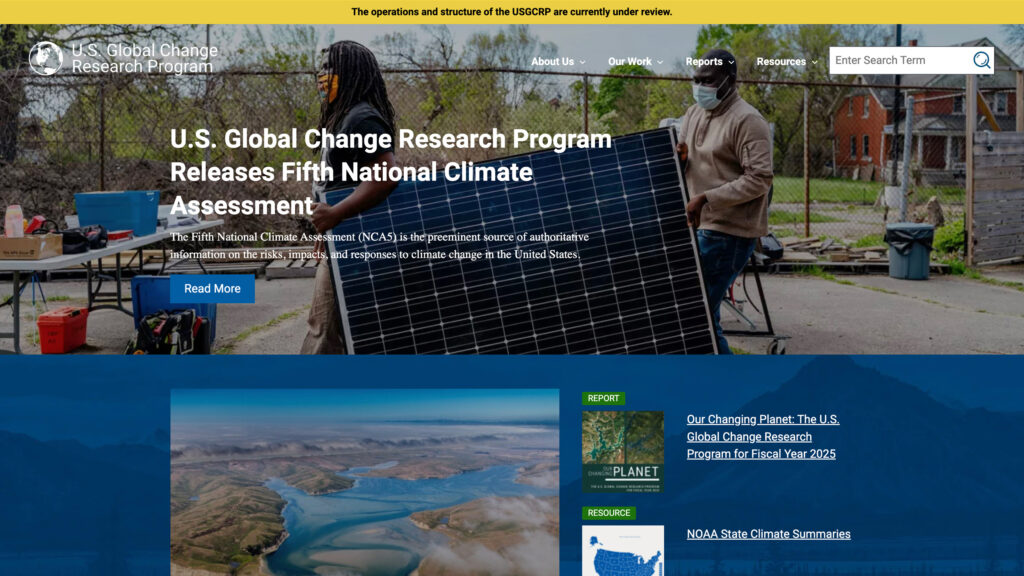
Federal Climate Research Program’s Website Goes Offline Amidst Ongoing Cuts
In a surprising turn of events, the federal government’s Global Change Research Program, which has been instrumental in monitoring climate change over the past 35 years, suddenly saw its website go offline on Monday. This development comes as part of broader actions taken by the Trump administration against the program.
The Global Change Research Program is a collaborative interagency effort tasked with producing the National Climate Assessment every four years, offering insights into climate science on both national and international levels. Additionally, it provides annual updates to Congress on its findings.
However, the program has faced significant challenges recently. In April, the Trump administration reduced its staffing and funding, marking the beginning of several setbacks. Later, in an unexpected move, all scientists involved in crafting the sixth National Climate Assessment, scheduled for release in 2028, were dismissed, including Rachel Cleetus from the Union of Concerned Scientists.
Rachel Cleetus expressed her frustration, stating, “It’s an honor to be invited to participate. It was a real disappointment not just to see the effort disbanded, but there’s been no word from the administration about what they intend to do.”
With the website down, access to past reports and data is now limited to a few online platforms and the Internet Archive’s Wayback Machine. Previous assessments remain available through the National Oceanic Atmospheric Administration’s repository.
Some former contributors to the National Climate Assessment suggest that eliminating these reports and potentially halting future assessments may contravene the Global Change Research Act of 1990. This act mandates that research findings, including the quadrennial National Climate Assessment, be presented to Congress and the president and be accessible for crafting relevant policies.
While the White House has not commented on the situation, the National Climate Assessment serves as a crucial resource for the public, offering insights into regional climate challenges. Cleetus highlighted the report’s significance, mentioning it provides “actionable information that communities, decision-makers, businesses can use to help inform their decisions about how to protect themselves as climate change is worsening.”
This isn’t the first instance of the Trump administration targeting climate science. Earlier in his term, President Trump revoked an executive order from former President Biden that aimed to establish the National Nature Assessment. Furthermore, the administration has removed climate change references from numerous government websites and reduced funding for climate science research.
Donald Wuebbles, an atmospheric science professor, emphasized the importance of public awareness, stating, “It is to the benefit of all Americans to be aware of this information and what it means to us.” He further criticized the administration’s stance, stating, “Climate change is one of the most serious issues humanity has ever faced, and for us to not take that seriously, as this administration is doing, it’s criminal.”
While the assessments do not introduce new scientific discoveries, they compile existing data to provide a comprehensive overview of regional climate effects, serving as a reliable resource for lawmakers. Cleetus remarked, “The science itself will endure, but making sure that it’s publicly accessible in a useful format for decision makers—that was a unique responsibility and really the domain of the federal government.”
Original Story at insideclimatenews.org