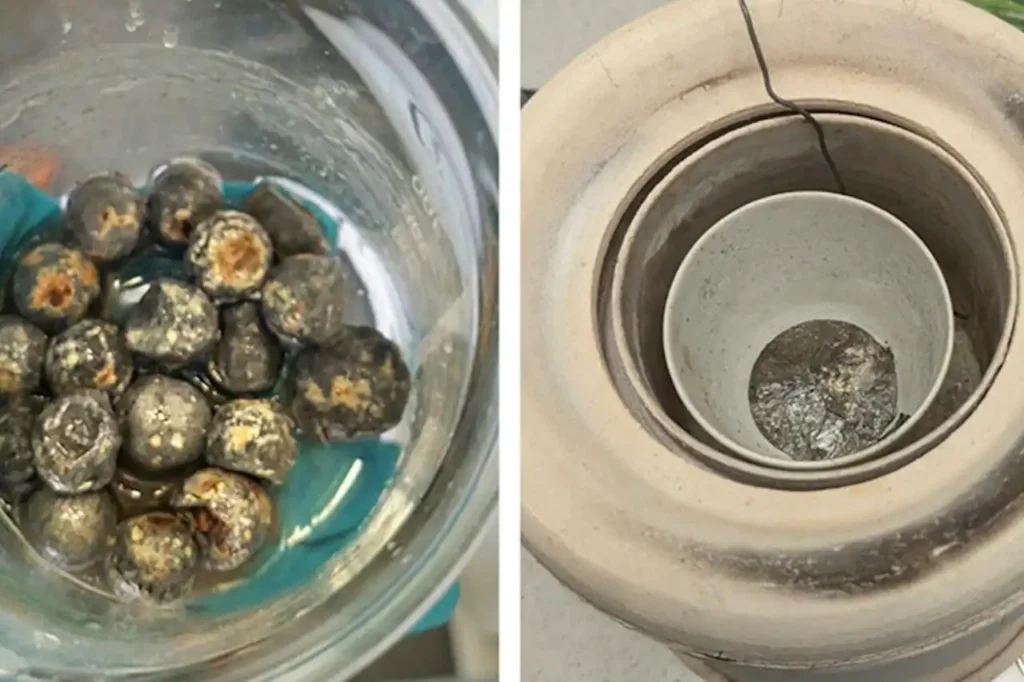
In a fascinating blend of history and innovation, researchers in Germany have repurposed centuries-old lead musket balls, once used in warfare, into cutting-edge solar panels. These musket balls were acquired from eBay, melted down, and turned into precursor materials for perovskite solar cells, a promising new class of renewable energy technology.
The production of perovskite solar cells demands significant amounts of pure lead, typically sourced through environmentally harmful mining processes. By utilizing old ammunition as a lead source, scientists are not only preserving resources but also mitigating toxic waste, paving the way for more sustainable energy solutions.
The Rising Star of Perovskites
While silicon currently leads the solar market, perovskite crystals are quickly emerging as a formidable competitor. Their unique structure allows them to be printed on flexible materials, enhancing their versatility. According to Tonio Buonassisi from MIT, “Perovskites are highly tunable, like a build-your-own-adventure type of crystal structure.”

Despite the potential of perovskites, their reliance on lead presents an environmental challenge. “Perovskite solar cells rely on high-purity lead iodide,” noted Ian Marius Peters on LinkedIn. “But lead is both toxic and resource-intensive to mine and refine.”
Innovative Recycling Techniques
At the Jülich Research Centre, scientists tackled the challenge of recycling musket fragments, laden with impurities like carbon residue and oxidation. Their successful extraction of high-purity lead from these materials suggests the potential to recycle modern lead waste effectively.
Rather than relying on conventional methods that generate significant waste, the team employed an environmentally friendly two-step process. By melting the musket balls using electrical contacts and dissolving them in a chemical solvent, they managed to achieve an impressive 94% efficiency in producing lead iodide.
Towards a Closed-Loop System

Further purification involved heating the lead iodide to form high-purity crystals, achieving a remarkable purity level of 99.999%. These crystals were then used to create perovskite solar cells that converted about 21% of sunlight into electricity—comparable to those made with commercial lead.
The study highlights the potential of recycling lead waste, which often ends up in landfills, into valuable materials for clean energy. Peters emphasized, “Millions of tons of lead already exist in waste streams that remain underutilized. This work shows that toxic legacy waste can become a resource for clean energy.”
The findings were published in the journal Cell Reports Physical Science.
Original Story at www.zmescience.com