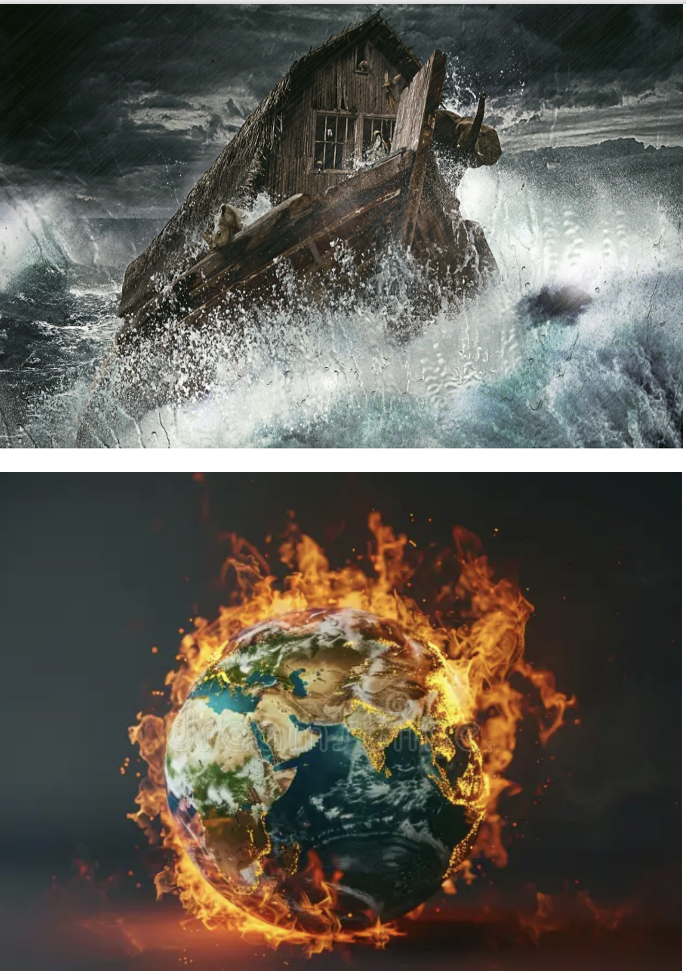
The Christian scriptures, specifically 2 Peter 3:10-18 in the New Testament, prophesy a fiery conclusion to Earth’s wickedness, distinct from the great flood of Noah’s time. The passage states, “But the day of the Lord will come as a thief in the night; in the which the heavens shall pass away with a great noise, and the elements shall melt with fervent heat, the earth also and the works that are therein shall be burned up.”
In a modern twist, both fire and water are manifesting as agents of change amidst human-driven climate shifts.
While the Northeast and Midwest endured a cold winter and early spring, California and the Southwest faced unprecedented heat waves. These conditions are attributed to the irregular behavior of the atmospheric Jet Stream, which creates “valleys” allowing arctic air to move southward and “peaks” causing tropical heat to surge north. Meteorologists and local authorities caution residents of the Southwest and California coast to reduce outdoor activities due to the potential health risks.
The National Weather Service in San Francisco has predicted March temperatures in the nineties for the Bay Area, an anomaly considering the time of year. Many Bay Area homes lack air conditioning due to this historical rarity. Meteorologists have noted new record highs for March and the earliest occurrence of 100-degree days in Phoenix, Los Angeles, and San Francisco. In response, Los Angeles has opened libraries and recreation centers as cooling shelters. Scientific data highlights how these heat waves dry out vegetation, heightening the risk of wildfires.
Recent years, specifically 2023 and 2024, have been the hottest on record. The global average temperature in 2024 was 1.5° C (or just over 2.5° F) above preindustrial levels—a critical threshold beyond which the most severe impacts of climate change become unavoidable. The pace of global warming appears to be quickening. A study affirms with 98% certainty that global warming has accelerated since 2015. Climate experts anticipate a record-breaking Super El Niño event in 2026-2027, likely intensified by climate change. The El Niño–Southern Oscillation (ENSO) is a global climate event triggered by variations in the Pacific Ocean’s surface temperature. This could mean severe storms in California and the southern United States, with potential flooding, wind damage, and droughts and wildfires in the Southern Hemisphere. The northeastern U.S. may experience a milder and wetter winter.
Regarding water, new research suggests scientists may have underestimated the extent of high water levels along coastlines, putting hundreds of millions at risk of being displaced. A study published in Nature shows that sea levels are 8 to 12 inches higher than previously mapped. Earlier assessments, which relied on outdated models, did not reflect actual sea-level measurements. This miscalculation is most pronounced in Southeast Asian and Pacific regions due to complex ocean dynamics, affecting millions in Vietnam, the Philippines, and Indonesia. Policymakers must now adapt to these revised projections.
The Earth’s oceans absorb over 90% of the excess heat trapped by greenhouse gases. Each of the past eight years has set records for ocean heat, with warming rates doubling over the last two decades. This phenomenon contributes to the melting of polar ice caps and rising sea levels.
By 2050, more than 800 million people in over 570 coastal cities could face flood risks due to rising seas. In the United States, the frequency of coastal flooding has tripled since the 1990s and is expected to occur ten times more often by 2050. Florida, New Jersey, and New York are particularly vulnerable, with Nassau County at substantial risk. In New York City, the southern tip of Manhattan has flood-prone real estate valued at over $100 billion.
Globally, major urban centers at risk include Dar es Salaam in Tanzania, Jakarta in Indonesia, Manila in The Philippines, along with Shanghai, Shenzhen, and Hong Kong in China, and much of Bangladesh.
Original Story at www.dailykos.com