Machine Learning Advances Battery Health Insights
Battery technology is rapidly advancing, thanks in part to the integration of machine learning techniques. Researchers are increasingly using artificial intelligence to predict battery end-of-life and enhance battery management systems. These advancements are crucial for the growth of electric vehicles and renewable energy storage solutions, which rely heavily on efficient and reliable battery technologies.
Predicting Battery End-of-Life
A recent study by Aitio and Howey focused on predicting battery end-of-life using machine learning. Their research, published in Joule, utilized field data from solar off-grid systems. This approach allows for more accurate predictions of battery lifespan, which is essential for optimizing the use of renewable energy systems (source).
Battery Aging Diagnosis
Che, Hu, and Teodorescu explored the opportunities for diagnosing battery aging modes in renewable energy storage. Their work in Joule highlights the potential for improved battery performance and longevity when aging modes are accurately diagnosed (source).
Second-Life Batteries
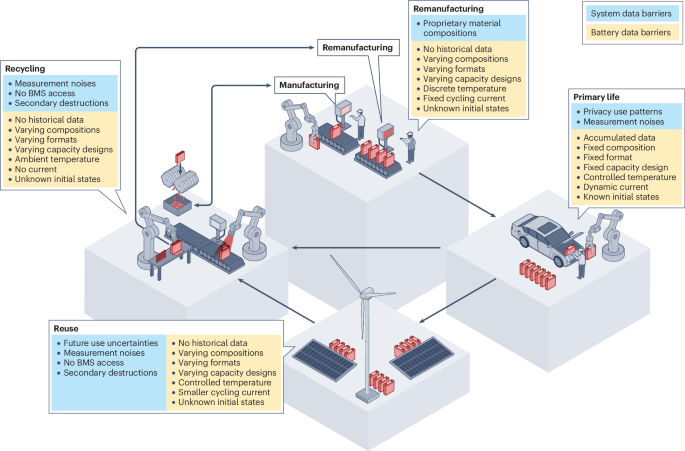
Gu and colleagues examined the challenges and opportunities associated with second-life batteries, focusing on key technologies and economic aspects. Their research, published in Renewable and Sustainable Energy Reviews, suggests that repurposing old batteries can significantly reduce costs and environmental impact (source).
Economic Benefits of Retired Batteries
Xu et al. investigated the economic benefits of using retired electric vehicle batteries in electricity markets. This study, found in Journal of Cleaner Production, demonstrates how these batteries can be a valuable asset in energy storage, aiding in grid stability and energy security (source).
Advancements in Battery Recycling
Ji and team are exploring the direct upcycling of spent cathode materials. Their approach not only enhances the performance of recycled batteries but also promotes sustainability by reducing waste. This work is detailed in Advanced Materials (source).
Original Story at www.nature.com