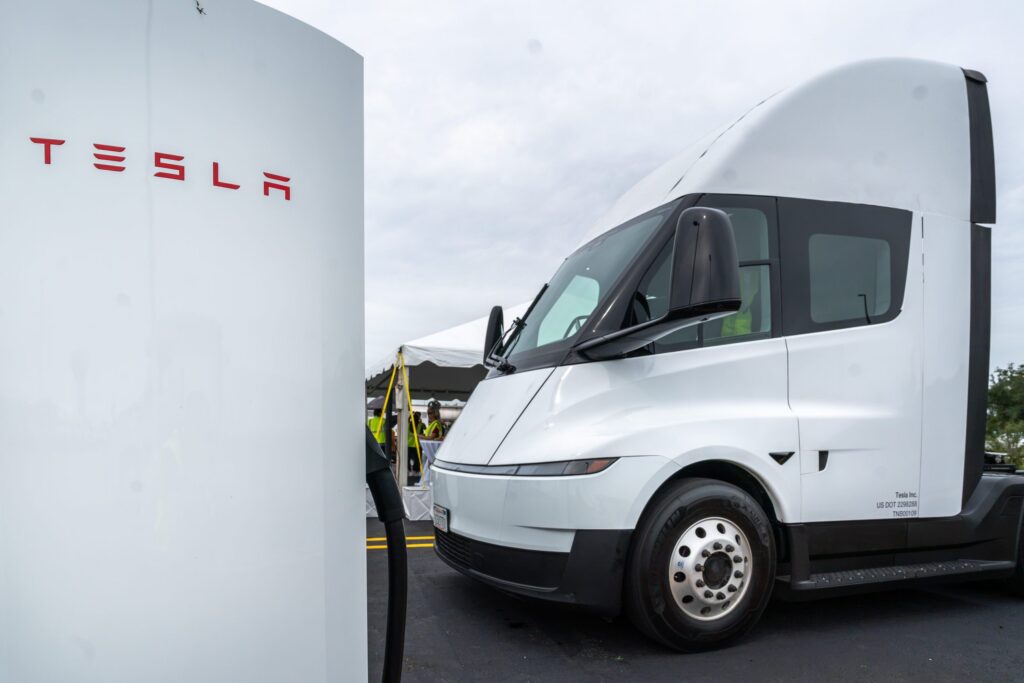
The push towards electrification in the trucking industry is gaining momentum, notably along key freight routes like I-16. A new installation in Bryan County aims to make this transition smoother for fleets, especially as diesel prices continue to rise.
The Pilot Travel Center in Ellabell has introduced six Tesla Megachargers, capable of delivering up to 1.2 MW each. These chargers can replenish approximately 300 miles of range to a Tesla Semi in just half an hour.
Tesla offers two versions of its Class 8 electric trucks: a standard range model with a 325-mile range and a long-range model that can travel 500 miles per charge. Both models were recently showcased at the Pilot Center.
Jason Gies, Tesla’s East Coast business development lead, emphasized the cost benefits of electric semis. “From just a fuel perspective, it’s about 50% cheaper,” he explained. Charging a Tesla Semi from Ellabell to Atlanta costs about $80, compared to $160 for diesel trucks last year.
As of last Friday, diesel in the Savannah area averaged $5.68 per gallon, according to AAA.
While electric semis have a higher initial cost, with a median price of $411,200 compared to $172,500 for diesel, they promise long-term savings. “So if you run around 75,000 – 100,000 miles a year, you will see a return on investment in about three to four years,” Gies noted.
Expansion Plans
Near Atlanta, Tesla has launched an eight-stall Megacharging site in Conley. Gies stated, “This route is going to be one of our core centers of where we’re going through the next year as we grow.” Tesla aims to have over 100 Megacharging posts by year-end and 700 by the following year.
Shannon Sturgil, Pilot’s senior vice president of alternative fuels, announced plans for 12 more truck charging sites in states like California, Indiana, Nevada, and Texas. “Our goal is simpler: to help remove barriers, increase confidence, and make it easier for fleets to operate wherever the road may take them,” he said.
Pilot, based in Knoxville, operates the largest travel center network in North America, boasting over 900 locations. A report from the Southern Alliance for Clean Energy and Atlas highlighted a $366 million investment in charging infrastructure for medium and heavy-duty EVs in the Southeast, marking a shift from planning to implementation.
Electric heavy-duty trucks are advancing faster in regions like China and Europe compared to the U.S., according to the International Energy Agency.
Environmental and Operational Benefits
Beyond cost savings, electric semis are environmentally advantageous. Gies called them “zero emissions vehicle[s],” contrasting with diesel trucks, which he described as “the most polluting vehicles in the country.”
Gies personally drove the 325-mile-range semi from Conley to Ellabell, highlighting the improved visibility and aerodynamics from the central driver’s seat. The electric semi also offers a smoother ride with its 1076 horsepower, facilitating seamless highway merges and consistent speeds.
Conni Reynolds, from the Savannah Area Chamber of Commerce, expressed enthusiasm for the new technology, noting Savannah’s blend of history and innovation. “So that’s what’s exciting to see,” she remarked.
Original Story at thecurrentga.org