
In a groundbreaking study, the prevalence of climate misinformation in television and radio broadcasts has been systematically measured over the course of a year. This study, conducted by Science Feedback in partnership with the Observatory of Media on Ecology (OME), sheds light on the extent of false climate narratives in French media.
13 Cases of Climate Misinformation Per Week in 2025
Throughout 2025, an extensive evaluation of climate-related broadcasts was carried out across 18 major television and radio channels in France, amassing over 5,000 hours of content. The monitoring process was powered by an AI-based detection system, part of the Climate Safeguards project. This system, with a recall rate exceeding 80%, identified 80% of misleading climate content.
Each detected case was meticulously analyzed by Science Feedback editors and climate experts to ensure only verifiable misinformation was included. By the end of 2025, 665 cases were documented, averaging 13 instances per week.
19 Dominant Disinformation Narratives
To better understand these misinformation cases, they were categorized based on thematic content. This approach distinguishes between isolated inaccuracies and repeated falsehoods, the latter often part of deliberate disinformation strategies.
Through automated language analysis and manual review, cases were grouped into narratives. Findings reveal that 19 narratives, each with at least eight instances, comprised around 80% of all misinformation cases.
A notable example is the narrative linking renewable energy to soaring electricity prices, repeated 125 times from January to August 2025.
Most narratives emerged in early 2025, with additional cases bolstering them throughout the year. Comprehensive data and verifications are publicly accessible.
More than 90% of narrative-linked misinformation pertains to climate change mitigation, predominantly focusing on the energy sector, mobility, and France’s role in global climate efforts. Notably, narratives denying climate change or its human origins are now less common.
A Decline in Climate Misinformation at Year-End
While the first eight months of 2025 were previously analyzed, this report reveals a decrease in misinformation cases in the year’s final quarter. This decline was observed both in absolute numbers (Figure 1) and in cases per hour of climate coverage (Figure 2). Notably, CNEWS and Arte saw significant reductions, while TF1 experienced an increase.
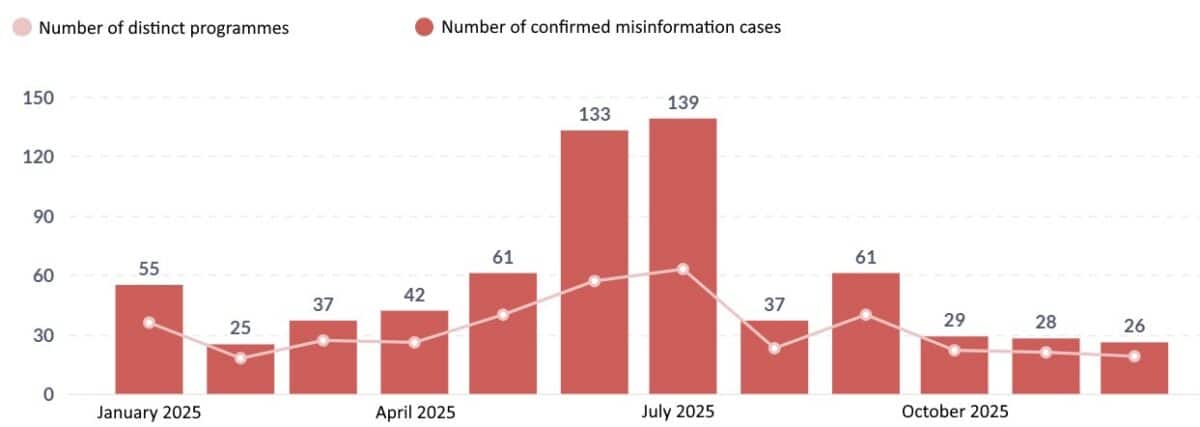
“This trend can largely be explained by one key factor: the absence of any major debate on public environmental policy during this period. In other words, when climate issues are less prominent on the political and media agenda, opportunities to spread misleading narratives automatically decrease.”
Explains the OME in its 2025 Review (article in French)
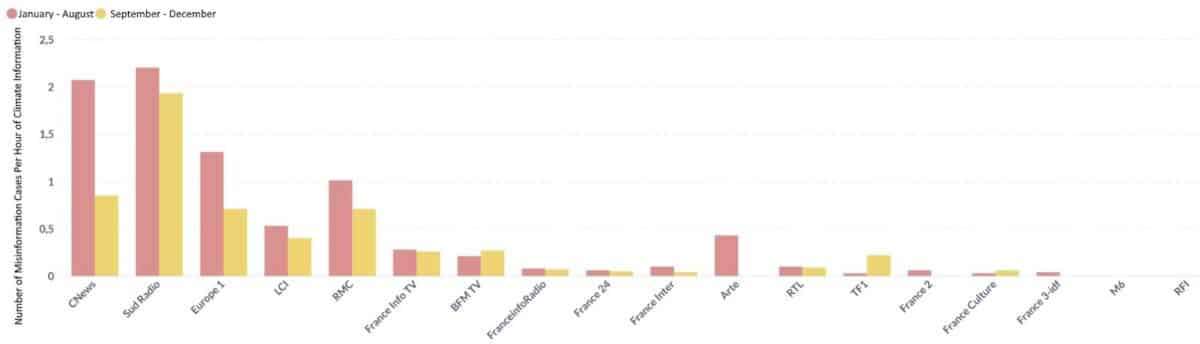
Established Narratives Persist Through Year’s End
Analysis of the year’s final months reveals that misinformation cases were largely consistent with the 19 identified narratives from early 2025. No significant new narratives emerged, underlining a reliance on repeating established themes.
Renewable Energies Targeted by Disinformation
Variable renewable energies remain a primary focus for disinformation campaigns. The top three disinformation narratives persist, including allegations that:
- Renewable energies cause electricity prices to rise sharply.
- They receive inflated public subsidies.
- They are inefficient due to their intermittency and lack competitiveness.
These claims often rely on misleading logic, erroneous cost assessments, and inaccurate data.
Rise of Automotive Narratives
With the EU reconsidering a ban on combustion engine vehicles by 2035, automotive narratives gained traction. Two significant narratives emerged late in the year:
- Claims that electric vehicles pollute more than combustion or hybrid cars.
- Assertions that certain fuels pose no environmental threat.
These narratives illustrate how climate misinformation can quickly adapt to political shifts by distorting facts.
Decline in Climate Science Denial
Denial of climate change’s existence or human origins saw a decrease in the year’s final quarter, with eight cases noted. However, the remaining narratives challenge the scientifically established human cause of global warming, presenting it as debatable or negligible.
Environmental Coverage Review
In 2025, environmental topics occupied 4.9% of news airtime, a 33% increase from 2024’s 3.7%. This uptick is partly due to comprehensive reporting on two heatwaves, accounting for 9% of airtime in June and 11% in August.
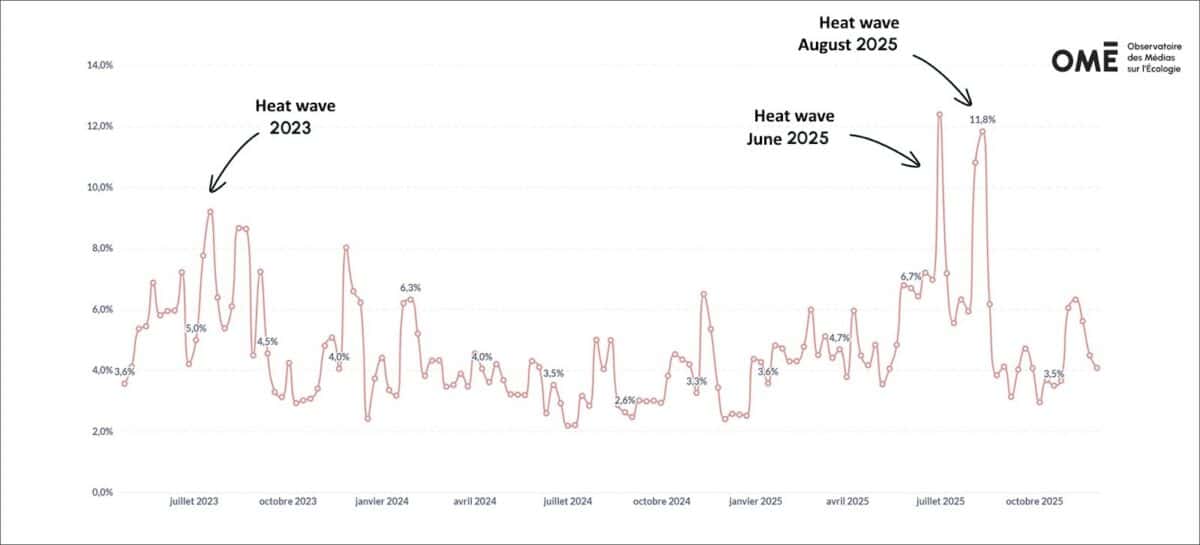
Environmental coverage varied significantly by sector. Agriculture, industry, and energy were the most covered, while transport, the top greenhouse gas emitter in France, received less attention.
The Observatory highlights the disparity between media focus and sectoral emissions. Agriculture was overrepresented in media coverage relative to its emissions (35% coverage vs. 20% emissions), whereas transport was underrepresented (12% coverage vs. 35% emissions).
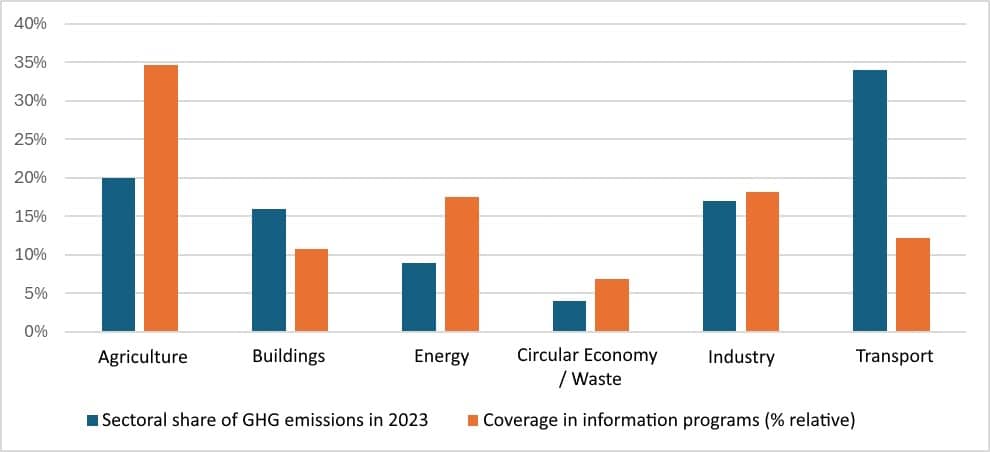
The insufficient focus on transport’s environmental impact, given its emission significance, poses a risk for misinformation. Two narratives unveiled in October 2025 frequently mislead the public: exaggerated claims about electric cars’ climate impact and minimized emissions from combustion vehicles. These narratives gained prominence in late 2025, surpassing their average presence earlier in the year.
Original Story at science.feedback.org