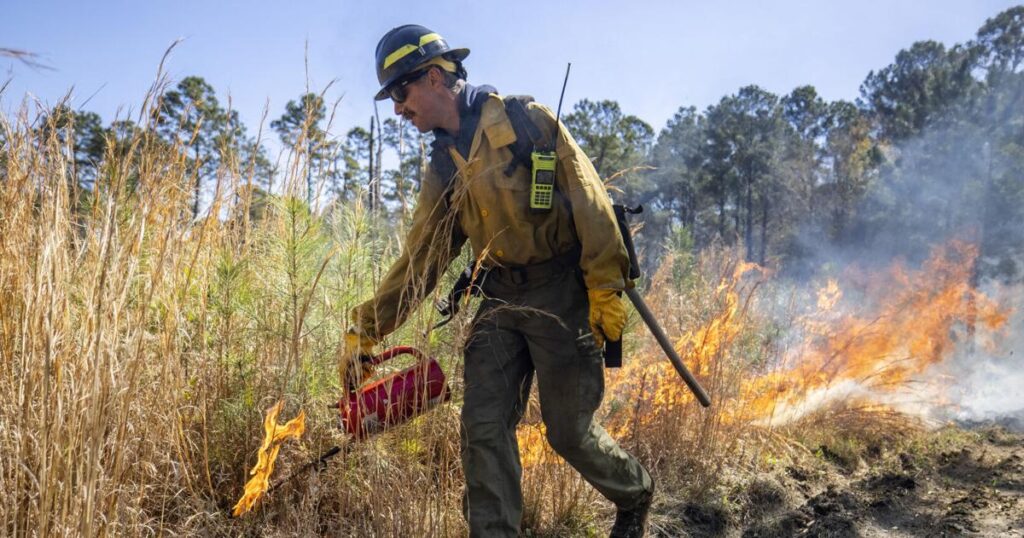
In the serene backdrop of South Carolina’s pine forests, a well-orchestrated dance with fire helps prevent future wildfires and enriches the ecosystem. On a cool spring morning, a dedicated team led by Chelsea MacKenzie initiates a controlled burn, a practice gaining renewed appreciation for its ecological benefits.
Historically, fire was a key tool for indigenous communities to shape their environment, but this practice was sidelined by European settlers who favored fire suppression. Today, however, prescribed burns are recognized by forest managers as vital for maintaining healthy forests in the region. These burns clear undergrowth, support wildlife movement, and promote plant diversity, though they face challenges from urban expansion and climate change.
Executing a Controlled Burn
At The Nature Conservancy’s Driftwood Preserve in Awendaw, a team convenes to discuss the day’s burn plan. Detailed planning documents outline every aspect of the operation, from property boundaries to emergency protocols. The crew, which includes members from the Southeast and wildland firefighters from the West, meticulously prepares to light the first test plot.
Patrick Ma, conservation forester with The Nature Conservancy, notes the smaller, independent teams in South Carolina, in contrast to larger firefighting crews in the West. This setup allows team members to gain various training certifications and return with valuable experiences to their home units. “We hope that a little bit of South Carolina travels back with them to their home units,” Ma says.
As the burn progresses, smoke fills the air, and the crew members efficiently manage the flames using specialized terminology and precise communication. Their roles are clearly defined, with a focus on maintaining fire boundaries and preventing escape into undesignated areas.
Challenges of Prescribed Burns
The growing proximity of residential areas to forestland adds complexity to prescribed burns. Jonathan Calore from the South Carolina Forestry Commission emphasizes the need to control smoke dispersion to avoid impacting nearby neighborhoods. Climate change further complicates the situation, reducing the number of suitable days for burns due to variable weather patterns, as highlighted by a 2024 study in Nature.
In recent years, unpredictable weather has delayed burns, leaving forest floors densely packed and increasing the risk of uncontrolled wildfires. Despite these challenges, prescribed burns remain crucial for forest health and safety.
Ecological Benefits
Prescribed burns at Driftwood Preserve aim to balance the coexistence of longleaf and loblolly pines. Longleaf pine, once dominant across the Southeast, thrives with fire and offers habitat for species like the red-cockaded woodpecker. Ma explains, “Without prescribed fire, hardwood trees would grow quickly and create a ladder for these snakes to easily reach the nest.” The sap-rich longleaf provides a natural defense against predators, unlike the loblolly.
The burns also support understory plants vital for wildlife, ensuring a diverse ecosystem. The long-term goal is to restore longleaf dominance, leveraging their fire tolerance to gradually replace loblolly pines, ultimately fostering a healthier and more resilient forest environment.
Original Story at www.postandcourier.com