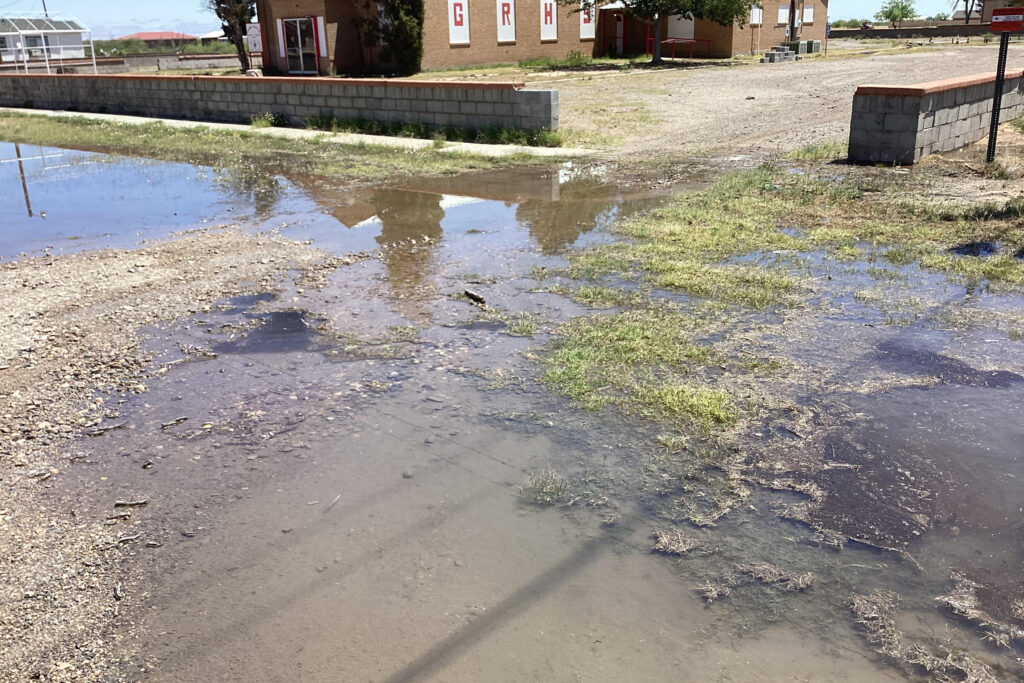
Salty water is surfacing from underground in the small Permian Basin town of Grandfalls, Texas.
The liquid began pooling in the parking lot of the First Baptist Church on Tuesday. State inspectors from the Railroad Commission arrived soon after and remained on-site Wednesday. Nearby landowners suspect oilfield wastewater is surfacing through the wellbore of an old plugged oil well.
This is the latest occurrence of water emerging in the Permian Basin, which has seen blow-outs, geysers, and surface leaks over the past five years. Oilfield wastewater, known as produced water, is injected underground, increasing subsurface pressure.
State regulators acknowledge that excess underground pressure has led to other surface leaks in the area. The wastewater has high salt content and may contain contaminants.
Unlike previous blowouts that occurred on ranches, this incident is within a town of over 300 people. The leak is one block from Grandfalls-Royalty K-12 school and across from the historic Union Church. Vacuum trucks were removing the liquid from the Baptist Church parking lot on Wednesday. Residents were advised to keep their distance.
“The Railroad Commission of Texas is responding to an unidentified flow located in Grandfalls in Ward County,” stated spokesperson Bryce Dubee. “State Managed Plugging crews are on site, removing fluid and assessing the area to determine the flow’s source.”
The Grandfalls city administrator advised residents to direct any questions to the Railroad Commission. She noted difficulty reaching the commission’s district office in Midland. A school district employee mentioned that classes continued as the cleanup proceeded.
The Railroad Commission’s Geographic Information System map shows a plugged oil well beneath the Baptist church. The well’s drill or plug date and other details were not immediately available. There are at least two dozen plugged wells within Grandfalls’ city limits. Many plugged wells in Texas predate modern record-keeping, limiting officials’ information about the methods or materials used.
Laura Briggs, a nearby landowner, noticed water accumulating on the street early Tuesday. She observed water seemingly leaking from under the church sanctuary, which dates back to 1955. Any plugged oil well beneath the church predates it.
By the time Sarah Stogner, district attorney for the 143rd Judicial District of Texas, arrived Wednesday afternoon, vacuum trucks had removed most of the water. The crew appeared to have drilled a hole in the parking lot to collect water. Liquid continued surfacing as Stogner captured drone footage.
“This is why we need to stop building on top of old plugged wells,” Stogner wrote on X. “They don’t always stay plugged.”
Since the advent of fracking in the Permian Basin, oil companies have produced vast quantities of wastewater, which is generally injected back underground into deep disposal wells. After these wells were linked to earthquakes in the Permian Basin, the Railroad Commission restricted deep injection in some areas.
Operators shifted to shallower formations, but this filled underground reservoirs, increasing pressure. Aging or improperly plugged wells have become pathways for pressurized water to erupt. The Railroad Commission introduced permit restrictions last year to limit injection pressure.
Many incidents have occurred around aging oilfields in Ward, Crane, and Pecos Counties, where wells were drilled as early as the 1930s. Grandfalls’ population surged after oil was discovered nearby in 1928 but declined since the 1990s.
Stogner documented a similar leak in Grandfalls in 2022. Grandfalls is located on Farm to Market Road 18, between Fort Stockton and Monahans, about 70 miles southwest of Midland and over 350 miles west of Austin. The town was named for the falls that once cascaded on the Pecos River, but there is no longer enough water to sustain them.
Original Story at insideclimatenews.org