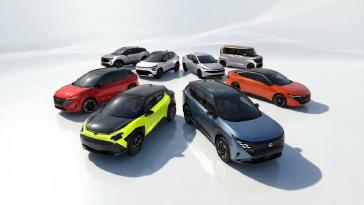
NASHVILLE, Tenn. – Nissan Motor Co., Ltd. has unveiled its latest strategic vision to integrate cutting-edge mobility technology into daily life, branded as “Mobility Intelligence for Everyday Life.” This initiative emphasizes the development of AI-Defined Vehicles (AIDV) alongside a diverse array of electrification technologies aimed at meeting the varying requirements of customers and markets.
Ivan Espinosa, Nissan’s President and CEO, elaborated: “This is the right moment to articulate Nissan’s long‑term vision as we move beyond the Re:Nissan recovery plan and set a clear path for the future. Our vision defines where Nissan is headed, with customer experience as our guiding priority. By advancing mobility intelligence, we will deliver intuitive, advanced, and reliable products and technologies that offer outstanding value and enrich how mobility is experienced.”
Christian Meunier, chairman of Nissan Americas, shared insights on the company’s regional successes: “Across the Americas, our focus on execution is making the region a key contributor to Nissan’s turnaround, driven by both revenue growth and disciplined cost reduction. We delivered significant year-over-year increases in U.S. retail share, making Nissan the fastest-growing mainstream brand since August 2025. We’re also seeing solid progress in Canada and continued growth in Mexico, where we have maintained the #1 position for 18 consecutive years – proof that getting the fundamentals right matters. Our balance of strong execution today and smart, impactful investments in the future will strengthen our business and drive sustainable growth.”
As Nissan’s Re:Nissan plan enters its final year, the company remains committed to achieving a competitive cost framework, optimizing capacity utilization, and sustaining momentum with new products to ensure future growth.
Next-Generation Technologies: AI-Driven Intelligence and Electrification
The cornerstone of Nissan’s vision is the integration of AI-driven intelligence within its vehicles. The Nissan AI Drive Technology, coupled with Nissan AI Partner technology, aims to enhance both the driving experience and the time spent in transit.
Nissan plans to implement its AI Drive technology in 90% of its vehicle lineup over the long term. The new Nissan Elgrand, set to launch in summer 2026, will be the first model to feature next-generation ProPILOT with end-to-end autonomous capabilities by the end of fiscal 2027.
In addition to advancing autonomous driving, Nissan AI Partner technology will enhance customer interactions by seamlessly integrating vehicles into daily life.
Nissan’s future of mobility will be further supported by increased electrification. The company’s innovative Hybrid e‑POWER technology serves as a bridge to fully electric vehicles and will be complemented by a variety of other electrified powertrains.
Nissan is also developing a new hybrid electric vehicle system (HEV) for forthcoming frame-based vehicles, catering to customers who need greater range and capability. The company will broaden its offerings with plug-in hybrid and range-extender hybrid options through collaborative partnerships.
Streamlined Product Portfolio: Defining Model Roles
Nissan’s strategy includes refining its product lineup from 56 to 45 models, focusing on performance and reallocating resources to areas with growth potential. Powertrain options for each model will be expanded to provide more choices to customers and strengthen Nissan’s market position.
Approximately 80% of Nissan’s vehicle volume will be covered by three core families, allowing the company to direct investments and accelerate development to better meet market demands.
Models Categorized by Role
Nissan will categorize its models into four groups under its new portfolio strategy:
- Heartbeat models that reflect Nissan’s identity, innovation, and emotional value
- Core models that ensure global business stability and scalability
- Growth models aimed at expanding in emerging demand areas
- Partner models that broaden market coverage through strategic collaborations
Nissan has highlighted several models that exemplify this strategic focus:
- New Rogue and X‑Trail Hybrid e‑POWER: Global Core models showcasing Nissan’s unique electric-motor-driven system.
- Xterra: A Heartbeat model for the U.S. and Canada, featuring robust design and body-on-frame strength.
- Juke EV: A Europe Core model combining electrification with distinctive styling.
- Skyline: A Heartbeat model for Japan, known for its performance and driver-focused design.
In the premium segment, INFINITI will continue to be a vital part of Nissan’s global strategy, with plans for new and refreshed models, including the 2027 QX65 SUV and a luxury hybrid compact SUV by 2028.
Industrial Model
Nissan is reshaping its industrial model through the Nissan Product Family strategy, emphasizing architecture-led development over individual model optimization.
By focusing on three core product families, Nissan aims to cover over 80% of global volume, increase model volume by more than 30%, and accelerate the rollout of new technologies.
This approach aligns product design with industrial execution, enhancing quality, reducing costs, and enabling quicker, more competitive product launches.
Redefined Market Approach
Nissan is refining its market strategy by defining specific roles for its three leading markets: the U.S., Japan, and China.
These markets will be pivotal in driving Nissan’s competitiveness and industrial capabilities, serving both local and global strategic roles.
The U.S. (with Canada) aims to provide consistent returns and a foundation for growth, targeting one million units by fiscal year 2030. The focus will be on large vehicles and a strong manufacturing presence, with an emphasis on localization.
Japan will continue to be Nissan’s home for advanced technologies, including next-generation ProPILOT and mobility services. A new compact car series is planned for FY2028, targeting 550,000 units by fiscal 2030.
China will be a hub for development speed and cost efficiency, with a goal of reaching one million units by fiscal year 2030. Exports will play a key role, with models like the N7 and Frontier Pro reaching LATAM, ASEAN, and the Middle East.
Other regions such as Mexico and the Middle East remain crucial to Nissan’s global strategy, with Mexico leveraging a strong local base and the Middle East focusing on large SUVs and premium segments.
As part of its global approach, Nissan will continue to explore opportunities in Europe, India, and Africa, aligning with its product portfolio strategy.
Concluding on the company’s vision, Espinosa remarked: “As we continue on our path to recovery, it is essential that Nissan seizes the opportunities provided by AI technologies, by electrification and the innovation embedded in our latest products to drive market growth and focus relentlessly on serving the customer.”
Nissan will provide further updates on its Re:Nissan progress and strategic directions in future announcements.
For further information
For more information about our products, services and commitment to sustainable mobility, visit nissanusa.com. You can also follow us on Facebook, Instagram, X (Twitter) and LinkedIn and see all our latest videos on YouTube.
Original Story at usa.nissannews.com