Revolutionizing Freight: Mercedes-Benz Debunks Electric Truck Myths with Real-World Data
As electric vehicles become more common on the roads, misconceptions about their practicality and efficiency continue to linger. In response, Mercedes-Benz has released operational data from its fleet of 80 electric semi-trucks, challenging these myths and offering a fresh perspective on the viability of battery-electric long-haul transport.
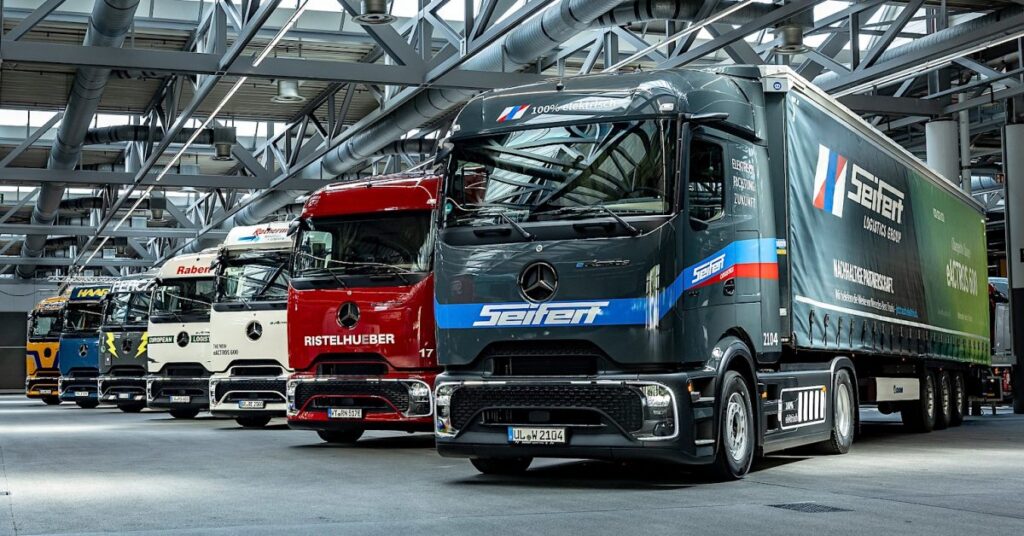
Mercedes-Benz’s data spans thousands of journeys, charging cycles, and millions of miles, concluding that electric long-haul transport is indeed viable. A standout example involves the logistics company Seifert, operating a route from Wörth am Rhein to Bielefeld with an eActros 600 truck. This vehicle, with an average gross combination weight of 36 metric tons, covers about 600 kilometers daily. Notably, around half of its charging occurs at public stations, leading to monthly toll savings exceeding €4,000 and an annual reduction of 90 metric tons of CO2e. The energy consumption from November to February is about 100 kWh per 100 km, equating to approximately 11 liters of diesel.
These findings echo earlier studies from organizations like NACFE and Transport Canada, highlighting the readiness of electric trucks for commercial use. They demonstrate potential savings in time and money for fleets under optimal conditions.
The success of these electric trucks is attributed more to operational alignment than to vehicle capability. Routes with predictable distances and controlled schedules enable efficient and reliable electric truck operations, whereas variability and scheduling pressures expose operational weaknesses.
Mercedes-Benz’s eActros trucks also showcase an impressive efficiency of 1.61 kWh per mile while operating at an average weight of 36 metric tons. This performance compares favorably with the Tesla Semi’s reported efficiency of 1.55 kWh per mile. It’s important to note that Mercedes achieved these numbers under heavy loads and cold conditions in Germany, contrasting with the Tesla Semi’s trials between Reno and Sacramento, which experience milder winters.
Ultimately, regardless of the chosen electric semi-truck model, fleets can expect greater efficiency and cost savings than initially anticipated.
SOURCE | IMAGES: Mercedes-Benz.
If you’re considering going solar, it’s always a good idea to get quotes from a few installers. To make sure you find a trusted, reliable solar installer near you that offers competitive pricing, check out EnergySage, a free service that makes it easy for you to go solar. It has hundreds of pre-vetted solar installers competing for your business, ensuring you get high-quality solutions and save 20-30% compared to going it alone. Plus, it’s free to use, and you won’t get sales calls until you select an installer and share your phone number with them.
Your personalized solar quotes are easy to compare online and you’ll get access to unbiased Energy Advisors to help you every step of the way. Get started here.
Original Story at electrek.co