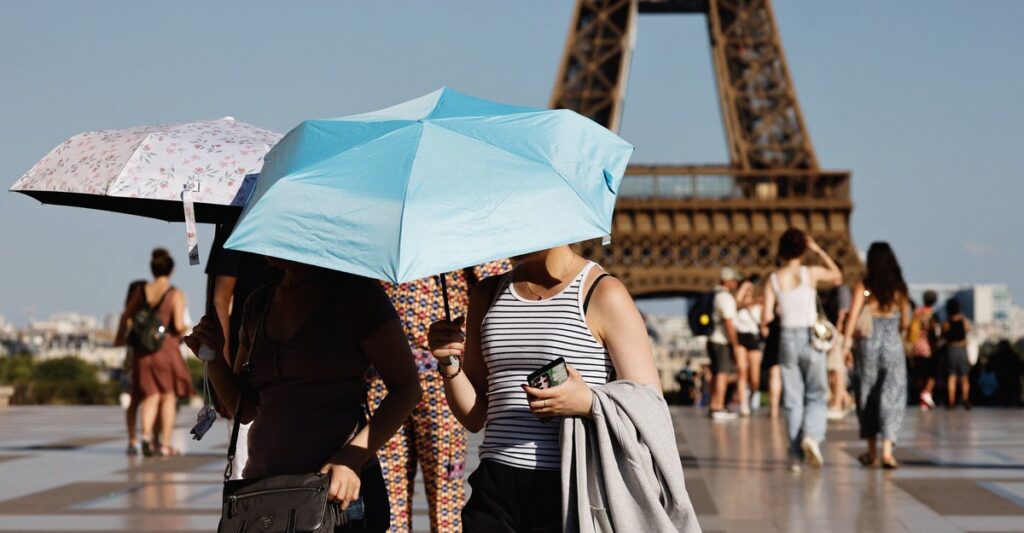
Amid Historic Heat Wave, France Faces Air Conditioning Dilemma
Amid an unprecedented heat wave gripping France, air-conditioning technician Dhafer Kahri is swamped with calls as he navigates the increasing demand for cooling solutions in Paris. Despite the rising temperatures, Kahri remains selective about his jobs, preferring apartments with balconies where air conditioners can be discreetly installed, rather than the city’s perilous gray zinc rooftops, which can reach 150 degrees on the hottest days.
The French government and the city of Paris have long held the position that air-conditioning is a “maladaptation” to climate change. They argue it is a wasteful technology that exacerbates the problem it is meant to solve. However, with record-breaking heat pushing temperatures in Paris above 96 degrees for ten consecutive days, this stance is being challenged.
Beth Gardiner: Europe’s come-to-AC moment
France has traditionally relied on measures like shutters and ceiling fans to combat heat, but the current climate crisis has exposed the limitations of these methods. The absence of a clear air-conditioning strategy has led to makeshift and inefficient solutions across French cities, leaving many residents to endure the extreme heat without relief.
Surviving a heat wave without air-conditioning requires constant vigilance. The French have adapted by closing windows during the day to trap cooler air and using sheets or tablecloths to block the sun. However, as the heat wave persists, these DIY methods, known as bricolage, are proving ineffective, especially as nighttime temperatures remain high.
While many public spaces in France, such as offices, theaters, and shops, are air-conditioned, the technology is less common in homes. A 2021 survey found that nearly two-thirds of French respondents did not have air-conditioning and did not plan to install it, citing economic and environmental concerns. This skepticism is rooted in a belief that air-conditioning is an unnecessary luxury, and reinforced by building codes that limit its installation.
Efforts have been made to incorporate “thermal comfort” into new building designs, requiring features like cross-ventilation and balconies. However, France’s progress in retrofitting older buildings has lagged, leaving many vulnerable to extreme heat. Without legal pressure on landlords to install cooling measures, many buildings remain unprepared for rising temperatures.
Even advocates of France’s energy-efficient building standards acknowledge that some structures, such as hospitals, schools, and top-floor apartments, require active cooling. In response, Paris Mayor Emmanuel Grégoire has ordered air conditioners for schools after temperatures in renovated classrooms remained uncomfortably high.
Paris, facing both a critical need for air-conditioning and strict regulations, exemplifies the national challenge. The city’s complex installation rules aim to prevent the urban-heat-island effect, but also complicate efforts to provide relief. Some residents resort to illegal installations or inefficient mobile units, while others use water-powered systems that consume large amounts of water.
The political landscape around air-conditioning is equally heated. The French far right has seized the issue to criticize the government’s approach, with leaders like Marine Le Pen advocating for a national air-conditioning plan. Meanwhile, President Emmanuel Macron’s administration has reduced taxes on heat pumps to encourage more sustainable cooling solutions.
Joshua Partlow: Perhaps France should reconsider AC
While some French politicians remain opposed to air-conditioning, the environmental impact of modern systems is less severe than in the past. The need for immediate cooling solutions is becoming undeniable as public spaces swelter and essential services face disruptions.
As Sylvain Waserman, head of France’s climate transition office, noted, the extreme temperatures are a “wake-up call” acknowledging the reality of climate change. The debate over air-conditioning continues, but the urgency for solutions grows as the heat persists.
Original Story at www.theatlantic.com