Five environmental groups are seeking to overturn a water quality permit granted by the U.S. Army Corps of Engineers for the contentious Transco pipeline.
The $1.5 billion Southeast Supply Enhancement Project (SSEP) spans five states, including a 28-mile stretch in North Carolina through Rockingham, Guilford, Forsyth, and Davidson counties.
As one of the largest pipeline expansions in the Southeast, Transco claims the SSEP is vital to meet natural gas demand. The project proposes augmenting existing pipelines to transport more gas between the Gulf and the Southeast.
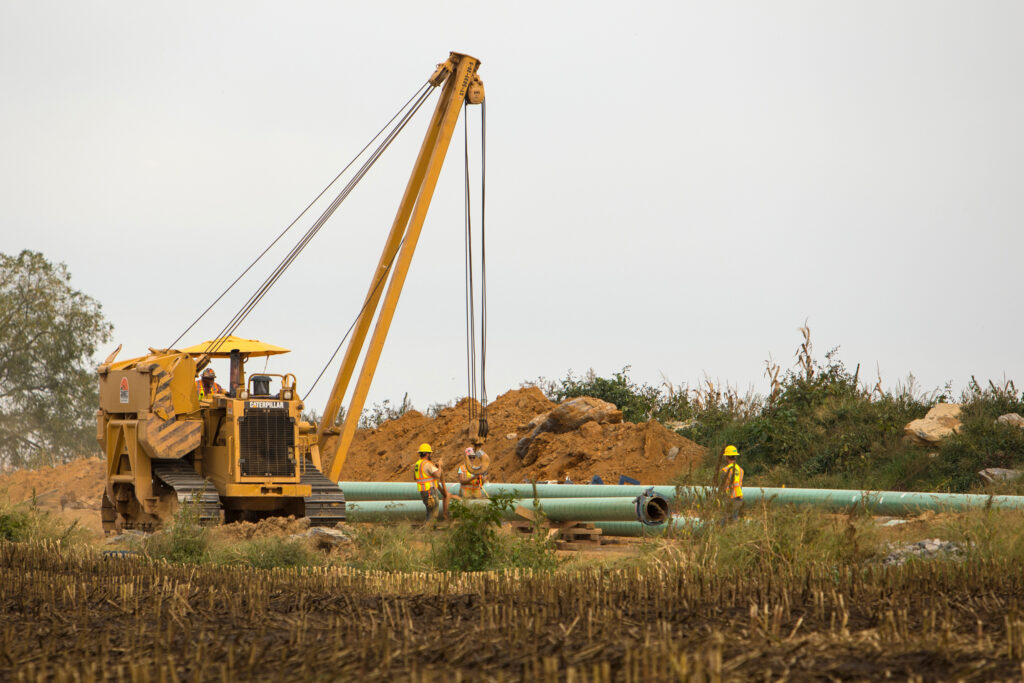
Transco obtained a federal permit for 165 out of 173 stream and wetland crossings, allowing a “dry-ditch, open-cut” construction method. This method can cause irreversible harm to aquatic ecosystems.
According to a 2021 study by Downstream Strategies, the method involves redirecting water flow at the construction site to dig trenches and lay pipes, aiming to minimize sediment release into streams. However, sediment release still occurs, particularly during the installation of diversion materials, which can harm aquatic life and introduce pollutants into drinking water sources.
“Rivers have the right to flow and thrive. Our communities deserve a healthy environment,” said Crystal Cavalier-Keck, executive director of 7 Directions of Service, a North Carolina nonprofit led by indigenous people.
Represented by the Southern Environmental Law Center and the Appalachian Mountain Project, the plaintiffs—Wild Virginia, 7 Directions of Service, Haw River Assembly, Sierra Club, and Appalachian Voices—have taken their case to the Fourth Circuit Court of Appeals.
Williams, Transco’s parent company, maintains that the SSEP underwent extensive review and expresses confidence in the Army Corps’ permitting decision, despite the lawsuit’s claims.
The Army Corps did not comment on the matter.
Over 90 environmental groups urged the Federal Energy Regulatory Commission (FERC) in 2024 to require a comprehensive Environmental Impact Statement from Transco. Instead, FERC permitted an Environmental Assessment, which offers less detail and a shorter public comment period.
Several North Carolina local governments along the SSEP route have expressed concerns, citing the need for new compressor stations that emit harmful pollutants, including carbon monoxide and greenhouse gases.
The SSEP forms part of a significant natural gas expansion in North Carolina, intersecting with Enbridge’s T15 Reliability Project and the MVP Southgate. This extension of the Mountain Valley Pipeline crosses 300 miles through West Virginia and Virginia.
The North Carolina projects aim to supply Duke Energy’s extensive natural gas initiatives, including two new power plants in Person County under construction. Duke has proposed additional plants, pending state Utilities Commission approval.
Transco began SSEP construction on March 2, with contractors undertaking tree felling, acoustic barrier installation, and test drilling for blasting.
“SSEP would trench across streams and wetlands, harming sensitive ecosystems,” said Caroline Hansley, Sierra Club campaign organizer. “Regulators have ignored the environmental toll and community impact of this unnecessary project, sparking widespread opposition along the proposed route.”
Original Story at insideclimatenews.org