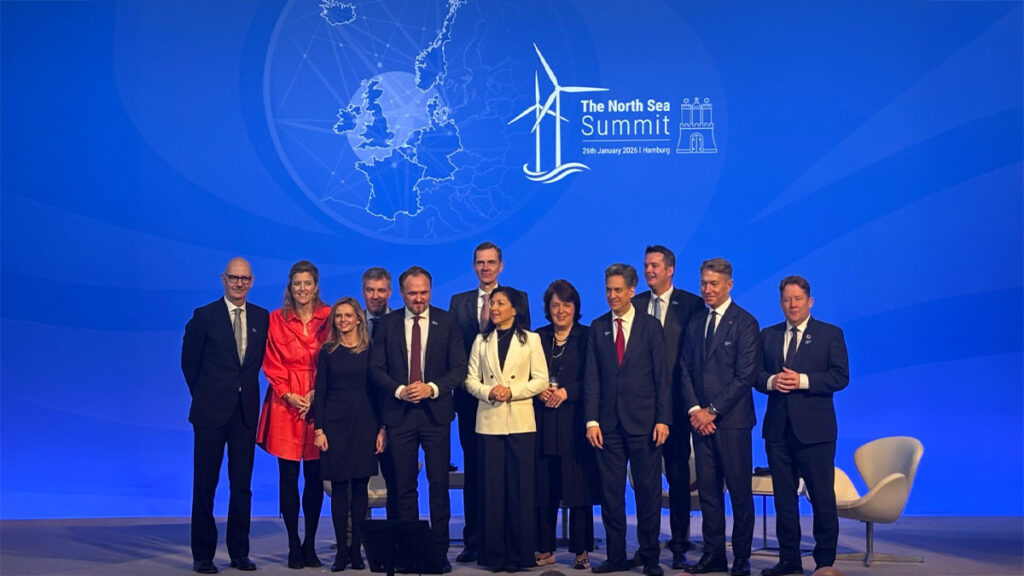
Energy ministers from nine North Sea nations signed the ‘Hamburg Declaration’ at the North Sea Summit in Hamburg on January 26. They committed to develop up to 100 GW of cross-border offshore wind capacity by 2050 and advance offshore renewable hydrogen for a more integrated regional energy system.
The declaration supports the ambition of achieving 300 GW of offshore wind capacity by 2050, first outlined in earlier Esbjerg and Ostend agreements. It builds on the North Seas Energy Cooperation (NSEC) work. It was signed by ministers from Belgium, Denmark, France, Germany, Ireland, Luxembourg, the Netherlands, Norway, and the UK, with Iceland as an observer.
The agreement emphasizes cross-border projects over national developments, aiming to transfer electricity across borders, enhance supply security, and reduce costs. The declaration targets up to 20 GW of cooperative projects by the 2030s, opening avenues for larger cross-border offshore wind development.
Energy ministers agreed on the need for coordinated offshore grid planning. National plans will align with regional and European processes, while remaining voluntary and respecting national powers.
The declaration proposes an Offshore Financing Framework to support cross-border projects, improve capital access, and equitably share costs and benefits between countries.
The ministers’ agreement underpins an offshore wind investment pact to mobilize substantial investments in the region, aiming to develop 15 GW of offshore wind annually from 2031 to 2040. The pact includes support through Contracts for Difference (CfDs) and removal of regulatory barriers to power purchase agreements (PPAs).
The declaration advocates for enhanced cooperation on offshore renewable hydrogen, focusing on research, development, and demonstration. The goal is to support hydrogen uptake in sectors that are hard to decarbonize.
“Cooperation projects will support the integration of substantial renewable electricity across the North Seas Region, enhance supply security, and reduce consumer prices in Europe. Some projects may include offshore hydrogen production for better utilization. Offshore renewable and low-carbon hydrogen could reduce reliance on fossil energy imports and strengthen energy security,” states the Hamburg Declaration.
Ministers committed to faster permitting, stronger protection for offshore infrastructure, and supply chain and workforce support. They agreed to explore potential coordinated planning and permitting, including environmental impact assessment cooperation.
“Participating EU Member States acknowledge the European Grids Package’s measures to streamline and accelerate permitting processes for grid infrastructure, renewable energy, storage projects, and recharging stations while ensuring public acceptance and benefit-sharing,” the ministers stated.
For the UK, the declaration commits to reforming planning to accelerate the transition to clean energy by 2030.
Original Story at www.offshorewind.biz