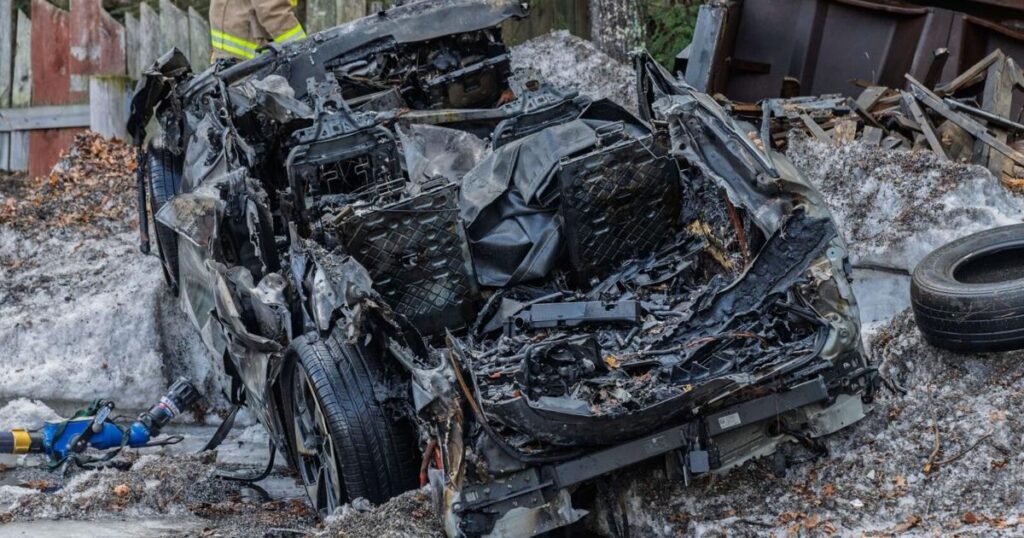
In a dramatic turn of events on March 31, an electric vehicle burst into flames at the F.E. Everett Turnpike toll plaza. A state trooper, accompanying Governor Kelly Ayotte, acted swiftly to rescue the vehicle’s sole occupant, Eugene Mirman, a comedian renowned for his role in “Bob’s Burgers.”
After the incident, Mirman was released from the hospital without any significant injuries. Despite the absence of charges as the investigation continues, the incident highlights a concerning issue with electric vehicle fires. Days later, the remnants of Mirman’s Lucid Gravity reignited at a tow yard, attributed to a thermal runaway of its lithium-ion batteries. Firefighters had to intervene once more.
To mitigate further incidents, the vehicle was submerged in a saltwater pool, a recommended practice for controlling electric vehicle fires. This method, experts suggest, is expected to curtail further outbreaks of fire, though some officials argue for alternative disposal measures.
State Fire Marshal’s Recommendations
Drawing parallels with the management of large-scale wildfires, the state Fire Marshal’s Office advises containment as a key strategy for handling electric vehicle fires. State Fire Marshal Sean Toomey emphasizes the importance of isolating the wreckage post-extinguishment to allow the battery packs to burn out safely if they reignite.
“I advocate for dragging the vehicle out to a place where you can safely let it burn,” Toomey stated. “When there’s a failure and they burn, you don’t just pull up with one engine carrying 500-1,000 gallons. It’s nearly impossible to stop a thermal runaway.”
According to EV FireSafe, a resource dedicated to global EV fire incidents, it can take over 2,500 gallons of water to cool EV batteries effectively. Between 2010 and 2022, EV FireSafe reported 337 confirmed cases of thermal runaway worldwide, with a notable increase in incidents after 2020, coinciding with electric vehicles capturing a 10% global market share.
Challenges of Electric Vehicle Fires
EV FireSafe data indicates that electric vehicles are generally less likely to catch fire than their gas-powered counterparts. However, when fires do occur, they can burn 20% hotter and are more challenging to extinguish, necessitating greater resources.
In a guide for first responders, EV FireSafe advises immobilizing damaged EVs with tire chocks to prevent unintended movement. The guide also warns of the risks associated with extrication efforts due to the location of EV batteries, which could pose electrocution hazards.
Additionally, responders are alerted to the signs of thermal runaway, characterized by dark vapor clouds — not smoke — signaling the release of toxic gases and potential directional flames. In about 5% of cases, batteries may explode violently, posing significant risks, especially in confined spaces.
Toomey cautions that these dark vapors are hazardous to breathe, and while fire blankets might be used to contain them, the risk of trapping combustible gases remains.
Electric Vehicle Statistics in New Hampshire
The state’s Division of Motor Vehicles reports approximately 16,400 all-electric and 6,400 plug-in hybrid vehicles registered in New Hampshire. However, the New Hampshire Automotive Dealers Association notes a decline in EV sales, linked to the cessation of federal tax incentives.
Dan Bennett, the association’s president, highlights the perception of EVs as less safe, though he stresses that there is only one EV fire for every 160 traditional engine fires. Efforts continue to enhance the safety of lithium-ion batteries, which are also prevalent in consumer electronics.
EV owners in New Hampshire are subject to an additional annual fee, as outlined by the U.S. Department of Energy, while some local utilities still offer rebates for electric vehicles.
Original Story at www.unionleader.com