Electric Vehicles: A Tale of Two Trends in May
As the journey toward electrification continues, the electric vehicle market is witnessing an intriguing bifurcation. In May, registrations for battery electric vehicles (BEVs) surged, while plug-in hybrid electric vehicles (PHEVs) faltered, highlighting a shift in consumer preferences.
BEV Growth Outpaces PHEVs
May saw a 4% increase in plugin vehicle registrations compared to the same month last year, reaching approximately 1.7 million units. BEVs experienced a robust 15% year-over-year growth, whereas PHEVs declined by the same margin. This marks the first time since 2019 that PHEV sales have consistently decreased over five months.
Year-to-date (YTD) figures show a modest 2% increase overall in plugin vehicle registrations, driven solely by BEVs’ 9% rise. The downturn in PHEVs, which recorded an 11% decline, underscores the challenges facing this technology.
In terms of market share, BEVs captured 71% of plugin sales in May, amounting to 1.2 million units. This figure represents one of the highest BEV shares in recent years, pushing the YTD figure to 70% in favor of pure electrics.
Market Dynamics in China and the USA
Global electric vehicle sales have been impacted by policy changes in major markets. The removal of incentives in the USA last October and the partial phase-out in China, set for the end of 2025, have contributed to a slowdown. However, excluding these two nations, global EV sales jumped 39% YoY in May, with BEVs alone increasing by 47%.
PHEVs saw a 20% growth rate outside China and the USA, the lowest for over a year, signaling a structural decline in demand for this segment.
BEVs achieved a 19% market share in May, rising to 26% when including PHEVs. The total plugin vehicle share is now at 22%, with BEVs contributing 16% and PHEVs holding steady at 6%.
Top-Selling Models and Emerging Trends
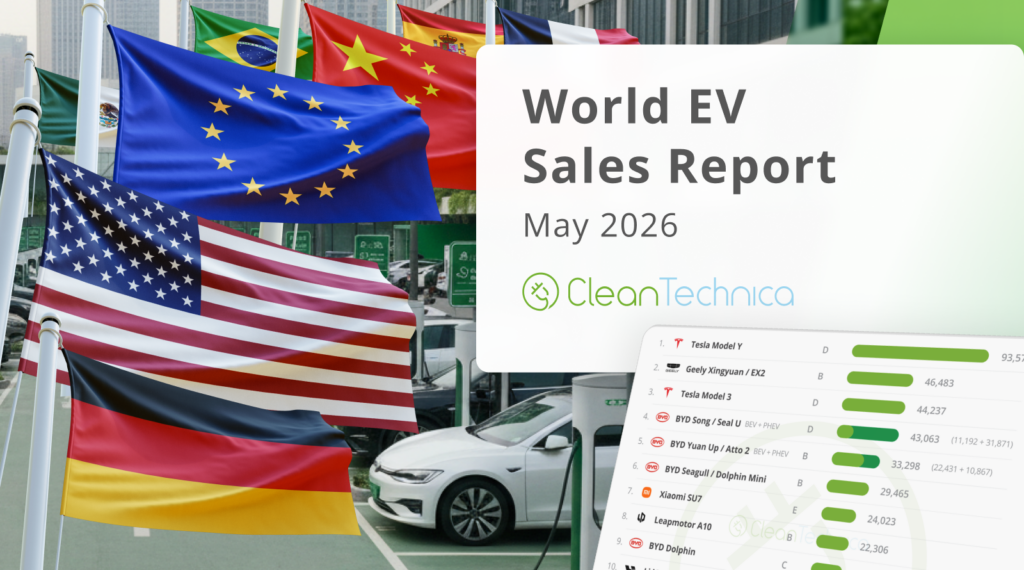
The Tesla Model Y maintained its lead with 93,571 units sold, up 16% YoY, followed by the Tesla Model 3, which rose to third place with 44,237 units, a 28% increase. China’s Geely Xingyuan, known as EX2 in export markets, secured the second spot with 47,000 registrations, boosted by international sales.
BYD’s Song and Yuan Up/Atto 2 models also made significant advances, with the Song reaching a new year-to-date high of 43,000 units, despite an 18% YoY decline. The BYD Yuan Up, bolstered by a PHEV version, climbed to fifth place.
The Leapmotor A10, a small electric crossover, achieved 22,000 registrations, marking a notable entry for the startup. Meanwhile, MG’s 4 hatchback and Wuling’s Mini EV continue to perform well, each achieving over 18,000 sales.
Brand Performance and Market Shifts
BYD, Tesla, and Geely led the market in May, but Leapmotor emerged as a significant contender, surpassing Volkswagen to claim the fourth spot. Zeekr also demonstrated strong performance, entering the top 10 with a record 34,377 registrations.
In the year-to-date rankings, Leapmotor’s rise to fourth place signals a shift in the competitive landscape, as it outpaces established brands like BMW and Volkswagen. Wuling’s growth to sixth place, driven by the Bingo and Mini EV models, further illustrates the dynamic nature of the EV market.
Overall, BYD retains its lead in the OEM landscape with a 19% share, followed by Geely and Tesla. Hyundai-Kia has climbed to become the sixth-largest OEM, while Leapmotor’s rapid ascent continues to challenge the status quo.
Original Story at cleantechnica.com