The Evolving Landscape of Electric Vehicle Manufacturing in Georgia
In October last year, a significant federal immigration raid took place at an electric vehicle battery plant in coastal Georgia, resulting in the arrest of over 400 workers, predominantly from South Korea. Despite this challenging incident, the electric vehicle (EV) industry in Georgia continues to progress, albeit with necessary adaptations.
Governor Brian Kemp has been striving to establish Georgia as a hub for clean-energy manufacturing, encompassing electric vehicles, solar panels, and batteries. Through tax incentives and a comprehensive worker training program, Georgia has successfully attracted key players in these industries.
Blue Bird, a Georgia-based bus manufacturer, began commercially selling electric buses in 2018 and expanded its factory in 2023. Hyundai set up a dedicated EV plant near Savannah in 2022, while Kia commenced EV production at its West Point facility in 2024. Rivian also initiated construction of its manufacturing plant near Atlanta in 2025. These ventures by Hyundai and Rivian rank among Georgia’s largest economic development projects, further bolstered by the state’s efforts to lure battery makers, recyclers, and solar panel companies.
However, the landscape shifted under the second Trump administration. The federal EV tax credits for car buyers were terminated, tariffs were imposed on various components, and the initiative to electrify government vehicle fleets was halted. These policy changes have affected the economic climate for EV manufacturers in Georgia.
Adapting to Change
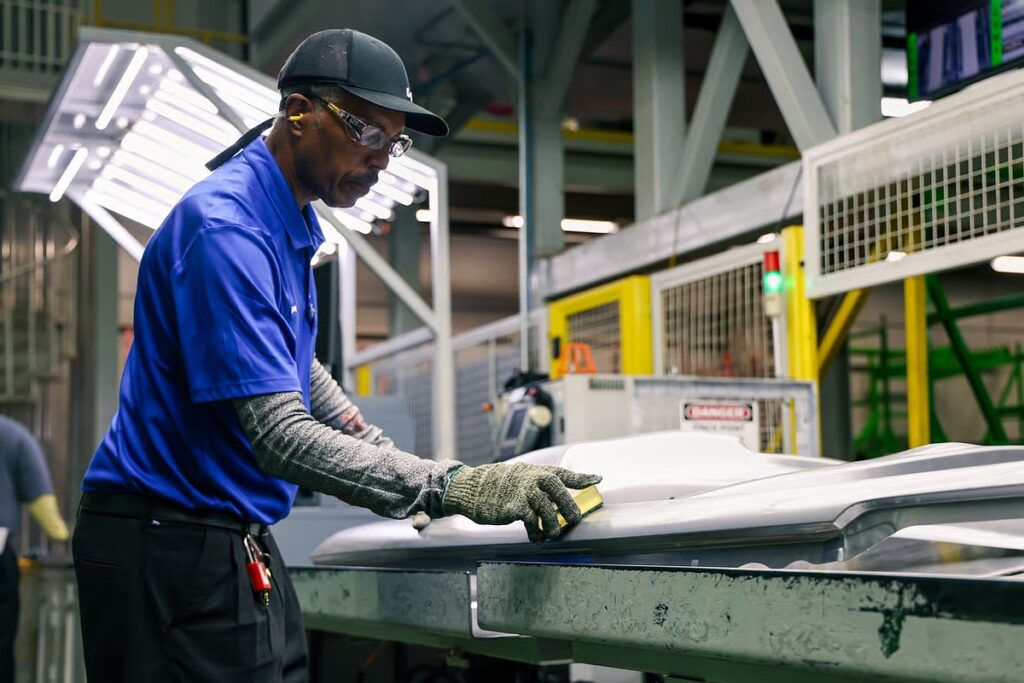
At Kia’s plant in West Point, the assembly line operates with remarkable flexibility, producing a diverse range of vehicles with varied models, colors, and trims, including gas-powered, hybrid, and electric cars. This adaptability is in response to consumer preferences, which currently favor hybrids.
Kia’s factory CEO, Stuart Countess, commented, “What we’ve seen is a transition back away from maybe full EV vehicle building to this kind of a middle-of-the-road opportunity.” He noted that while electric cars remain the future, factors such as pricing and charging infrastructure have slowed consumer adoption. The removal of federal tax incentives has also played a crucial role. “We had a tax incentive credit that did go away,” Countess explained, affecting sales momentum.
Similarly, Hyundai has integrated hybrid production at its Savannah plant, initially intended solely for EV manufacturing. “It’s kind of a messy period we’re in right now,” observed Stephanie Valdez-Streaty, director of industry insights at Cox Automotive. “But I think the manufacturers are adjusting.”
Concurrently, battery manufacturers in Georgia are diversifying their production to include storage batteries for electricity, in addition to those designed for vehicles. “The state continues to have a lot riding on the success of both the electric vehicle but also the battery market,” said Stan Cross of the Southern Alliance for Clean Energy (SACE).
Despite Georgia’s leadership in EV and battery manufacturing within the region, the sector has encountered setbacks, including layoffs at SK Battery and over $4 billion in canceled or scaled-back investments in the Southeast. However, these challenges are overshadowed by the nearly $74 billion in ongoing manufacturing investments.
Navigating Incentives and Infrastructure
An essential consideration is whether Georgians will purchase the hybrids and EVs produced locally. Currently, Georgia lacks EV adoption incentives and imposes an additional registration fee to offset lost gas taxes. “When it comes to electric vehicles, Georgia politics remains utterly confused,” commented Cross.
Despite limited legislative actions, private investments continue to focus on charging infrastructure, a critical factor for potential EV buyers. Kia and Hyundai participate in the IONNA charging consortium, which has established multiple charging stations across Georgia, including one at Kia’s West Point site. Additionally, electric utilities in the region have increased their EV-related investments by 14% this year, according to SACE.
“Though we’re not seeing a lot of activity on the legislative side, we do see potential on the regulatory side,” Cross stated, emphasizing the role of Georgia Power in addressing the gap left by policymakers.
Valdez-Streaty expressed optimism that local EV manufacturing could eventually boost consumer adoption in Georgia. “It’s like that familiarity, right?” she noted. “People have jobs at those companies and familiarity with those products.”
While the EV market has faced instability, it is gradually stabilizing, and the automotive industry’s shift toward electrification continues, albeit at a slower pace.
Grist is a nonprofit, independent media organization dedicated to telling stories of climate solutions and a just future. Learn more at Grist.org
Original Story at www.timesfreepress.com