
As Georgia’s Public Service Commission (PSC) prepares for a critical decision, the stakes are high for both Georgia Power and its customers. With two new Commissioners set to join in January, the current lame-duck board must decide whether to approve a massive spending proposal that could significantly impact utility bills for decades.
In the backdrop of this decision, two incumbent Commissioners were ousted in the November elections, a clear signal from voters frustrated by rising electricity costs. The question remains: will the current Commissioners heed this message or proceed with business as usual?
Considerations for the Commission
The current five-member PSC is tasked with deciding on Georgia Power’s request to invest $20 billion in new power generation, anticipating increased demand from data centers in the future. PSC staff estimate that the total investment could reach $50-60 billion over the lifetime of the assets if approved in full. As a result, the staff recommends a cautious approach: partially approve the plan and proceed with additional projects only if binding contracts with data centers are secured.
The proposal from Georgia Power includes diverse resources such as purchasing power from existing plants, contracts with battery and solar projects, and the construction of three large gas power plants. These new gas plants represent a significant cost, with Georgia Power suggesting an extended payment period of 45 years, potentially keeping customers on the hook until 2075. According to PSC staff, this could increase monthly bills by $20, excluding fuel costs, which would also be incurred by all customers.
Long-Term Financial Implications
The extended asset life of 45 years for these gas plants is unusual, as typical gas plant asset lives are modeled at 25-30 years. This extended timeframe might make the upfront costs appear less daunting, akin to the idea of longer mortgages reducing monthly payments but increasing total costs over time.
Given the plants are scheduled to start operations in 2029 and 2030, this decision means committing customers to ongoing payments until 2075.
The Concerns
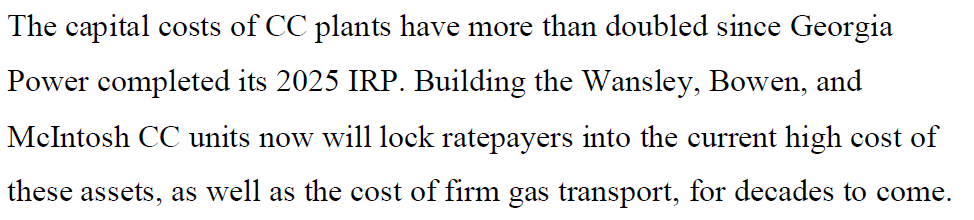
Technical expert Lucy Metz has outlined several concerns regarding these gas plants, noting that construction costs have more than doubled since the initial analysis. Additionally, customers would face high “firm transportation” costs, locking them into paying for the right to purchase gas on designated pipelines.
With customers obligated to pay for gas regardless of price increases, economic impacts could be substantial. PSC staff analysis shows potential monthly bill increases of $20, with lifetime costs reaching $50-60 billion, excluding transportation and fuel expenses.
Analyzing Alternatives

PSC staff have analyzed and ranked the bids Georgia Power received, considering confidential materials as part of the process. While there are disagreements on methods and assumptions, it is clear that some resources are more cost-effective and pose less risk. Staff did not recommend certifying the three gas plants, suggesting they could lead to significant profit for Georgia Power and increase customer costs.
Recommendations for the PSC
While it is clear that the PSC should not fully approve Georgia Power’s request, they should consider approving a subset of the proposed resources. This includes options like stand-alone battery storage or solar-associated battery storage, which offer modularity and lower long-term costs and risks.
The Commission could mandate further cost-effectiveness evaluations and consider conditional approvals for some resources, pending firm contracts. The upcoming PSC hearing on the YouTube channel starting December 10 will feature discussions from Georgia Power, SACE, Sierra Club, PSC staff, and others on this pivotal decision.
Original Story at cleanenergy.org