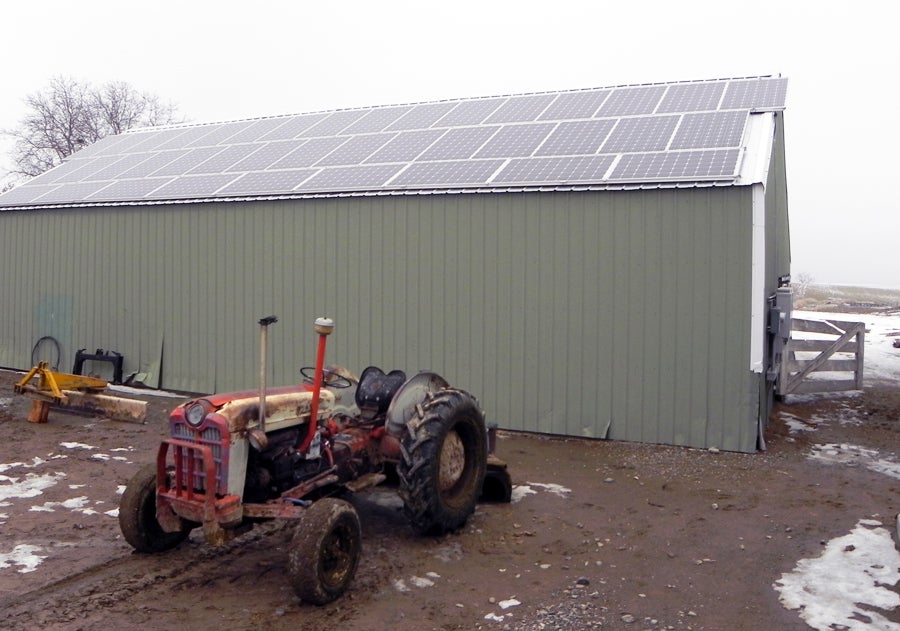
The Trump administration’s decision to significantly reduce solar energy’s eligibility in a federal program designed to support rural energy projects has sparked legal action from environmental groups. These organizations argue that the changes to the program have imposed substantial financial burdens on farmers and small businesses.
Last month, Environmental Law & Policy Center and Earthjustice filed a lawsuit against the U.S. Department of Agriculture (USDA) on behalf of farmers, solar project developers, and clean energy groups. One of the plaintiffs, RENEW Wisconsin, is a nonprofit that supports the renewable energy industry, including members involved in solar power installations.
The lawsuit challenges amendments made to the Renewable Energy for America Program (REAP), which was initially established in 2002 to assist farmers and rural business owners in adopting renewable energy. Previously, solar projects received 68 percent of REAP’s grants and loans from 2011 to early 2025, according to court documents.
Between 2021 and 2024, Wisconsin benefited from over $66.7 million in REAP funding, which facilitated the installation of renewable energy systems and improved energy efficiency for rural businesses, as per USDA estimates. However, in August 2025, the USDA altered the program to render “almost all solar projects ineligible for REAP funding,” immediately affecting loan applications and later, in March 2026, solar grant applications.
The Trump administration justified the modifications by emphasizing the need to preserve prime farmland for food production. A USDA spokesperson stated, “During the last administration we saw solar farms consume fertile farmland that should be feeding America. Those days are over. USDA will not actively participate in repurposing farmland historically used to sustain this country’s abundant food supply.”
According to the lawsuit, the USDA halted the processing of REAP grant applications, including those submitted before the rule change, and mandated that applicants must reapply under the new criteria to receive funding. Because REAP reimburses expenses after project completion, the delay in processing applications has had severe repercussions for participants.
For instance, an Illinois farm was slated to receive $446,000 in REAP funding in 2023 and 2024 for solar projects, but this funding was effectively retracted due to the program’s alterations. Sherif Halaweish, an attorney for RENEW Wisconsin, noted that many rural farmers and businesses are encountering similar difficulties.
Halaweish explained, “There were many applicants to this grant that were given approval. They went ahead and started construction, and then in the middle of that, the USDA announced that they were changing the criteria on eligibility and pausing processing of applications — even ones that were already approved.”
In Wisconsin, a member of RENEW faced the loss of a $101,000 solar installation contract, which was contingent on the awarding of REAP grant funds. Other solar installers have had to cancel, reduce, or indefinitely postpone contracts due to these policy changes, the lawsuit states.
Halaweish added, “For our members who install those systems, that is a good chunk of several of our members’ revenue. It is one of multiple things that have happened in the solar industry — in addition to tax credits being removed — that have severely impacted renewable energy installers and developers, and that is a huge industry in Wisconsin.”
The lawsuit seeks to overturn the USDA’s revised solar policy and compel the agency to process REAP applications according to the original rules in effect at the time of submission.
Original Story at www.wpr.org