Foreign Automakers Revamp Strategies to Reclaim China’s Auto Market
As the world’s largest automotive market, China poses both challenges and opportunities for global car manufacturers. Recently, foreign automakers are striving to keep pace with Chinese competitors by enhancing their technological offerings.
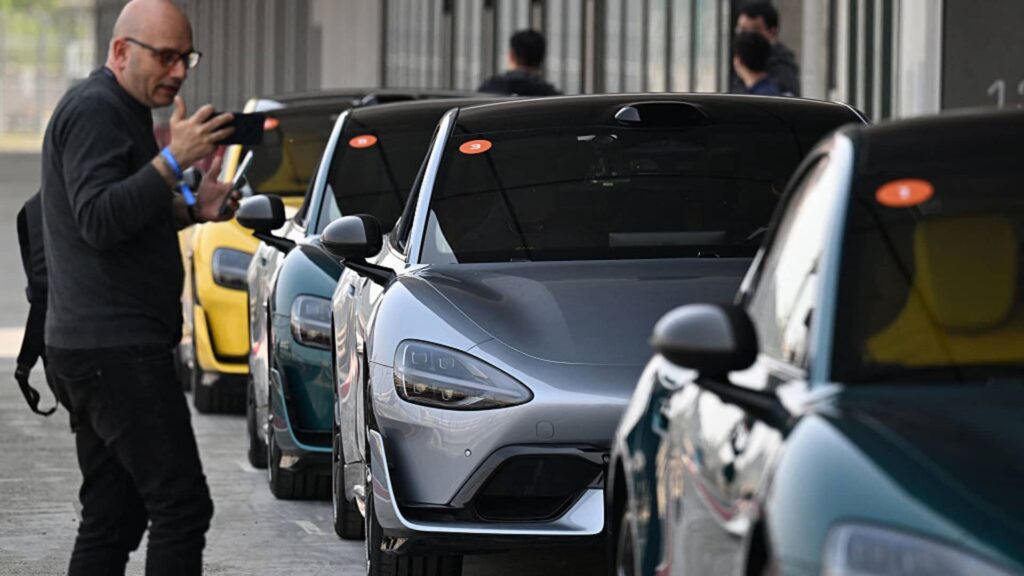
During the Beijing auto show, U.S., Korean, and German car manufacturers unveiled new models tailored for the Chinese market. Will Stacy, Vice President of Cadillac China at General Motors, expressed ambitions to regain market share, stating, “We have plans to really build this brand and return [to] where we used to be in terms of volume and [market] share.”
Cadillac has introduced the VISTIQ, its first vehicle in China equipped with driver-assist technology. This luxury electric SUV, priced between 468,000 yuan ($68,000) and 508,800 yuan, features advanced software for highway and city driving, developed in collaboration with Chinese startup Momenta.
Hyundai has also taken significant steps by launching its all-electric IONIQ brand in China. José Muñoz, President and CEO of Hyundai Motor Company, emphasized the importance of the Chinese market in shaping future mobility, noting, “China is where the future of mobility is being defined, and Hyundai intends to help define it, in China, for China, and ultimately, for the world.”
Despite a decline in sales from 17% to 4% of Hyundai’s total sales, the company plans to reinvigorate its strategy. The IONIQ V features driver-assist technology and voice-control functions powered by a Qualcomm Snapdragon 8295 chipset.
Hyundai’s March sales in China were one-third of pre-pandemic levels in March 2019, a trend seen across various foreign carmakers. For instance, Nissan experienced a 47% drop in sales, while Cadillac saw a 39% decline, according to CNBC data.
Stephen Dyer, head of AlixPartners’ Asia automotive consulting practice, commented on foreign brands integrating Chinese technology, stating, “I’m glad to see that these foreign brands are humble enough and recognize the value of the Chinese tech that they’re incorporating it.” He also mentioned the potential for this technology to spread globally.
Integrating AI for Smarter Vehicles
Volkswagen is also making strides with its ambitious product campaign in China. The company plans to introduce AI-powered voice commands in its vehicles, sourcing technology from Tencent, Alibaba, and Baidu.
Thomas Ulbrich, Volkswagen China CTO, remarked, “The car should be like a companion,” highlighting the role of AI in anticipating driver needs. Volkswagen’s collaboration with Xpeng has resulted in the development of the ID. UNYX 09, among other models.
Hyundai plans to introduce 20 new models in China over five years, targeting 500,000 annual sales. Meanwhile, market leader BYD recorded a 30% year-over-year decline in sales in the first quarter of 2026 but remains a dominant player.
Nissan is also focusing on new energy vehicles, with plans to launch five plug-in electric models over the next year. The company leverages its partnership with China’s Dongfeng and has integrated AI capabilities into models like the N7 electric sedan.
As automakers vie for a share of China’s competitive market, their ability to remain innovative and responsive to consumer preferences will be crucial.
Original Story at www.cnbc.com