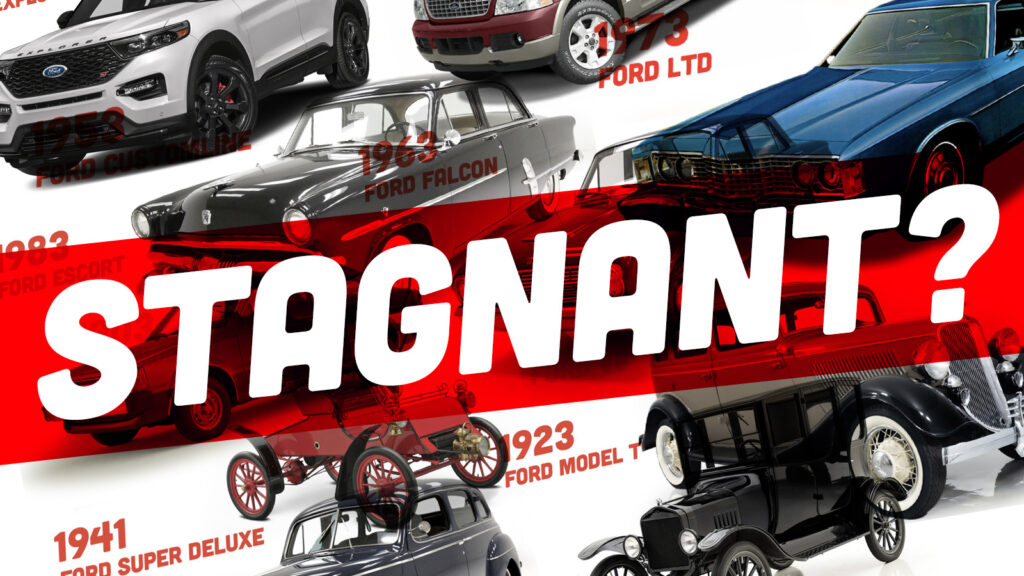
In recent discussions across various platforms, there’s a noticeable sentiment that cultural, artistic, and technological advancements are experiencing a slowdown. This perception isn’t limited to a few critics on online forums. Influential voices in substantial publications are also weighing in on this notion of stagnation, sparking widespread debate.
This perceived stagnation is evident in diverse fields such as fashion, art, music, and popular culture. Technological progress, traditionally exemplified by Moore’s Law, is also reportedly decelerating. Similarly, the automotive industry is being scrutinized, with many suggesting that innovation in cars has plateaued over the last two decades.
The question arises: Is this stagnation real? There’s an argument that while changes today might be subtle, they’re still significant. The evolution of automobile design and technology, for instance, might not be as conspicuous as in the past, but it remains impactful.
By examining Ford’s history, dating back to its inception in 1903, it’s evident that cars have undergone substantial transformations. The early Model A was rudimentary compared to the more robust and mass-produced Model T of 1909. This period marked a significant leap in automotive development.
Throughout the decades, cars have continuously evolved. The 1933 Ford introduced the first mass-produced V8 engine, and by the 1950s, vehicles boasted integrated designs and enhanced comforts. The 1960s and 1970s saw shifts toward compact and then more flamboyantly styled cars, respectively.
In the 1980s, a paradigm shift occurred with the introduction of the Ford Escort, a compact car that embraced front-wheel drive and fuel injection, setting new standards for the industry. The 1990s continued this trend with mid-size cars like the Taurus, emphasizing aerodynamics and efficiency.
In more recent decades, the rise of SUVs and the integration of advanced electronics have characterized automotive trends. However, the changes between the 2000s and 2020s, while present, appear to be more evolutionary rather than revolutionary.
When comparing vehicles across 20-year intervals, the differences between recent models are less pronounced than those from earlier generations. This observation fuels the debate on whether genuine stagnation exists or if development has merely shifted to less visible aspects.
The continuous advancement in car technology, such as electrification and driver-assist features, suggests ongoing progress. However, the era of groundbreaking leaps might be over, replaced by more nuanced and refined improvements.
Despite the perception of stagnation, development is undeniably occurring. The automotive industry, like other sectors, may have transitioned from addressing fundamental challenges to focusing on subtler innovations. Whether this is perceived as stagnation or progress depends on one’s perspective.
Original Story at www.theautopian.com