“You must not blame me if I do talk to the clouds.” — Henry David Thoreau
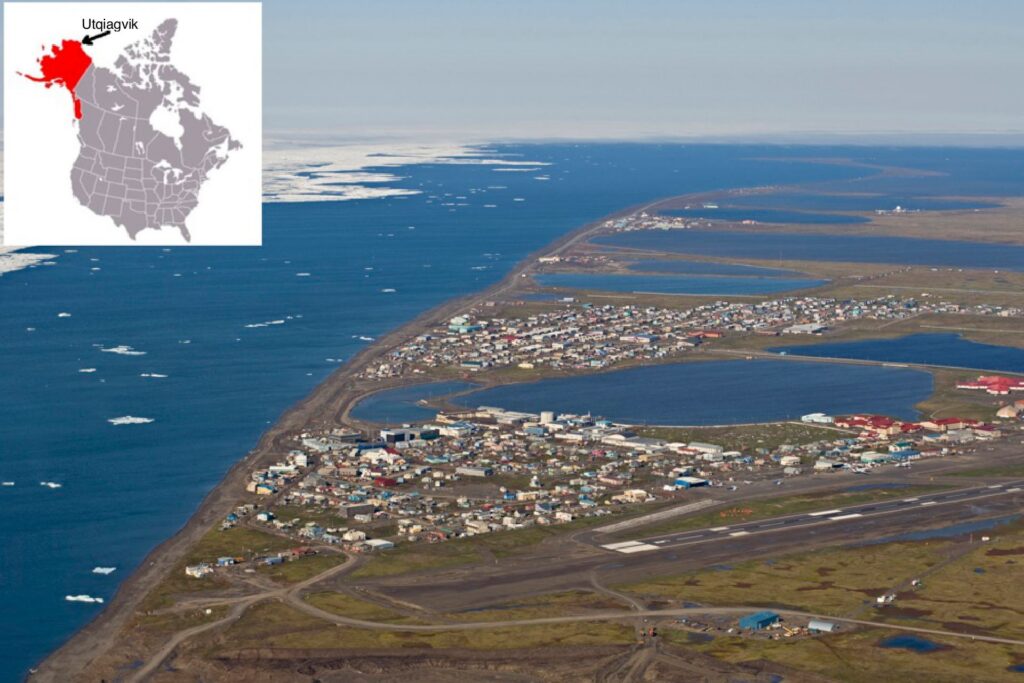
Nestled against the Arctic Ocean in northern Alaska, Utqiagvik is an adventure beyond a typical vacation. This remote seaside city, home to 4,600 people, is surrounded by vast tundra and lies hundreds of miles from Anchorage. Despite its small-town feel with just one gas station, one streetlight, and one bank, Utqiagvik offers a unique blend of breathtaking scenery and diverse ethnic restaurants, reflecting its modern-day community.
The town’s roots trace back 1500 years to the Inuit tribe, who remain the majority today. Conversations with locals reveal a deep spiritual connection to the Arctic land and a strong emphasis on family. Many businesses even close at noon so families can gather for lunch.
Life at the top of the world appeals to those who wish to escape the hustle of city life or embrace the challenge of an extreme environment. This close-knit community attracts individuals who cherish a life far removed from urban chaos.
Change is in the air
During my visit, I accompanied a team from Scripps Institution of Oceanography at the NOAA Polar Observatory, where I learned about climate change research. Atmospheric scientist Lynn Russell, PhD, and graduate student Sourita Saha focus on aerosols and their role in cloud formation. Clouds are crucial to climate change as they can either warm or cool the atmosphere, acting as gatekeepers between the sun and Earth.
The Arctic is a critical location for these studies as climate change progresses three times faster here than elsewhere. The baseline air quality in Utqiagvik, named by the Indigenous Iñupiat, serves as an early warning system akin to the proverbial canary in the coal mine.
The Sustaining the Utqiagvik Aerosol Record of Decades (STUARD) project, funded by the National Science Foundation, contributes to the U.S. Arctic Observing Network. This initiative ensures that data collected is publicly accessible, aiding polar scientists in their research.
“STUARD has enabled the first-ever multi-year record of cloud condensation nuclei in the American Arctic, which provides critical insights on how the changing aerosol particle emissions affect clouds,” stated Russell.
My previous article, “Clouds can be cool: Climate change in the Arctic,” explored summer aerosols. This piece delves into winter and spring aerosols.
How to make a cloud
Clouds require “starter seeds” or cloud condensation nuclei, such as sea-spray droplets, soot, or sulfate particles. Russell and Saha work to predict which particle sizes and types lead to cloud formation, a challenging task in a remote environment.

“Datasets have been exceptionally difficult and expensive to obtain in the Arctic. To advance our understanding of aerosol-cloud-climate interactions, we want to ensure that every measurement is accurate. As part of STUARD, I’ve identified and corrected data artifacts so that we are able to recover critical measurements that might otherwise be lost,” Saha commented.
Saha’s insights reveal that particle size and composition are crucial in determining cloud formation. Larger particles with a higher percentage of sulfate-type particles are more likely to form clouds.
Sulfates, often from burning fossil fuels, significantly influence cloud formation and whether clouds will have a warming or cooling effect.
Clouds are warming
In winter, the sun remains below the horizon, and prevailing winds bring smoke and soot pollution, known as black carbon, as well as sulfates. Local oil fields and heating fuels add to this mix. Atmospheric conditions create an inversion layer, trapping pollutants under a dome of heat.
“During the polar night, when there is little sunlight, thick low-level clouds can absorb longwave radiation from the surface and re-emit it downward. An increase in cloudiness under such conditions can cause warming,” Saha explained.
Clouds are cooling
With spring’s arrival, sunlight breaks the inversion layer, allowing air circulation. Aerosol pollution sometimes appears as Arctic haze, reflecting heat away from Earth. While cooling occurs, air pollution remains harmful.
Efforts to reduce aerosol emissions in Europe, North America, and China over recent decades have yielded health and environmental benefits. Yet, reduced sulfate aerosols have unveiled the extent of warming from black carbon and greenhouse gases.

Locals on thin ice
Locals in Utqiagvik witness real-time impacts of warming. Mabel Kaleak, a student at Illisagvik College, shared how climate change has altered cultural traditions.
“We, the Iñupiat, have been here for generations so the elders know the land inside and out, the big and small details of the land, the animals and the weather over time. This knowledge is what’s traditionally passed along to the next generations, but the change in climate has changed the culture in that what the elders know isn’t so anymore. The ice comes later, the weather gets warmer, the winter is shorter; the summer is longer. So the animals respond differently,” she said.
She also explained how changes in ice thickness have affected bowhead whale hunting, a culturally significant practice. “We have had to change expectations for landing bowhead whales. When a whale is landed far offshore, it must be pulled onto ice to be processed. Now, much of the ice is too thin to support a big whale so if they kill a whale, they may not be able to bring it in. What will happen to the life we know? It’s very heartbreaking,” she added.
A changing world for wildlife
Climate change also affects local wildlife. Birds, mammals, and plants are adapting to new conditions. Some migratory birds now stay longer due to delayed tundra icing and warmer temperatures, leading to potential ecological mismatches.
Groundcover succulents, once a staple for early Iñupiat, now face competition from taller shrubs due to prolonged warming. I spotted an Arctic fox, not yet in its winter coat, leaping across the tundra. Encroachment by the larger red fox threatens these native mammals.
Cotton grass, historically used by the Iñupiat, is also affected by summer warming, which dries the soil, stunting growth and reducing its ability to absorb carbon dioxide.
Ray of hope
Despite the challenges posed by climate change, the Iñupiat continue practicing their traditions. The Iñupiat Heritage Center showcases Native art, and local artisans create pieces from tusks, whalebones, and antlers. However, as climate warming progresses, communities like Utqiagvik face uncertain futures.
Understanding aerosols and their impact on clouds is crucial in addressing climate change, a significant environmental challenge. The Arctic plays a vital role in regulating global climate, and continued research is essential for developing solutions.
Original Story at timesofsandiego.com