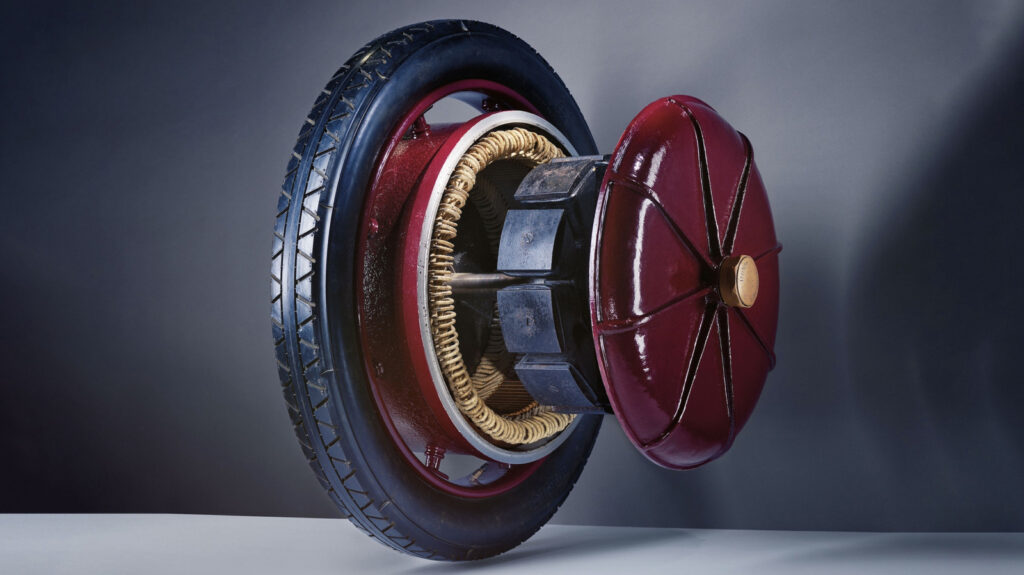
Long before today’s electric vehicle (EV) innovations, the concept of the hub motor was already in play. Ferdinand Porsche showcased an electric hub-wheeled vehicle at the Paris Exposition’s Palace of Electricity in 1900. Fast forward to the 1970s, and these motors were even used in the Lunar Roving Vehicles during the Apollo missions. Despite these promising beginnings, hub motors have yet to become mainstream.
Hub motors offer several potential benefits. Designed by Porsche to eliminate the need for a traditional transmission, these motors can provide more space and potentially increased efficiency by reducing power loss through the driveline. The setup could be simpler than the conventional motor and transmission configurations prevalent today.
However, hub motors also come with inherent challenges. The motor’s weight, previously supported by the chassis and suspension, now resides in the wheels, posing issues for suspension and handling. Without suspension protection, these motors are vulnerable to damage from road conditions like potholes, dirt, and speed bumps. Additionally, cooling them remains a significant hurdle. Are these challenges insurmountable?
Understanding the Drawbacks
The shift in weight to the wheels turns it into unsprung mass, meaning it’s not supported by the suspension. This weight also contributes to rotational mass. In racing, it’s noted that each pound of unsprung mass can feel like seven pounds of sprung mass, affecting ride and handling. The gyroscopic effect of this added rotational mass helps maintain a straight course, impacting vehicle maneuverability, especially in lighter vehicles.
Durability is a recurring concern. Hub motors are exposed to the road’s harsh conditions, leading to constant vibrations and potential damage from obstacles and weather. Ensuring these motors are protected and sealed could complicate cooling efforts.
Examining efficiency, current EV motors transmit power through several components before reaching the wheel, each adding friction and reducing power. A direct connection might seem more efficient, but examples like the Lordstown Motors Endurance pickup suggest otherwise. Nonetheless, this is based on limited data.
The Path Forward for Hub Motors
Many of these issues can be addressed through engineering, and companies like Elaphe, Protean, and Donut Lab are making strides in this direction. Elaphe provided motors for the Lordstown Motors truck, though it never reached full production. Donut Lab, working with Verge on motorcycles with in-wheel motors, collaborates with Longbow Motors for future vehicles. A Czech company’s hub-motor vehicle was anticipated in 2018, but is still awaited.
In 2023, Hyundai Motor Company introduced the Universal Wheel Drive System (Uni Wheel), a hybrid approach to hub motors. By placing an electric motor on the chassis and situating the gearing in the hub, this system splits the weight and protects the motor, addressing some common issues.
Renault’s venture into hub motors has moved into limited production with the Renault 5 Turbo 3E. This model features two rear hub motors from Protean, delivering 555 horsepower, a 0 to 62 mph time of 3.5 seconds, and a top speed of 167 mph. Limited to 1,980 units, this production nods to the 1980 Renault 5 Turbo. If successful, these advancements could bring Porsche-inspired, moon-tested hub motors to the public.
Original Story at www.jalopnik.com