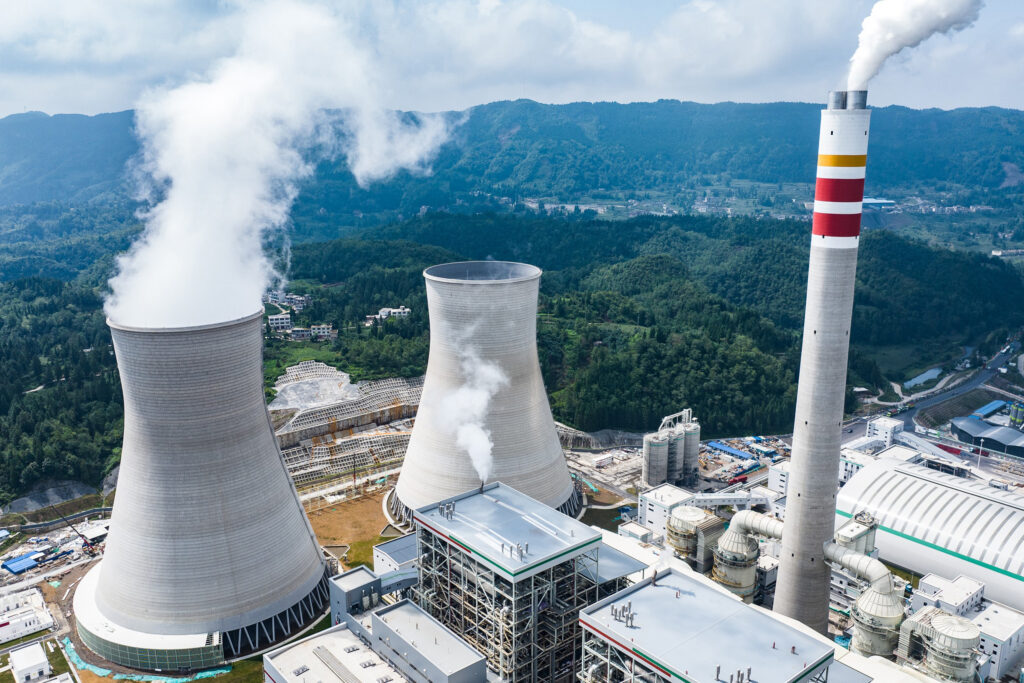
China’s coal power output increased in early 2026, raising concerns that last year’s drop in power-sector emissions might be temporary despite rapid renewable energy growth.
Data from China’s National Energy Administration indicates 2025 as a pivotal year for China’s transition from fossil fuels to renewable energy. Installed renewable capacity, including wind, solar, biomass, and hydro, reached 2,340 gigawatts, making up nearly 60 percent of total generating capacity. Wind and solar capacity exceeded thermal power for the first time.
The expansion of renewables contributed to the first annual decline in carbon emissions from China’s power sector in over a decade, reported by the Centre for Research on Energy and Clean Air (CREA). This trend supports expectations that China might peak its carbon emissions before 2030 and achieve carbon neutrality by 2060.
However, coal-fired generation rose in the first four months of the year, increasing power-sector emissions, though still below 2024 levels. Analysts suggest this rebound casts doubt on whether the previous year’s decline signals a lasting structural change.
The resurgence coincides with China’s rapid approval and construction of new coal-fired power plants.
“The situation is alarming,” said Qi Qin, an analyst at CREA, “China has installed vast solar and wind capacity, but whether that capacity is being fully utilized is uncertain.”
Coal has long been a cornerstone of China’s energy security. Unlike oil and natural gas, coal is seen as a stable electricity source during uncertain times.
Official data shows China produces over 90 percent of its coal domestically, while imports fulfill about three-quarters of its oil and roughly 40 percent of natural gas consumption.
Global energy market disruptions, linked to tensions over the Strait of Hormuz, have reinforced these concerns, as shown by a 20 percent drop in China’s crude oil imports and a 12.5 percent decline in natural gas imports in April, according to customs data.
Some researchers argue the energy-security rationale is weakening as renewable energy expands.
“The argument that we need coal due to geopolitical tensions is outdated,” said Daniel M. Kammen, a professor of energy and climate justice at Johns Hopkins University, “Many political leaders underestimate renewables’ cost-effectiveness.”
A BloombergNEF analysis indicates electricity from new wind and solar projects is already cheaper than from new coal and gas plants globally. China’s dominance in solar-panel and wind-turbine manufacturing has significantly lowered renewable-energy costs.
Kammen and Qin assert that coal’s persistence is driven by both energy-security concerns and political and economic interests.
Coal-producing provinces rely heavily on mining for employment and tax revenue, incentivizing local governments to support the industry. Coastal provinces prefer maintaining local generation capacity over relying on electricity imported from western and northern China.
In 2024, China began construction on 94.5 gigawatts of new coal-fired capacity, the highest level since 2015, continuing into 2025 with 78 gigawatts commissioned, marking the largest annual increase in a decade.
The trend persists this year, as 24 gigawatts of coal power were added in the first quarter.
Qin believes the increase in coal-fired generation is likely due to the rapid addition of new coal plants rather than conflicts around the Strait of Hormuz.
Analysts warn the coal construction surge could impact China’s energy transition. New coal plants, under medium- and long-term contracts, might compete with renewable energy for electricity demand.
“New coal plants are said to back up renewable energy,” Qin noted. “But China has limited room for new demand, creating competition between coal and renewable energy, with coal having an institutional advantage.”
Supporters argue new plants replace older, less efficient ones, but Qin refutes this, citing that China retired only about 3 gigawatts of coal-fired capacity last year.
This tension is evident in western China, rich in renewable resources but low in electricity demand.
Qinghai province, about Texas’s size, has 5.9 million people. It leads in renewable energy, with 73 gigawatts of clean-energy capacity by October 2025, including solar, wind, and hydropower, making up 93 percent of its total capacity.
Much of this electricity targets eastern China’s population centers, facilitated by long-distance transmission lines, a strategy promoted by Beijing.
However, Qin said many eastern provinces prefer controlling power generation locally.
“Eastern provinces favor maintaining local generation to retain investment, tax revenue, and employment,” she said.
This creates a conflict between China’s national climate goals and local government incentives.
“This creates significant issues in China’s energy strategy flexibility,” Qin remarked.
Economically and politically, the stakes are high. China’s coal-mining industry employs about 2.7 million people. Despite halving since its 2013 peak, coal remains a major job source in many inland provinces.
The debate continues as China deals with coal production’s human costs. A gas explosion at a Shanxi province coal mine in May killed 82, injured 124, and left two missing, marking the deadliest mining disaster in over 17 years.
Coal’s toll extends beyond accidents. Miners face pneumoconiosis, or black lung disease, from prolonged coal dust exposure, a significant occupational health challenge.
Coal combustion contributes to air pollution and carbon emissions. Despite significant air quality improvements via stricter standards and cleaner technologies, coal remains a major source of fine particulate pollution and greenhouse gas emissions.
Kammen noted the mining accident renewed focus on coal mining’s dangers. However, many provinces hesitate to reduce coal production, fearing job losses.
Most coal mines are in inland provinces, while renewable energy manufacturing hubs are in the east.
“A Shanxi coal miner losing their job is unlikely to move to a clean-tech job in Shanghai,” Kammen said. “The challenge is pushing renewables without angering coal-producing regions.”
In a statement, China’s National Energy Administration called coal-fired power the “backbone” and “stabilizing force” of the electricity system, emphasizing its role in ensuring a secure power supply.
Kammen argues this shouldn’t justify new coal power plants.
“China leads in solar panels, wind turbines, and batteries,” he said. “China could convert some hydro capacity to act as a battery. The idea that coal is needed for security is outdated.”
Kammen, who collaborates with Chinese researchers and policymakers on clean-energy development, finds the shift challenging in accelerating China’s transition to net-zero emissions.
“This complicates efforts,” he stated. “China’s path is slow. The U.S. made progress under President Biden but now moves in the wrong direction.”
U.S. clean-energy and transportation investment fell 11 percent year-on-year in the fourth quarter last year, the first decline since 2019, and another 3 percent in the first quarter, found the Clean Investment Monitor.
Solar and wind power are expanding rapidly in China. Nearly 59 gigawatts of new renewable capacity were installed in the first quarter, representing about 70 percent of new power-generation capacity.
The key question remains: as more coal plants are commissioned, how fast and to what extent will renewables displace coal? The answer may emerge this year: whether China’s power-sector emissions decline for a second consecutive year will be a crucial test of the country’s energy transition.
Original Story at insideclimatenews.org