
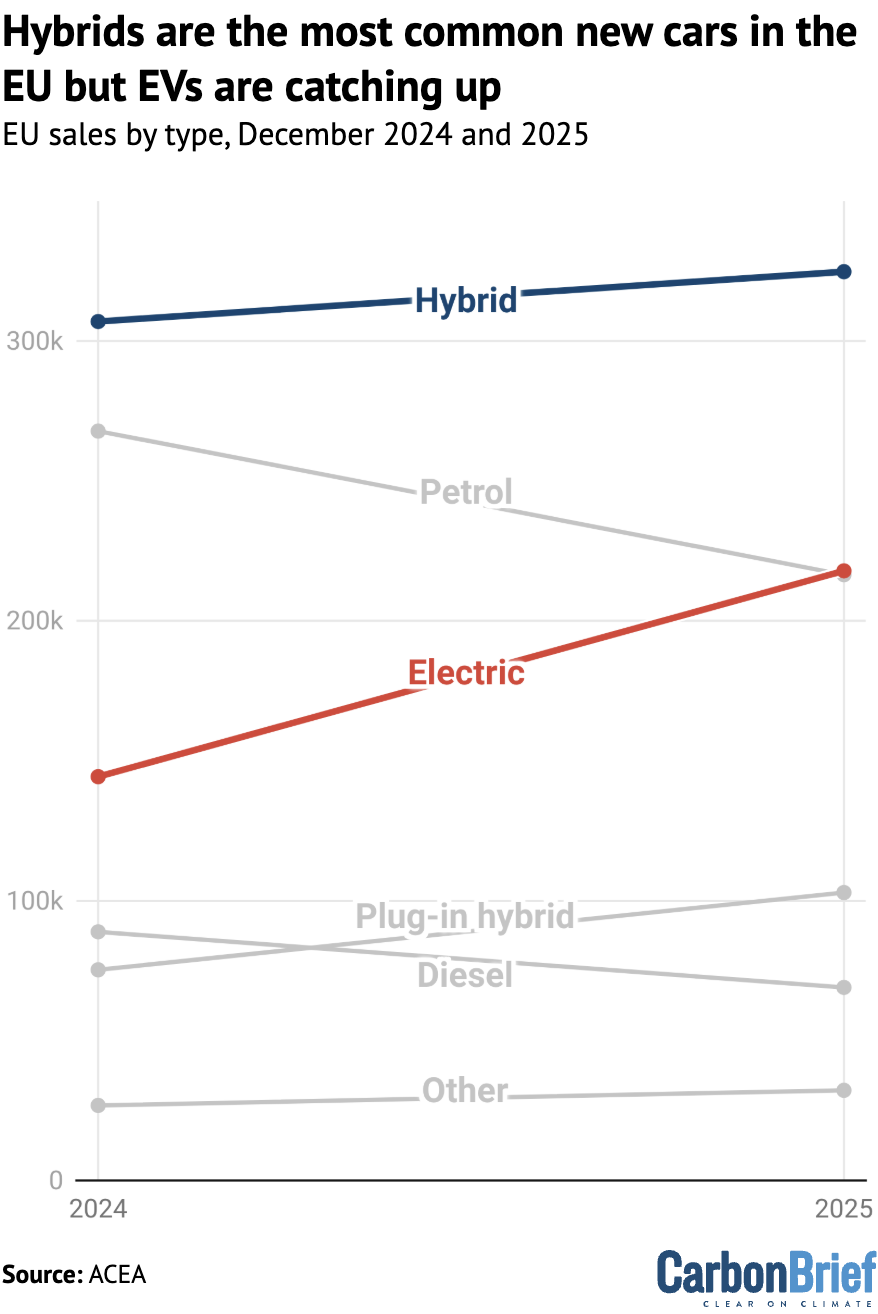
In a historic shift within the European Union’s automotive market, electric vehicles (EVs) surpassed traditional petrol-powered cars in sales for the first time in December 2025. This milestone highlights the growing consumer preference for cleaner transportation options.
According to the European Automobile Manufacturers’ Association (ACEA), battery electric vehicle (BEV) registrations soared to 217,898 in December 2025, marking a 51% increase from the same month in the previous year. In contrast, registrations of standard petrol vehicles dropped by 19%, reaching 216,492 from 267,834 in December 2024.
Throughout 2025, EVs represented 17.4% of the market share within the EU, rising from 13.6% in 2024. The four largest markets—Germany, the Netherlands, Belgium, and France—contributed significantly to this growth, accounting for 62% of total BEV registrations.
The ACEA’s report emphasized that despite the progress, there is still potential for further expansion to meet transition goals.
On the other hand, petrol car registrations experienced an 18.7% decline over the same year, with France seeing the largest reduction at 32%. Germany, Italy, and Spain also reported significant decreases.
Hybrid vehicles continue to dominate the EU car market as the largest segment, with sales increasing by 5.8% year-on-year. However, vehicles capable of running on grid electricity, including BEVs and plug-in hybrids, are experiencing faster growth, with sales rising by 51% and 36.7%, respectively.
This shift aligns with the EU’s automotive package initiative, aimed at supporting a clean mobility transition. The proposed plan modifies the ban on new combustion-engine cars by 2035, instead focusing on a 90% reduction in carbon dioxide emissions from 2021 levels.
The automotive sector has expressed concerns over these targets, citing competitive pressures from Chinese manufacturers and US tariffs. The head of Stellantis in Europe recently stated concerns about the natural demand for EVs.
In terms of market share, Volkswagen remains the largest player in the EU, capturing 26.7% of new registrations in December. Despite a decline, Tesla’s market share dropped to 2.2% from 3.5% the previous year, while Chinese EV maker BYD saw its share triple to 1.9%.
Original Story at www.carbonbrief.org