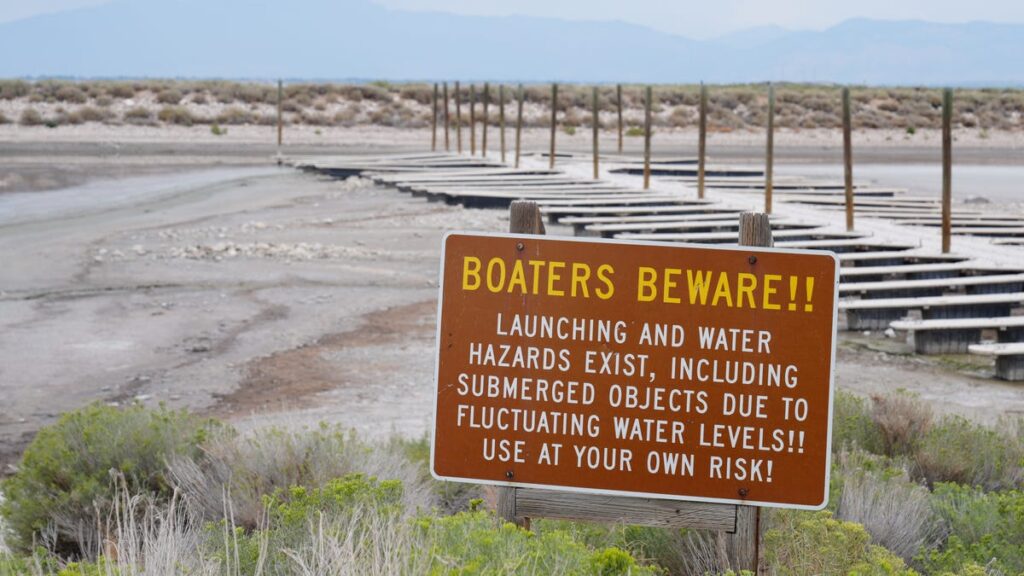
Efforts to Revive the Great Salt Lake Amidst Drought Concerns
Amidst growing concerns over prolonged drought conditions, efforts to restore the Great Salt Lake have been gaining momentum. The lake’s decline is primarily linked to two factors: excessive water use and decreased precipitation due to climate change. A significant intervention might require as much as 260 billion gallons of water.
This winter’s minimal snowfall presents a challenge to the ambitious initiative to rejuvenate the Great Salt Lake by the 2034 Winter Olympics in Utah. A push led by Utah officials has gained traction, bolstered by a proposed $1 billion federal aid package from President Donald Trump to secure additional water resources and mitigate environmental impacts. The lake has been shrinking due to water diversion for agricultural purposes.
Optimism remains high among advocates such as Utah businessman Josh Romney, who believes the problem is solvable. “I am fully convinced we’re going to fix this. This is a fixable problem,” he stated.
Understanding the Lake’s Challenges
In 2022, the Great Salt Lake’s water levels dropped to the lowest ever recorded. Although levels have slightly improved, experts warn that ongoing trends due to water consumption and climate change are concerning. The lake is not just a symbol of Salt Lake City; it is also a hub for recreation, wildlife, and a thriving fishing industry.
Ben Abbott, an ecology professor at Brigham Young University, highlighted the critical state of the ecosystem, describing it as being on “life support.” He attributes 80% of the lake’s decline to water overuse in Utah, Idaho, and Wyoming, with climate change and drought as additional factors.
Impact of Population Growth and Agriculture
While climate change plays a role, water-intensive farming is the largest contributor to the lake’s drying. The rapid population growth in Utah exacerbates the situation, as more residents lead to increased water consumption for domestic use.
Josh Romney emphasizes the need for voluntary cooperation from farmers to reduce water use without compromising their livelihoods. Encouraging more efficient residential water use, such as optimizing lawn watering, could save significant water resources.
Snowfall’s Role in Lake Levels
The West has experienced a historically low snowfall, influencing water availability for irrigation. Although the Great Salt Lake’s salinity prevents it from being a direct water source, its reduced size affects local weather patterns. Abbott explains that a smaller lake results in less water vapor, impacting snowfall.
In 1986, the lake spanned about 2,300 square miles, but by 2022, it had shrunk to under 1,000 square miles. Restoring it could enhance precipitation in the region, Abbott suggests.
Environmental Implications
As the lake lacks an outlet, evaporating water leaves behind minerals, increasing salinity. While this environment supports the brine shrimp industry, it poses risks to other wildlife. Additionally, drying lakebeds contribute to regional air pollution, exacerbating health concerns.
Restoration Initiatives
Efforts to restore the lake include state and federal initiatives, with Utah Gov. Spencer Cox announcing a plan backed by $200 million in private contributions. A key success was acquiring a defunct magnesium plant to preserve water in the lake.
Federal support from President Trump, including a proposed $1 billion allocation, underscores the national significance of the lake. Trump’s budget highlights the lake’s economic and environmental importance, emphasizing a comprehensive federal strategy for restoration.
The Great Salt Lake, the largest saline lake in the Northern Hemisphere, plays a vital role in Utah’s economy and ecology. The ongoing efforts to save it are crucial for sustaining the region’s environmental and economic health.
Original Story at www.usatoday.com