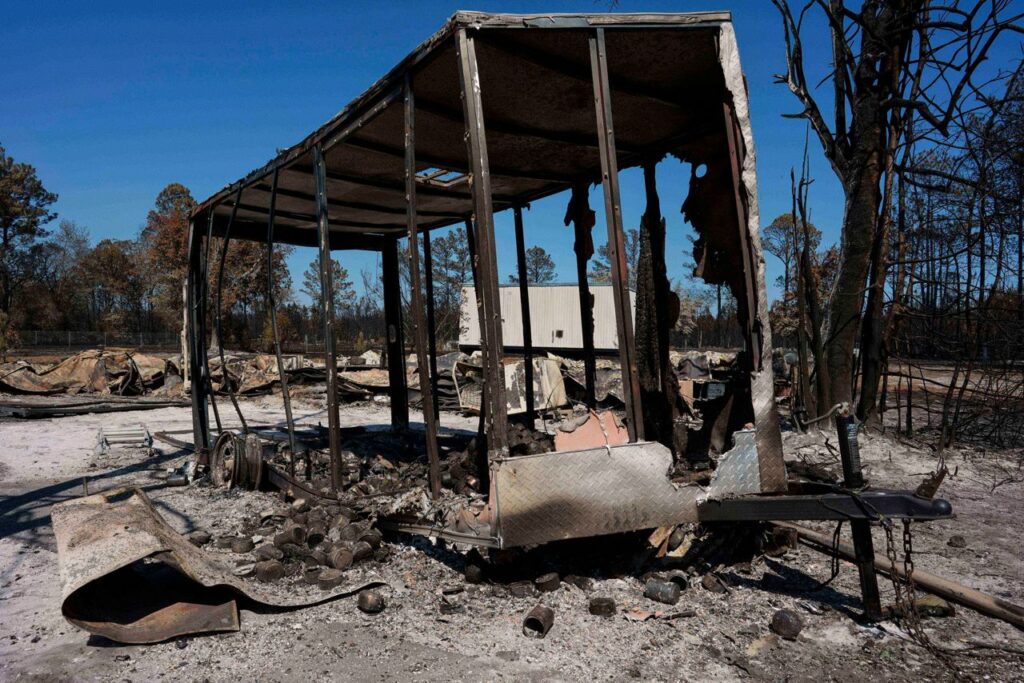
As wildfires increasingly ravage parts of Eastern North America, scientists are raising alarms over the growing intensity and frequency of these blazes. Recent fires have wreaked havoc, including a significant one that destroyed over 50 homes in Georgia. This new trend is attributed to a combination of climate change, drought conditions, and remnants of natural disasters such as Hurricane Helene.
Several factors are contributing to the increasing wildfire risk in the East. Climate change has led to drier conditions, making vegetation more flammable. A severe drought has compounded the problem, while millions of dead trees from past hurricanes add to the fuel load. These conditions create a perfect storm for wildfires, especially in regions where dense forests meet populated areas.
This year, wildfires have consumed 2,802 square miles (7,258 square kilometers) across the United States, significantly exceeding the 10-year average by 88%, as reported by the National Interagency Fire Center. This surge coincides with record-breaking winter warmth and spring droughts across significant parts of the country.
Fires Escalating in the Eastern U.S.
A study by University of Florida fire ecologists Victoria Donovan and Carissa Wonkka highlights the rise in large fires and burned areas in the Southeast from 1984 to 2020 (source). Although Eastern fires have traditionally been smaller than those in the West, this dynamic is changing, said Donovan. “Even though the changes that we’re seeing in the East are much smaller than we’re quantifying out West, we think it’s extremely important to start to get ahead of this problem now,” she added.
To address this shift, Donovan, Wonkka, and other scientists established a new research network focusing on Eastern wildfires. The East also faces unique challenges, such as a higher population density in fire-prone areas, known as the wildland-urban interface or WUI. Donovan noted that nearly half of large wildfires in the East impact these areas.
Aftermath of Hurricane Helene: A ‘Ticking Time Bomb’
Hurricane Helene left behind a hazardous legacy of dead trees, which are now fueling wildfires. Nick Nauslar from the National Interagency Fire Center explained that the abundance of dead trees, coupled with warm and dry conditions, heightens the risk of fires. In Georgia alone, the storm affected 13,954 square miles (36,142 square kilometers) of forest, resulting in over 56 million tons of downed timber.
“Many of us have worried about fuel buildup post-Helene. It’s a ticking time bomb,” warned Marshall Shepherd, a meteorology professor at the University of Georgia.
The Role of Dry Air
Dry air further exacerbates wildfire danger, as less humid conditions make it easier for fires to ignite and spread. Mike Flannigan, a fire scientist from Thompson Rivers University, stated, “As we warm … the atmosphere’s ability to suck moisture out of dead fuel, not live fuel, but dead fuel, increases almost exponentially as temperature increases.” This leads to more intense fires that pose significant challenges for fire suppression efforts.
Flannigan emphasized that human-caused climate change is a significant factor driving these changes. “That’s what we’re seeing now starting to make inroads into the East,” he noted.
___
The Associated Press’ climate and environmental coverage receives financial support from multiple private foundations. AP is solely responsible for all content. Find AP’s standards for working with philanthropies, a list of supporters and funded coverage areas at AP.org.
Original Story at ny1.com