
The global corporate landscape is navigating a complex web of climate commitments amidst varying government policies. While some businesses are scaling back their environmental ambitions, others are steadfast in their pursuit of sustainability, looking beyond short-term cost savings.
The Trump administration’s decisions to withdraw from the Paris Agreement and reduce emissions regulations have provided some companies with an excuse to relax their climate goals. Notably, Wells Fargo has abandoned its net-zero emissions target by 2050, citing insufficient policy certainty and consumer readiness. Similarly, oil giant BP acknowledged that expectations for a rapid shift to renewable energy were “misplaced” due to evolving regulations.
On the other hand, Walmart, the world’s largest retailer, remains committed to its climate agenda, despite federal policy shifts. The company is quietly advancing its environmental strategies, as are many others, to avoid unnecessary scrutiny, yet remain responsive to pressures from governments, consumers, and international bodies.
As an associate professor of economics and public policy, I have studied what influences corporate environmental practices. In my book, “Corporations at Climate Crossroads,” I explored the environmental strategies of Global 500 and S&P 500 companies over the past decade. Corporate climate actions are shaped by regulatory pressures, stakeholder expectations, and the quest for competitive advantages.
States wield influence, too
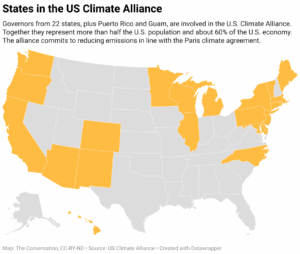
In the U.S., state-level climate policies significantly impact multinational corporations, particularly in California, the fourth largest economy globally. Despite federal rollbacks on climate action, California has enacted laws aiming for net-zero emissions by 2045, challenging corporations to comply with stringent standards akin to the European Union’s Green Deal.
Furthermore, the U.S. Climate Alliance, a coalition of 24 states, continues to uphold the goals of the Paris Agreement. States like Vermont and New York have implemented “polluters pay” laws, requiring companies to contribute financially to climate adaptation projects.
Climate laws still apply in Europe and elsewhere
Globally, countries maintain stringent climate regulations that multinational businesses must navigate. The European Union, for instance, seeks to reduce emissions by 50% by 2030, necessitating compliance with climate reporting rules and carbon taxes.
Other regions, including the UK, New Zealand, and Singapore, have instituted mandatory emissions reporting. The International Court of Justice has also emphasized the legal obligation for countries to mitigate climate impacts, potentially intensifying pressure on businesses worldwide.
Multinationals put pressure on supply chains
Efforts by multinational corporations to minimize their climate impact extend to their suppliers. For example, Walmart’s Project Gigaton, launched in 2017, aimed to slash supply-chain emissions by 1 gigaton by 2030, an objective it achieved six years ahead of schedule. This success was driven by suppliers like Nestle and Coca Cola, who adopted energy-efficient practices and reduced waste.
Despite some setbacks, including delayed emissions targets in 2025, Walmart continues to pursue renewable energy, with nearly half of its energy consumption coming from such sources in 2024.
There are profits to be made in clean tech
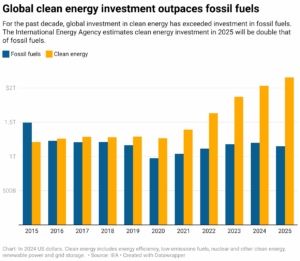
As companies face external pressures, they also recognize the lucrative potential of clean technology investments. Since 2016, global investments in clean energy have surpassed those in fossil fuels, with 2025 seeing nearly double the investment in clean energy.
Opportunities in the climate tech sector have provided substantial returns, with U.S. investments continuing to rise. In the first half of 2025, approximately one-fifth of over 1,600 venture deals in climate tech involved corporations seeking strategic advantages like technology access or supply chain integration.
Companies look to the future
Despite political challenges, corporations are increasingly aligning their sustainability initiatives with global standards. Companies like Intel and Adidas have emphasized integrating sustainability across their operations to efficiently manage environmental impacts.
This forward-looking approach not only mitigates potential regulatory risks but also addresses the growing demands from consumers, investors, and employees for responsible environmental stewardship.
Lily Hsueh is an associate professor of economics and public policy at Arizona State University.
This article is republished from The Conversation under a Creative Commons license. Read the original article. Banner photo: Amazon electric delivery vans in the London area (Philafrenzy, CC BY-SA 4.0, via Wikimedia Commons).
Sign up for The Invading Sea newsletter by visiting here. To support The Invading Sea, click here to make a donation. If you are interested in submitting an opinion piece to The Invading Sea, email Editor Nathan Crabbe at nc*****@*au.edu.
Original Story at www.theinvadingsea.com