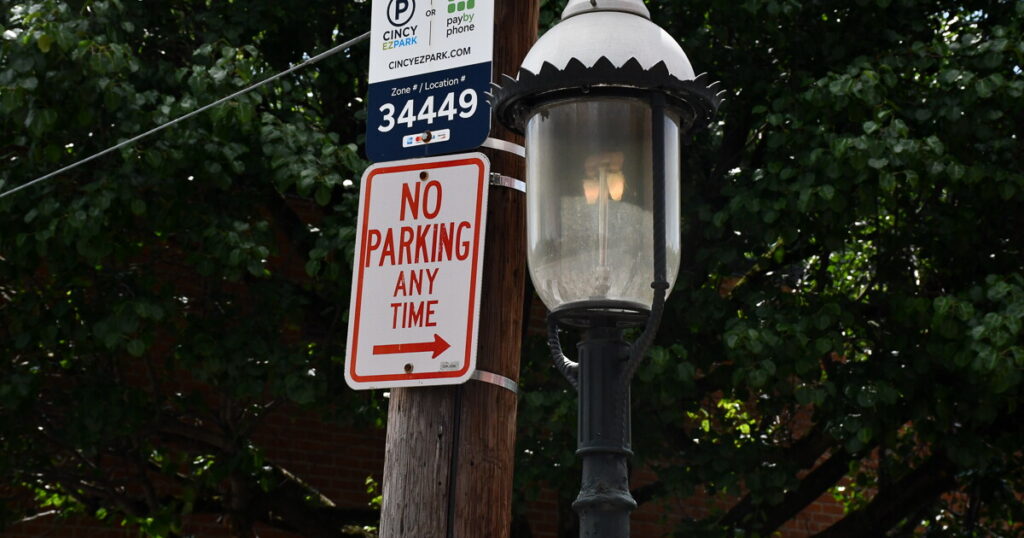
In several neighborhoods of Cincinnati, gas streetlights remain a significant part of the city’s heritage, found in places like Clifton’s Gaslight District and Pleasant Ridge’s Gas Light Cafe. These lamps, with over a century of history, have been central to discussions on preservation, safety, and municipal budgeting.
Recently, research conducted by University of Cincinnati scholars sheds light on how these gaslights pose challenges in the fight against climate change. Published in the Journal of Environmental Studies and Sciences, the study reveals significant insights into their environmental impact.
According to Professors Amy Townsend-Small and David Stradling, about 1,100 gaslights are operational in the city, relying on natural gas and continuously burning day and night. The professors highlight that these lights are prone to leaks.
The study notes that gaslights emit approximately 4% of the fossil fuels they consume, contributing to the release of methane, a potent greenhouse gas.
“They’re leakier than any other appliance that’s been measured, like a stove or a hot water heater,” Townsend-Small commented, pointing out the inefficiency of these lights.
Her measurements indicate that on average, a Cincinnati gas streetlight releases 1.7 grams of methane per hour, whereas gas stoves and water heaters emit 0.07 grams and 0.2-0.3 grams per hour respectively.
As the city strategizes to move away from fossil fuels for climate action, electrifying these gaslights is a key initiative in the Green Cincinnati Plan aimed at emissions reduction.
Despite the environmental benefits, preserving the character and charm of neighborhoods has spurred long-standing efforts to maintain these gaslights.
“There’s this complication that they’re very beloved. I think that overall, that’s a very good lesson for the energy transition,” Townsend-Small remarked. “You know, people like fossil fuels; they like driving a gasoline car that makes a loud revving sound. They like cooking with gas. So, there’s a cultural, emotional connection to burning fossil fuels.”
The Legacy
In the late 19th century, Cincinnati boasted around 10,000 streetlights. Currently, only about 1,000 remain.
Professor Stradling, who specializes in history, notes that over time, gaslights were replaced due to factors like cost and lower brightness compared to electric alternatives.
During the 1960s, facing financial constraints, Cincinnati proposed switching hundreds of gaslights to electric lights, particularly in affluent areas like Clifton. This led to public opposition, with residents lobbying to retain the gas lamps.
“Cincinnati was a declining city for decades in the late 20th century, and that’s really when this the battle to preserve gaslights took off,” Stradling reflected.
Residents valued the unique character these lamps imparted to their neighborhoods, enhancing property values and community identity.
“People in Clifton started to say that one of the reasons why Clifton is such a special place, that people want to stay in the city, is that it has this historic charm – not just in the buildings and the walkability and the housing, but in the streetscapes themselves,” Stradling added. “A really important part of the streetscape were these gas lamps, which are esthetically quite pleasing.”
Today, the emotional connection to gaslights persists, primarily for their visual appeal rather than the energy source.
“One of the things that I noticed most about Clifton’s defense of the gas lights is that they aren’t really that attached to the form of energy that’s being consumed. They’re really attached to the lamp posts themselves,” Stradling observed. “In fact, I think a lot of people don’t realize that some of the lamp posts in Clifton are electrified.”
Electrifying the existing lamp posts would involve wiring and hardware modifications, a potentially costly endeavor. Yet, this could harmonize preserving neighborhood aesthetics with environmental objectives.
Original Story at www.wvxu.org