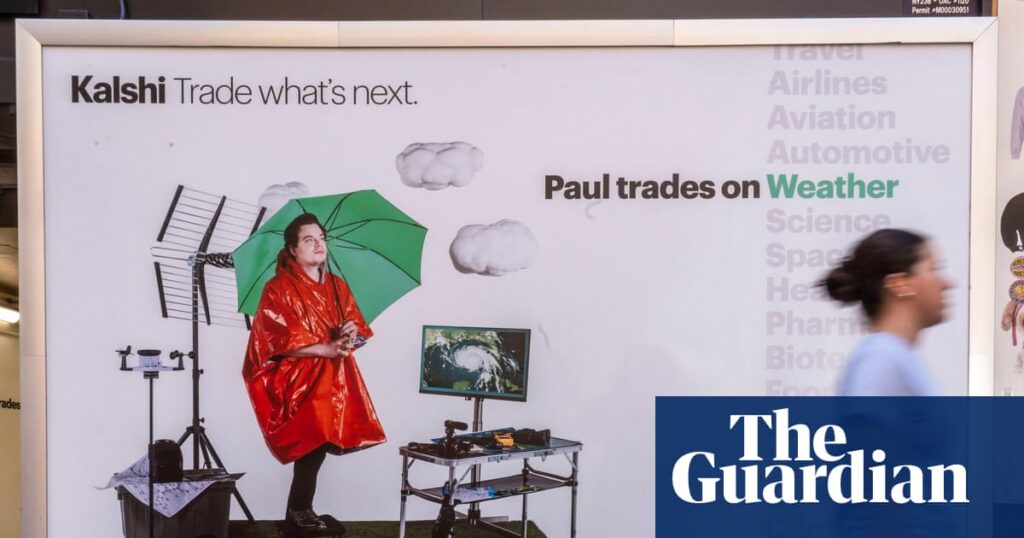
As the world grapples with the profound implications of climate change, a new trend is emerging that combines financial markets with weather forecasts. Online prediction markets, traditionally dominated by sports and politics, are now venturing into the realm of climate and weather prediction, offering a new way to engage with the challenges of our changing environment.
Kalshi, a prominent online financial exchange, has struck a significant deal with the Weather Company, owner of the Weather Channel, to use its data for verifying weather-related betting outcomes. This collaboration underscores the rapid rise of weather and climate-based predictions, which have grown by 500% over the last year, creating a $1.1 billion market.
Kalshi’s co-founder, Tarek Mansour, articulated the company’s vision as aiming to “financialize everything and create a tradable asset out of any difference in opinion,” highlighting their broader objectives beyond just weather forecasts.
Remarkably, Kalshi suggests that its markets not only reflect public opinion but could also serve as a financial hedge for businesses affected by extreme weather events. The integration of these markets into the Weather Channel’s app, which boasts over 330 million users globally, further emphasizes their potential impact.
A Kalshi spokesperson stressed the importance of “well-calibrated forecasting data about future climate impacts” for policymakers and the public, suggesting that their prediction markets contribute to this objective. They emphasized that “weather is the ultimate equalizer,” affecting everyone universally.
Users of platforms like Kalshi and its competitor Polymarket can place bets on a range of weather-related events. These include predictions on daily temperatures, the number of climate-related disasters in the US, the potential for catastrophic global warming, and more localized phenomena, such as coral bleaching in Hawaii or water levels in Lake Mead.
However, not all events are open for betting. While Polymarket allows international bets on wildfires, US users are restricted, and Kalshi does not offer wildfire markets due to “perverse incentives.”
The ethical implications of these markets have sparked concern among scientists and affected individuals. Kaitlyn Trudeau, a climate scientist with Climate Central, expressed discomfort with the notion of profiting from climate disasters, especially after personal experiences with the devastating Eaton fire in Los Angeles County.
Trudeau warned about the “dehumanization” of climate events through such markets, suggesting they might desensitize people to the impacts of climate change. She also questioned the accuracy and calibration of prediction markets in forecasting future climate impacts.
Michael Mann, a climate scientist at the University of Pennsylvania, highlighted potential risks, including the spread of conspiracy theories about weather manipulation, while other critics fear that large-scale betting could distort public understanding of weather data.
The Weather Company, however, emphasized that their partnership with Kalshi is about leveraging weather data for decision-making and risk management, not gamification. Polymarket views itself as an information hub during natural disasters, arguing that removing markets wouldn’t prevent tragedies but could limit access to accurate information.
Despite their growing popularity, these platforms face increasing scrutiny from federal lawmakers and state regulations, with courts ruling that states can regulate prediction markets akin to gambling. This legal pressure might push companies to focus more on climate-related topics, seen as less politically sensitive.
Jamies Pietruska, an economic historian, suggested that weather and climate, considered beyond human control, are perceived as safer bets compared to other categories like geopolitics. However, she also expressed concerns about the potential erosion of public trust in established forecasting institutions like the National Weather Service.
Interestingly, a 2023 study found that participation in climate prediction markets could increase concern about climate issues, even altering the views of climate science skeptics. Yet, researchers like Moran Cerf from Columbia University caution against the negatives of these markets, labeling them as a “turn to the dark side” due to their unregulated nature.
Pietruska echoed these sentiments, arguing that such betting trivializes human suffering and fails to foster the solidarity needed to combat climate change effectively.
Original Story at www.theguardian.com