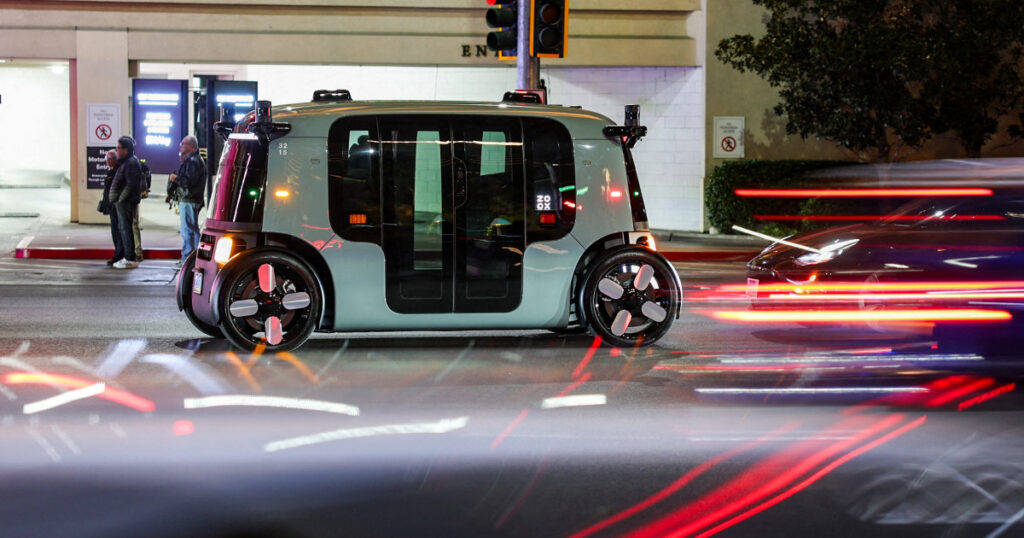
In a groundbreaking move for the autonomous vehicle industry, Amazon’s Zoox unit has obtained U.S. approval to deploy its steering-wheel-free robotaxis commercially. This decision, announced by the U.S. auto safety agency, marks a significant advancement in the realm of autonomous transportation.
According to Zoox, the approval from the National Highway Traffic Safety Administration (NHTSA) allows the company to begin charging for rides. They plan to start this service in Las Vegas, with further expansion planned as they comply with various state regulations.
The exemption from federal rules concerning human controls, initially reported by Reuters, is a landmark development for companies creating robotaxis from scratch. This is in contrast to modifying traditional cars to fit new safety standards that predate self-driving technology.
Competitive Landscape
Zoox is not alone in this pursuit. Companies like Tesla and Alphabet’s Waymo are also in the race to expand autonomous ride-hailing services across the U.S. Zoox’s vehicle, resembling an electric carriage with two rows of inward-facing seats, can reach up to 75 miles per hour.
Regulatory Approvals and Safety Measures
NHTSA Administrator Jonathan Morrison shared that Zoox has the green light to commercially deploy up to 2,500 vehicles annually for the next two years. Currently, Zoox is conducting passenger tests in areas of Las Vegas and San Francisco and will soon be able to charge fees, contingent on state and local approvals.
The agency concluded that Zoox’s vehicle offers safety equivalent to that of a vehicle meeting federal motor vehicle safety standards, despite the exemptions. However, Zoox is not permitted to sell these vehicles to the public. “We can say pretty clearly that the systems in place on the Zoox exceed the equivalent performance requirements of a compliant vehicle,” Morrison noted, adding that the automated system’s operational suitability will still be under review.
Additional reporting requirements have been imposed on Zoox for incidents such as crashes or inappropriate stoppages on roads. The NHTSA reserves the right to revoke the exemption if significant safety concerns arise. “We have the ability to pull the exemption if we see major safety issues,” Morrison confirmed.
Operational Transparency and Future Regulations
All remote operators must be based in the U.S., and Zoox is required to publish maps showing where its vehicles are operating. Looking ahead, Morrison mentioned that NHTSA aims to establish the first federal safety standards for automated driving systems by the end of the Trump administration. This includes revising certain existing regulations, like those requiring brake pedals and rearview mirrors, to better accommodate self-driving technology.
Despite Zoox’s recent regulatory success, Tesla is also venturing into the autonomous vehicle market with its Cybercab, which lacks human controls, though its regulatory approval process remains unclear.
Regulators continue to work on adapting rules to accommodate more self-driving technology while ensuring safety. Earlier this month, Morrison urged autonomous vehicle developers to address issues related to driverless vehicles interfering with law enforcement and first responders.
Concerns have been raised about robotaxis’ interactions with stopped school buses, construction zones, and other challenges like flooded roads and busy intersections. These safety concerns have led to recalls, including a recent one by Zoox to update its software for better detection of heavy smoke during emergencies.
“If we continue seeing issues, we will not hesitate to use the full extent of our enforcement authority,” Morrison emphasized, highlighting the importance of maintaining safety as technology evolves.
On Thursday, Morrison is scheduled to discuss the agency’s safety initiatives at the engineering group SAE International’s Automated Transportation Symposium in San Diego.
Original Story at www.nbcnews.com