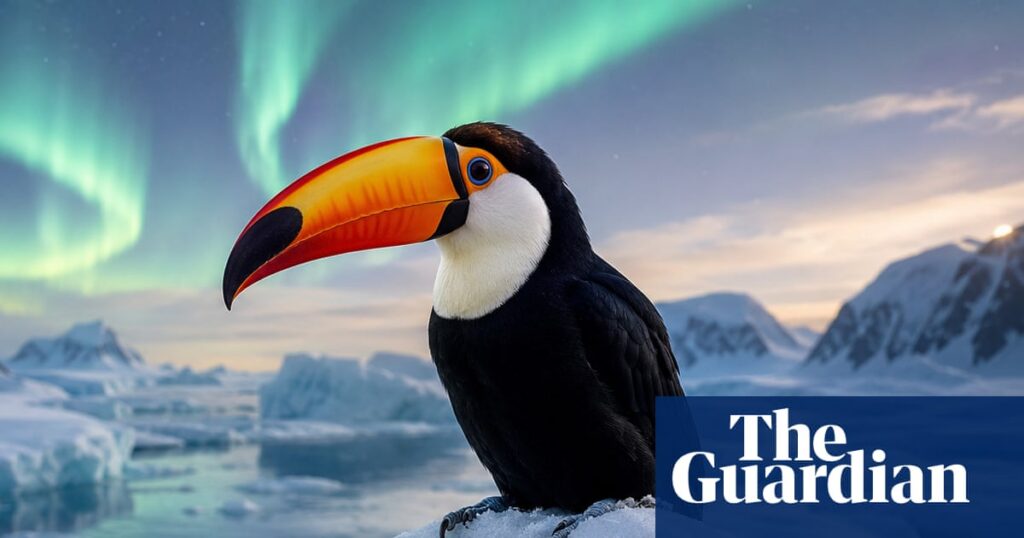
Birdwatching, a favorite pastime for many, often leads to thrilling discoveries when species are found outside their usual habitats. Such events are celebrated in the UK, with notable examples including a western reef heron, typically seen in Africa and southern Europe, recently spotted in north Wales. However, the rise of artificial intelligence (AI) is casting a shadow on these discoveries.
The Impact of AI on Birdwatching and Citizen Science
Enthusiasts and scientists are raising alarms over the influence of AI on wildlife photography, as the technology increasingly generates and alters images. The integrity of citizen science platforms like iNaturalist and Macaulay Library, which are crucial for tracking species distribution, is at risk due to AI-modified images.
Generative AI tools, including ChatGPT and Google Gemini, have enabled users to create convincing fake images or enhance photos, sometimes leading to significant alterations. A recent article in Nature highlighted the discovery of hundreds of such images on species recording databases, suggesting the problem might be more widespread than currently known.
Dr. Alexander Lees from Manchester Metropolitan University, who contributed to the article, noted, “My experience of looking at Facebook these days is that a huge volume of wildlife photos now are simply AI-generated imagery.” He emphasized the challenges these images present in understanding species distribution.
Challenges and Consequences
Although blatant hoaxes are rare, subtle AI edits can lead to misidentification of species. For instance, an edited photo led to a false report of a red-winged blackbird in Brazil, a bird native to North America. The image, altered to appear more appealing, merged characteristics of a red-winged blackbird with an epaulet oriole, misleading observers.
“Wildlife photographers can be quite obsessed with getting a beautiful photo, but there’s a risk that the image might actually cause problems down the line when AI has been used to edit it,” Lees cautioned.
Citizen science platforms are grappling with the extent of AI’s impact. On iNaturalist, only 1,400 out of over 610 million images have been flagged for AI usage. Despite this, these platforms are instrumental in significant discoveries, from tracking species’ responses to climate change to documenting rare behaviors.
Tony Iwane, iNaturalist’s community support director, highlights the importance of vigilance, stating, “On platforms like ours, regular people are posting information that a scientist could probably never get at scale… The more we know about where species are, the better informed we can be as conservationists. But the information needs to be accurate.”
As AI continues to advance, the balance between technological innovation and scientific integrity becomes more crucial than ever.
Original Story at www.theguardian.com