The Evolution of Economic Security: A Path Forward for America
In an era marked by economic challenges and international tensions, the words of President Franklin Delano Roosevelt from his 1944 State of the Union address resonate more than ever: “True individual freedom cannot exist without economic security and independence. Necessitous men are not free men. People who are hungry and out of a job are the stuff of which dictatorships are made.” This statement underscores the pressing need for a robust economic strategy that addresses job security and independence within the United States.
Amidst the ongoing global conflicts and the apparent squandering of taxpayer money, the focus must shift towards domestic issues with potential solutions. The offshoring of American jobs by corporations in pursuit of cheaper labor and lenient regulations is a well-known issue. However, the responsibility does not rest solely on businesses. The American workforce and the government have roles to play in adapting to the demands of the modern economy.
Economic Resilience and Workforce Development
Economic resilience should not revolve around allowing the wealthy to evade taxes by hiding assets overseas. Instead, it should focus on repatriating jobs by enhancing national infrastructure, upgrading workforce skills, and revitalizing rural and industrial areas. Expanding service jobs in sectors like healthcare and renewable energy, along with promoting teaching and infrastructure maintenance, can create jobs that are sustainable and unexportable.
Moreover, fostering local economic hubs through public-private partnerships can attract younger workers to rebuild communities. These efforts can lead to increased prosperity and a more equitable economic landscape, benefiting a wide range of industries and services.
The Role of Education and Workforce
The United States must adapt its educational system to produce analytical thinkers and problem-solvers rather than mere test-takers. The demand is for coders, engineers, and scientists who understand complex systems, not just assembly line workers. The public school system, once designed for factory work, needs a revolution to meet the demands of a rapidly evolving world.
Addressing Wage Disparities
The disparity in wages is stark, with the federal minimum wage remaining stagnant at $7.25 an hour since 2009. If it had kept pace with productivity, it would be $25 an hour today. Furthermore, the income gap between CEOs and average workers has widened dramatically, highlighting the need for a fair compensation system that reflects the true value of labor.
Implementing changes that mirror FDR’s New Deal, such as a federal jobs guarantee, could enhance economic stability and provide well-paying jobs for all Americans. This would not only uplift disadvantaged communities but also reduce reliance on welfare programs.
Smart Use of Automation
Automation should be harnessed to elevate workers into higher-paying roles, enhancing productivity and justifying the return of manufacturing to American soil. Redirecting corporate practices away from short-term gains towards sustainable economic health is crucial. A reevaluation of the taxation system to empower working Americans is equally important.
Renewable Energy and Future Opportunities
Prior to policy changes under the Trump administration, renewable energy was poised to create millions of jobs. The shift towards clean energy presents a future rich with employment opportunities that are both safe and well-compensated. With endless resources like the sun and wind, this sector stands as a beacon for sustainable economic growth.
Reassessing Business Costs
Addressing the high cost of doing business in the U.S. through initiatives like Medicare-for-All could enhance the competitiveness of American companies. Supporting programs like Head Start not only aids children but also generates jobs and stimulates economic activity.
The Importance of Unions
Despite a decline in union membership, unions remain vital for advocating fair wages and working conditions. They serve as a counterbalance against corporate excesses, promoting social welfare and protecting workers’ rights.
Reallocating Military Spending
The Pentagon’s substantial budget could be redirected to foster job creation and economic growth in various sectors. By investing in infrastructure and community development, the government can reduce reliance on military spending for economic stability.
A Call to Action
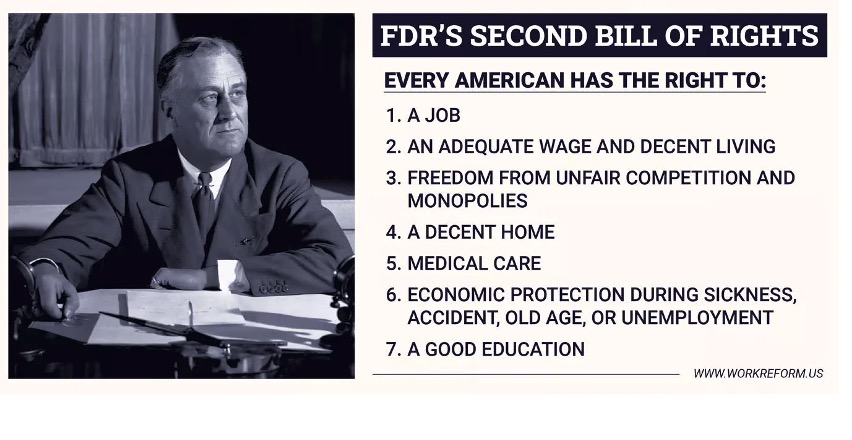
As America looks to the future, it must revisit FDR’s vision for economic rights, ensuring jobs that provide adequate living standards, education, and healthcare. Implementing these principles in today’s context could pave the way for a more equitable and prosperous society.
Inspired by the ideas of Progressive Capitalism and other thought leaders, the path forward involves embracing a modern version of FDR’s proposed second Bill of Rights. This vision seeks to guarantee economic security and independence for every American, fostering a society where democracy and opportunity thrive.
Original Story at www.citywatchla.com