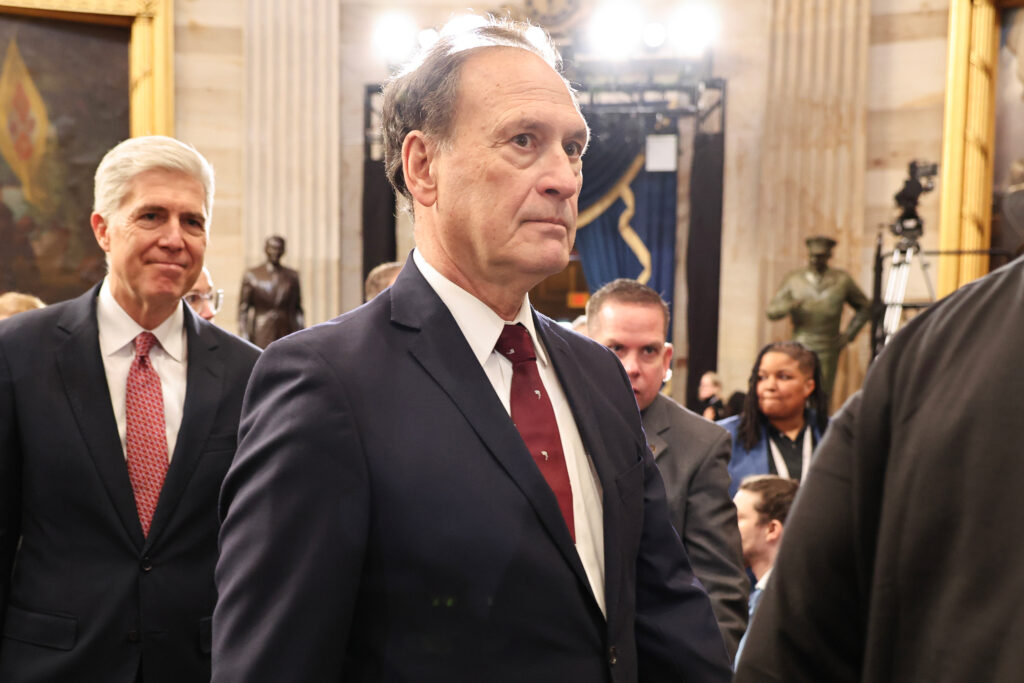
Supreme Court Associate Justice Samuel Alito was absent during the Supreme Court’s hearing on a significant case concerning the oil and gas industry’s responsibility for Louisiana coastline damage.
The court’s clerk recently informed that Alito would not participate due to his financial interest in ConocoPhillips, parent of Burlington Resources Oil and Gas Company, a defendant in the case. Allegations include extensive wetlands destruction making Louisiana more vulnerable to storms.
Alito’s portfolio includes $15,000 or less in ConocoPhillips stock and other fossil fuel investments valued between $60,000 and $245,000, according to his financial disclosure.
The late recusal underscores the potential conflicts of interest from Alito’s portfolio, unique on the high court. This term alone, Alito has recused himself 10 times and 53 times over the past three terms due to his investments in 25 companies valued up to $1 million, according to Fix the Court.
Even Small Holdings Raise Alarms
Federal law mandates U.S. judges, including Supreme Court members, to disqualify themselves from proceedings where their impartiality might be questioned, such as owning any financial interest in a company involved in a case.
In the Louisiana case, this rule became complex. On May 7, 2025, Burlington Resources notified the court of its intent to withdraw, but further briefings revealed it would remain involved in lower courts. Alito, who initially did not recuse, participated in the June 12 conference granting the oil companies’ petition to hear the case. Such decisions require support from at least four justices.
Deciding to hear the case was a preliminary win for oil companies seeking to move lawsuits over coastal environmental damage from state to federal court. The oil companies face significant liability in Louisiana state court for failing to restore wetlands damaged by dredging, well-drilling, and dumping. They argue federal contracts during World War II warrant federal court jurisdiction, where they view courts as more sympathetic to their arguments.
Stephen Gillers, a legal ethics expert, noted Alito’s recusal letter provided unusual detail. Justices rarely explain their disqualifications, which can stem from family conflicts or prior involvement at lower courts. Gillers suggested Alito explained his later recusal due to Burlington’s changing involvement in the case.
“Alito encounters this issue often due to broad investments,” Gillers said. “Some believe judges should limit equity investments to avoid unnecessary recusals, and many do.”
Most justices, including Alito, invest in mutual funds not posing such conflicts. Chief Justice John Roberts is the only other justice with any reported individual stock holdings, including Lam Research and Thermo Fisher. Alito’s numerous stock holdings prompt frequent recusal questions.
Arthur Hellman, a legal ethics expert, questioned why Alito maintains stock in companies frequently involved in Supreme Court cases. “It’s particularly troubling,” he said.
Alito’s office did not respond to requests for comment.
At the Supreme Court, no one replaces a justice who recuses. An eight-member court risks affirming lower court decisions by being equally divided, delaying answers to important legal questions, Hellman explained.
The “First and Final” Word on Recusal
Charles Gardner Geyh, a legal ethics expert, said federal judges owning stocks is allowed to avoid discouraging judicial service. “Judges shouldn’t face extreme sacrifices,” he said. “They can do things like ordinary people if they step aside when their finances conflict with impartiality.”
Geyh noted irony in minimal stock ownership causing disqualification, while other activities raising concerns do not. “If Justice Alito owns one stakeholder worth $15, he steps aside, but he can express political views freely,” Geyh said, referring to controversy over a flag outside Alito’s home in January 2021.
Fossil fuel stocks constitute nearly one-quarter of Alito’s holdings. He also owns Oklahoma mineral interests valued at $100,000 to $250,000, as per financial disclosure. Alito has often voted in favor of fossil fuel interests, such as in the 2007 Massachusetts v. EPA case and 2022 decision narrowing EPA’s regulatory authority.
Ultimately, Alito decides if his financial interests could affect case outcomes. “A justice is the first and final word on disqualification,” Geyh said.
Conflicts of interest rise with the number of individual stocks a justice holds. Legal experts say it would be challenging to enforce laws or ethics codes disqualifying justices from cases involving industries where they hold stocks or broad issues impacting their investments, like climate change.
Original Story at insideclimatenews.org