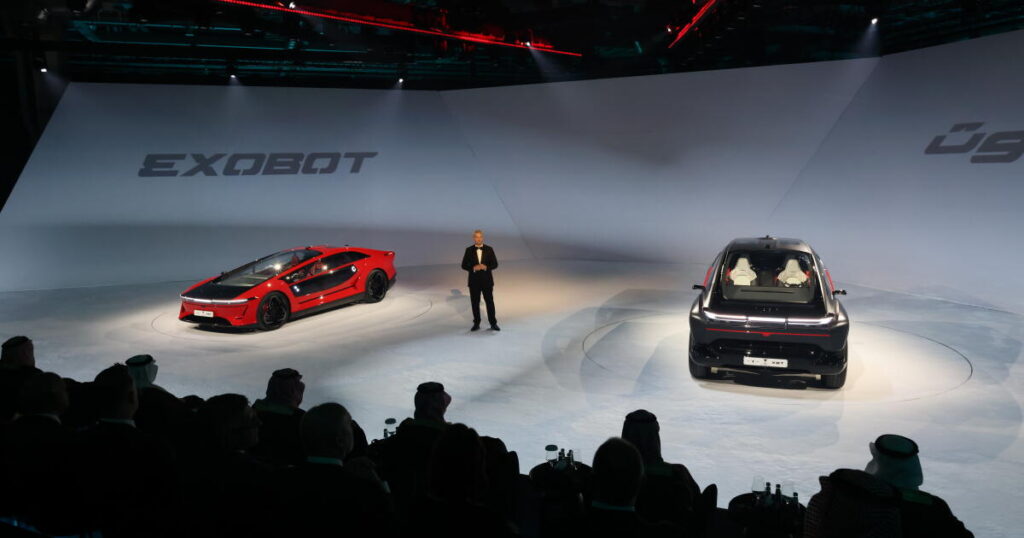
RIYADH, Saudi Arabia — In a surprising shift from its oil-driven economy, Saudi Arabia is venturing into the electric vehicle (EV) market with the introduction of its first homegrown electric cars, Exobot. The debut of these futuristic vehicles marks a significant step in the kingdom’s ambitious plan to become a leader in the EV industry.
On a warm October evening in the upscale area of Diriyah, Riyadh, Saudi citizens gathered to witness the unveiling of Exobot, a creation of the Saudi automotive startup Ceer. This joint venture, formed four years ago between Saudi Arabia’s Public Investment Fund and the Taiwanese electronics giant Foxconn, showcases the kingdom’s commitment to diversifying its economy. BMW also plays a crucial role by providing key components for these vehicles.
Ceer’s initial offering includes a fully electric sedan and an SUV, with plans to expand its lineup to seven vehicles by the end of the decade, incorporating hybrid and combustion engines. The initiative is poised to attract $150 million in foreign direct investment, generate up to 30,000 jobs, and contribute $8 billion to Saudi Arabia’s GDP by 2034.
This venture aligns with Vision 2030, a transformative economic strategy championed by Crown Prince Mohammed bin Salman to reduce the kingdom’s reliance on oil and foster growth in sectors like technology, entertainment, tourism, and advanced manufacturing.
Saudi Arabia’s foray into the EV market isn’t new. In 2018, the nation acquired a 5% stake in Tesla and invested significantly in Lucid Motors, a U.S.-based EV manufacturer, eventually establishing a factory in Saudi Arabia. However, Ceer aims to become the kingdom’s first original equipment manufacturer, with a goal to locally produce nearly half of its components by 2034.
According to Joseph Salem, a senior partner at Arthur D. Little Middle East, “Most countries import EV transition, but Saudi Arabia is manufacturing it and building on the strong financial capabilities that they have.” Salem emphasizes that the investment extends beyond car sales to include factories, supply chains, and charging infrastructure.
Walt Madeira, a principal analyst at S&P Global Mobility, likens Ceer to other national auto manufacturers like Turkey’s Togg, highlighting Saudi Arabia’s commitment to developing a robust automotive ecosystem.
The Exobots’ introduction comes at a crucial time when global EV demand is surging, fueled by rising gas prices amid geopolitical tensions. The International Energy Agency reports a significant rise in EV and hybrid sales, with projections that nearly a third of cars sold globally will be electric.
In the Middle East, electric car sales expanded by 40% in 2025, with the United Arab Emirates leading the regional market. Although Saudi Arabia’s EV sales reached 9.2%, forecasters expect rapid growth despite challenges posed by regional conflicts.
Chinese automakers, led by BYD, dominate the Middle Eastern EV landscape, accounting for 60% of sales last year, far outpacing Tesla’s 15% market share. Nevertheless, Ceer is confident in its ability to compete by offering luxury and cutting-edge technology.
The Exobots, designed with input from Crown Prince Mohammed bin Salman, boast distinctive features like gull-wing doors, a 94.5-inch windshield — the largest in the world — and a flight yoke instead of a traditional steering wheel. The cars’ Saudi identity is evident in details like the “Saudi made” badge and design cues inspired by local architecture and culture.
Equipped with three electric motors from Rimac and Hyundai, the Exobots deliver 625 kW, or about 850 horsepower, enabling acceleration from 0 to 60 mph in 2.6 seconds and a range exceeding 400 miles. Priced at nearly 400,000 riyals ($107,000), Ceer targets the premium segment, competing with brands like Porsche, Mercedes, and Tesla.
Despite entering a market dominated by affordable Chinese vehicles, Ceer intends to capture high-income consumers, potentially paving the way for wider acceptance and aspiration among middle-income buyers.
Chinese manufacturers are also expanding into the high-end market, exemplified by Geely’s Zeekr brand, which has already garnered significant interest in the UAE.
Ceer is bolstered by Saudi Arabia’s financial resources and strategic planning, including plans to expand the number of charging stations to 5,000 by 2030. With a manufacturing target of 240,000 cars annually, Ceer must also focus on regional sales, aiming to sell 50,000 to 70,000 vehicles for success.
Madeira notes that achieving success in Saudi Arabia is crucial before expanding internationally, acknowledging the challenges posed by the Exobots’ pricing. However, with substantial financial backing, Ceer is positioned for long-term perseverance and potential growth.
Original Story at www.latimes.com