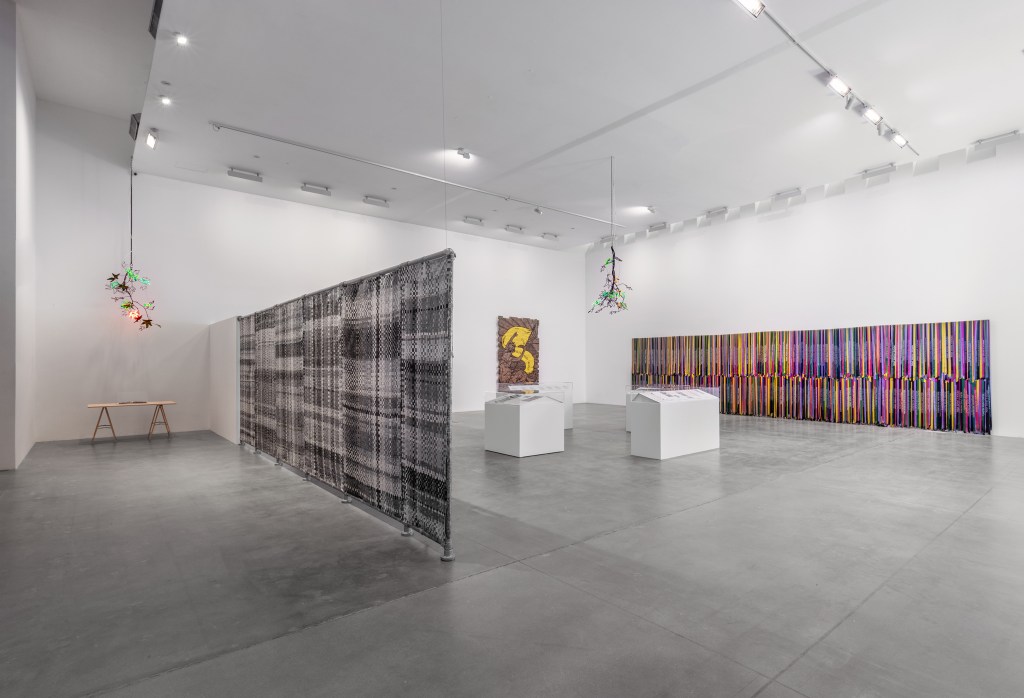
Andrea Bowers’ Exhibition Revives Forgotten Ecofeminist Movement in Italy
Andrea Bowers’ latest exhibition, “La Ragnatela,” at the Fondazione Sandretto Re Rebaudengo in Turin, Italy, uncovers the history of the Italian anti-nuclear feminist movement, coinciding with current political debates on environmental policies. The exhibition gains relevance as Italy’s Prime Minister Giorgia Meloni recently halted solar panel installations on farmland, citing threats to food sovereignty.
The exhibition revisits the La Ragnatela movement, which translates to “the spiderweb” in Italian, initiated in 1983 in Comiso, Sicily, to protest against US nuclear missiles at a NATO base. The show features a series of Bowers’ political activist works, including pieces from 2003, 2013, 2022, 2023, and four new artworks created for this exhibition.
Working closely with curator Bernardo Follini, Bowers aimed to resurrect the forgotten history of La Ragnatela by connecting with original members, now in their 80s and 90s, who contributed to the exhibition with documents and clippings. “The social engagement part of my practice is the least known about or documented,” Bowers stated during a preview in Turin.
The exhibition opens with Defense of Necessity (2003), a quilt that integrates traditional women’s crafts with political activism. The work features spiderweb motifs, symbolizing the Women’s Pentagon Action and its ties with La Ragnatela and the Greenham Common Women’s Peace Encampment in England. Bowers highlighted the symbolic meaning, saying, “The fence is the site often where nonviolence is questioned whether it’s becoming violence.”
On display are four vitrines, two of which chronicle the timeline of La Ragnatela, while others exhibit letters between Comiso women and their English allies. These displays include photographs of protests and a letter from an imprisoned protester, who wore a T-shirt reading “question authority,” a phrase Bowers incorporated into Neon Spiderweb #3 (2026). This neon artwork is accompanied by other signs bearing hopeful slogans.
Visitors are encouraged to take ribbons from Political Ribbons (2026), which bear mottos like “People over profits” and “Widen the web to break the nuclear chain.” Bowers described this interactive element as a “simple way for people to take a position.”
Bowers’ exhibition includes hyperrealistic graphite works such as Diabloblockade, Diablo Nuclear Power Plant, Abalone Alliance, 198 (2003). Her large-scale piece, Cardboard (2026), features an empowered Italian woman holding a flag with “Sun and wind,” created using an iPad to project the image onto cardboard.
The exhibition marks a return for Bowers to the Fondazione Sandretto Re Rebaudengo, where she last participated in 1998. Though the space may seem limited for her extensive body of work, Bowers leaves a significant impact, notably with Neon Opland (2026), a neon sign inspired by a La Ragnatela poster depicting a woman kicking a missile. The exhibition provides a humorous and thought-provoking experience for visitors.
Original Story at www.artnews.com