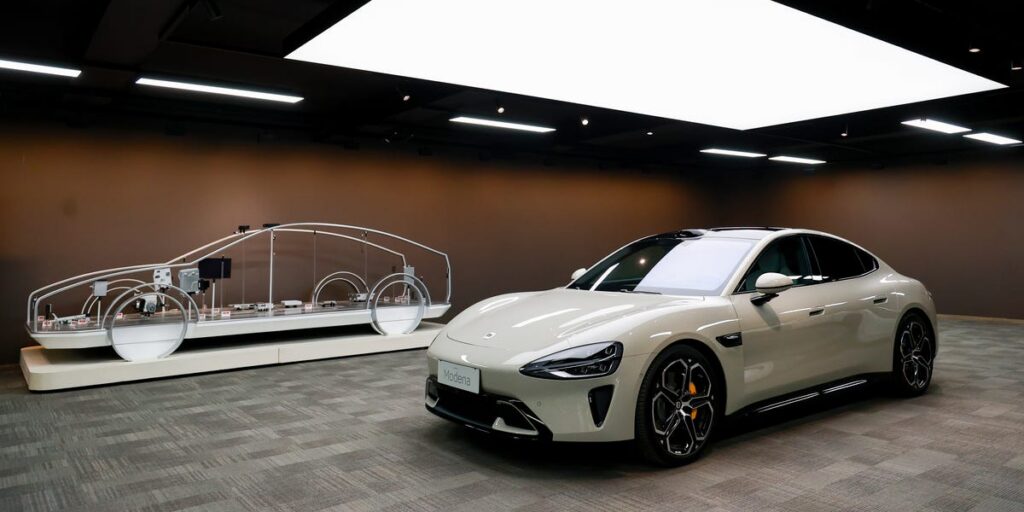
Controversy Over Chinese Cars Intensifies in U.S. Political Landscape
In recent months, the presence of Chinese vehicles in the United States has sparked significant political debate. The issue gained further traction when the Alliance for Automotive Innovation, a prominent lobbying group representing major automakers including General Motors, Toyota, Ferrari, and Porsche, voiced its stance. John Bozzella, the president and CEO of the Alliance, called for a permanent ban on Chinese vehicles in the U.S. market, citing security risks and unfair business practices.
Bozzella emphasized the potential risks associated with Chinese imports, stating, “We need to protect the U.S. market from a flood of Chinese imports that carry surveillance risk and disadvantage current manufacturers that have made generational investments in American communities,” Bozzella said, according to Reuters.
The call for banning Chinese vehicles has garnered bipartisan support. Senators Elissa Slotkin (D-MI) and Bernie Moreno (R-OH) co-authored the Connected Vehicle Security Act of 2026 earlier this year. The bill, which passed unanimously in the Senate Commerce Committee, is poised for a vote in the upcoming legislative session. In the House of Representatives, the bill has gathered over 100 cosponsors.
Beyond national security concerns, the competitive threat posed by Chinese vehicles in international markets has prompted further calls for regulatory action. Bozzella pointed to the surge of Chinese car imports in Europe, where over 1.1 million vehicles were imported in the first eight months of 2026, surpassing the total for 2025. The Volkswagen Group, represented by the Alliance, has also acknowledged the impact of Chinese competition in its restructuring strategy earlier this year.
Bozzella further argued, “Given the obvious national security risk and China’s pattern of unfair behavior, Congress should protect our defense and advanced manufacturing base and stop Chinese automakers from doing here what they’ve gotten away with in Europe.”
The Biden administration initiated the first wave of regulations on Chinese vehicles, effectively banning sales and manufacturing due to data privacy concerns. As a result, Polestar will be banned from selling vehicles in the U.S. starting in 2027. The Connected Vehicle Security Act of 2026 aims to further strengthen these restrictions, according to Senator Slotkin.
Highlighting the broader implications, Slotkin shared her concerns: “I think it’s an issue of economic security and national security,” she remarked in an interview with Road & Track in April. She criticized the Chinese Communist Party’s strategy of subsidizing industries to undercut and dominate markets, drawing parallels to the drone and solar industries.
As legislative efforts continue, a 100-percent tariff on Chinese electric vehicles remains in effect. However, congressional aides and industry experts express concerns about the feasibility of passing the ban within the current session if Democrats secure control of Congress, as reported by Reuters. Nonetheless, with growing support in both chambers, legacy automakers remain hopeful for progress.
Original Story at www.roadandtrack.com