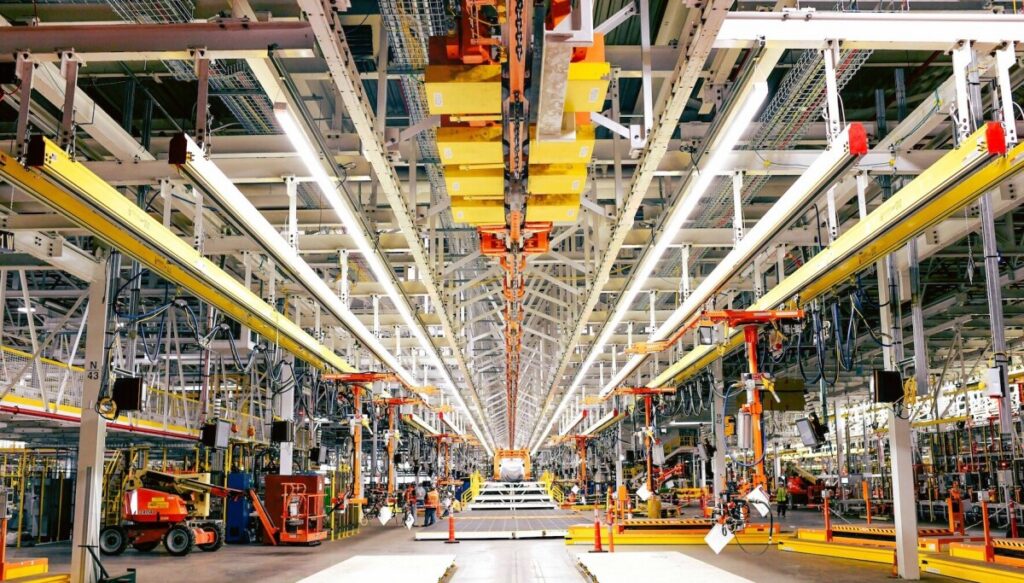
Ford is set to revolutionize its production process with a groundbreaking system at the Louisville Assembly Plant. The automaker is gearing up for the production of the Ford Fathom midsize electric truck by 2027 through a state-of-the-art Universal EV Production System. This system, part of a $2 billion revamp, promises to simplify assembly like never before. Prototype production is anticipated to commence in early 2026, with customer deliveries expected by mid-year.
Innovative Assembly Approach
Ford’s new assembly method replaces the traditional assembly line with an ‘assembly tree’. This system allows for the simultaneous construction of three subassembly sections: the front, rear, and a central section that includes the battery, seats, and interior components. These sections are brought together towards the end, streamlining the process and reducing complexity.
The components reach the assembly operators as kits, complete with all necessary tools, improving efficiency and ergonomics. This modular approach to assembly not only speeds up the process but also enhances the working conditions for operators by minimizing the constraints of working within a vehicle frame.
Unicastings, large aluminum components, are used to form two major vehicle sections, reducing the need for multiple stamped and welded pieces. The shift to this innovative production system is expected to increase the assembly speed by 40% and improve quality by integrating more automation.
Technological Enhancements
A key feature of the new system is the introduction of a software module flash station, which ensures vehicles have the latest software during assembly, rather than after. This innovation, supported by enhanced WiFi coverage and a private 5G network, facilitates real-time quality checks.
Ford has upgraded its network infrastructure at the assembly plant, increasing WiFi access points from 385 to 1,080 and incorporating WiFi-7 technology. This expansion provides robust, high-speed connectivity throughout the facility, enabling more efficient and precise manufacturing processes.
Battery Innovations
Addressing range anxiety and production costs, Ford is focusing on improving battery efficiency. The Fathom will feature lithium iron phosphate (LFP) batteries, produced at BlueOval Battery Park using technology from CATL. These batteries eliminate expensive materials like nickel and cobalt, contributing to cost savings and efficient vehicle design.
Ford’s engineering team has developed a multi-layer flexible circuit board for the battery pack, integrating various electrical connections into a single part, which simplifies the assembly and reduces costs.
Focus on Modules
Streamlining the manufacturing process, the Fathom’s architecture utilizes fewer connections and parts, enhancing quality and reducing complexity. The vehicle’s wiring harness is notably lighter and less extensive than previous models, contributing to overall efficiency.
Ford’s electronics division has also innovated with a High-Performance Compute Center, which consolidates various vehicle systems into a single, efficient module, reducing both costs and physical components.
By integrating parallel assembly with cutting-edge technology and innovative battery designs, Ford aims to enhance production efficiency and quality. The results from the Louisville plant will guide future applications of these innovations across other Ford manufacturing facilities.
Original Story at www.automotivemanufacturingsolutions.com