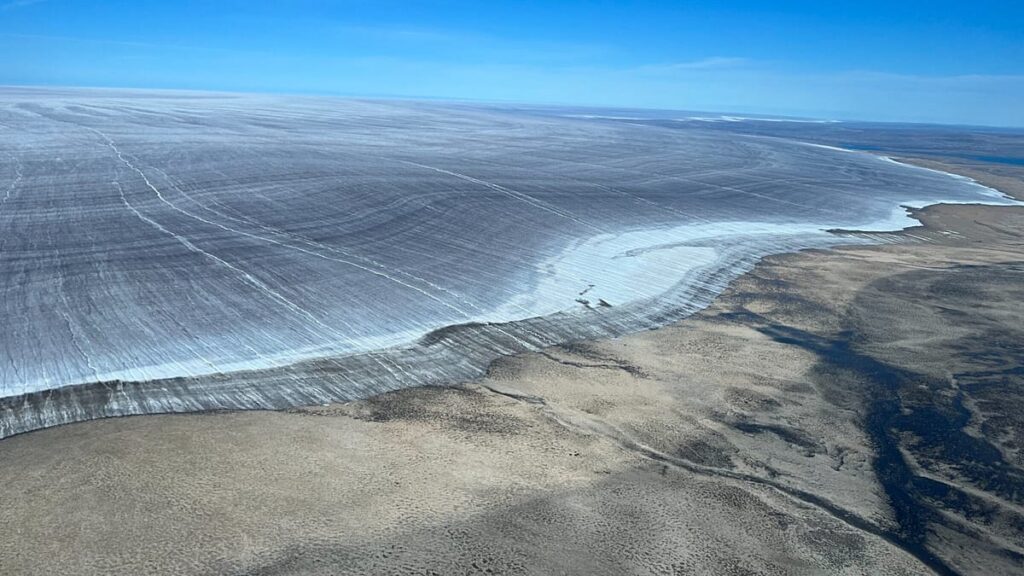
In northeastern Canada, a massive ice sheet known as the Barnes Ice Cap stretches over approximately 6,000 square kilometers. Despite its vast expanse, it has been steadily shrinking over recent decades, offering a glaring testament to climate change driven by human activities. Recent scientific evidence suggests that climate change may have even halted the onset of a new ice age.
Before 1960, the Barnes Ice Cap was expanding, indicating the anticipated arrival of a new ice age. However, this trend abruptly ceased. According to Nicolás Young, a geochemist at the Lamont-Doherty Earth Observatory, “everything seemed normal, that the next ice age was almost due, and then it suddenly stopped.” The anticipated glaciation was cut short.
Turning Point in 1961
The summer of 1961 marked a pivotal moment, recorded as one of the hottest summers of the 20th century, with temperatures comparable to those in 2021. Since that time, Canadian summers have grown increasingly warmer. The national average for summer temperatures has risen by about 2.1 degrees Celsius compared to the baseline period, with northern regions warming nearly three times faster than the global average.
Young points to this as a clear example of how human activity has disrupted the natural balance. He and his team have studied the remnants of the Laurentide Ice Sheet, which once covered vast areas of Canada and the northern United States between 95,000 and 20,000 years ago. Today, only the Barnes Ice Cap on Baffin Island remains.
The research team, led by Young, sought to determine whether the glacier had been smaller in the past and then expanded. They analyzed vegetation around the glacier, which may have once been covered by ice, to gather insights.
The Glacier Sheet Expanded Again 2,000 Years Ago
By examining carbon-14 traces in plant samples near the glacier, the researchers could estimate the age of organic material. Young explained that repeated measurements can create a timeline of ice expansion across the plants, effectively tracking the glacier’s advance.
The team discovered that the Laurentide Ice Sheet reached its smallest size about 3,000 years ago, then began to grow again around 2,000 years ago. The researchers believe that climatic conditions at the time were cold enough to allow fresh ice accumulation.
While researchers refer to this as an ice age, they clarify that it represents the onset of a new cold period within the current late Cenozoic Ice Age, which began 34 million years ago. During this era, colder glacial phases alternate with warmer interglacial ones.
Researchers Find Evidence for the Start of a Cold Period
Joerg Schaefer, a climate geochemist and Young’s colleague, noted that while they had indirect measurements of the ice sheet’s historical growth and decline, capturing its initial growth through direct observation is a novel achievement.
The researchers used new measurement techniques to identify the early stages of ice sheet growth. Schaefer highlighted that this approach provides a unique opportunity to understand how renewed glaciation begins and how the Laurentide Ice Sheet forms anew.
According to the researchers, the ice sheet’s growth around 2,000 years ago marks the beginning of Earth’s next ice age, challenging previous assumptions about glaciation timelines.
Earlier model-based studies suggested that the next glaciation would not start for thousands of years. However, Young contends that the ice sheet’s renewed expansion signals the beginning of a new glaciation, rather than waiting for massive continental ice sheets like those 95,000 years ago.
In the 1970s, some climate scientists controversially predicted an imminent ice age. Young now asserts that it has indeed begun, and they are close to proving it. The cooling effects would have taken millennia to become apparent.
Climate Change Is Making More Glaciers Disappear
The 1960s marked a turning point for the Laurentide glacier, as Earth’s warming climate caused the Barnes Ice Cap to lose more ice during summers than it gained in winters, shortening the next glaciation. This trend is causing numerous glaciers worldwide, including in Germany, to shrink.
Some models predict the eventual disappearance of the Laurentide glacier, which still dwarfs Germany’s remaining glacier fragments. Over the coming centuries, it could vanish entirely.
Young warns that these are likely the last remnants of the Laurentide Ice Sheet, soon to disappear completely. The loss of such vast ice areas may have far-reaching effects beyond the region. Researchers believe their disappearance could alter the dynamics of future glaciations and ice ages. Some scientists even suggest that a new ice age could commence in Europe.
This glacier has historically acted as a catalyst for new cold periods when Earth’s climate cooled. The immense cold ice mass produced feedback effects that spurred further ice growth. Once the glacier vanishes, this cooling effect will also be lost.
Original Story at www.euronews.com