General Motors’ Hybrid Strategy: A Shift in the U.S. Automotive Landscape
As gasoline prices soar and electric vehicle (EV) sales plateau, General Motors (GM) is gearing up to introduce hybrid models to its U.S. lineup. This move marks a strategic pivot for the automaker, which has predominantly focused on electric vehicles in recent years.
Mike Anderson, GM’s vice president of propulsion engineering, confirmed the company’s hybrid plans but withheld specifics about the timeline. “It’s fair to say that [hybrids are] part of the plan,” Anderson noted. “We’re not tone deaf to our customers. We know what they want and we want to give that to them as quickly as we can.”
The automaker’s shift comes in response to changing consumer preferences and regulatory landscapes. Despite GM’s long-term vision for an all-electric future, Anderson emphasized the need for “technology diversity” to meet varying customer demands.
GM CEO Mary Barra has previously expressed skepticism about plug-in hybrid electric vehicles (PHEVs), yet she hinted at new models being under consideration. By mid-2024, GM announced plans to release PHEVs by 2027, driven by the necessity to comply with federal emissions standards that were later relaxed.
Analysts expect GM to roll out PHEVs across its range, from the Equinox to the Silverado, by late 2027 to early 2028. This projection aligns with the growing popularity of hybrids in the U.S., as reported by Cox Automotive, which cited a 23% increase in hybrid sales in the second quarter compared to the previous year. Hybrids now account for 16.3% of U.S. vehicle sales, overshadowing the 5.8% share held by EVs.
Understanding the Hybrid Market
Hybrid vehicles integrate a traditional internal combustion engine with electric motors and batteries, offering improved fuel efficiency and performance. The fastest-growing segments for hybrids are compact crossover/SUVs and mid-size vehicles, according to Cox Automotive.
“Hybrid vehicles continue to be the clearest growth story in the electrified market,” stated Stephanie Valdez Streaty, Cox’s director of industry insights.
In the U.S., traditional hybrids like the Toyota Prius use a hybrid powertrain, while PHEVs include a plug-in feature for an all-electric range before switching to gasoline power. Another variant, extended-range electric vehicles, drives like an EV with an engine that acts as a generator to power electric motors.
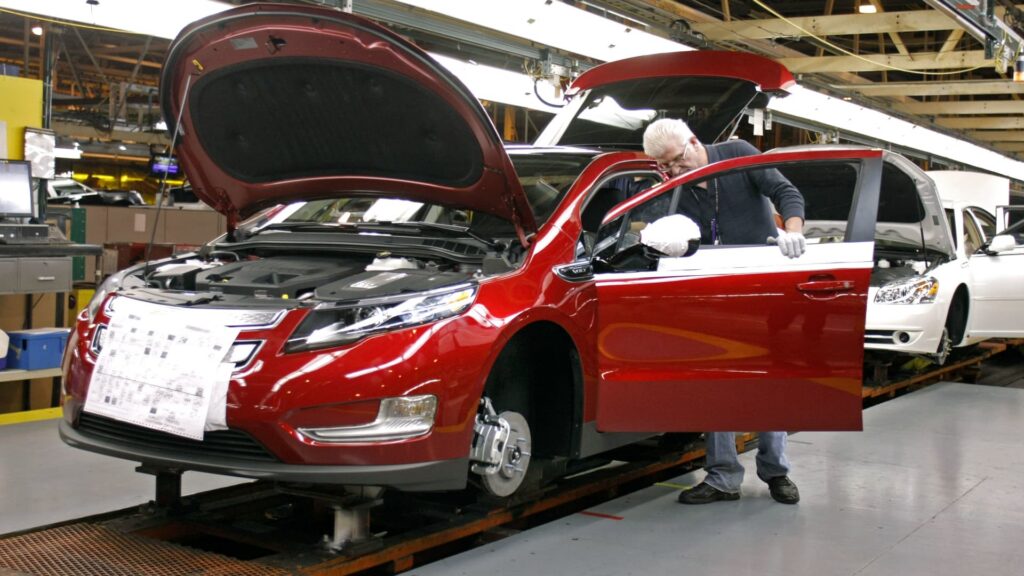
Despite GM’s previous reluctance, the rising consumer demand for hybrids is evident. Currently, GM offers a hybrid version of its Chevrolet Corvette, having discontinued the Chevrolet Volt plug-in in 2019. Meanwhile, competitors like Ford and Stellantis have accelerated their hybrid offerings.
Anderson explained that GM’s hybrid strategy would involve a combination of internal and external technologies, balancing costs and product needs. “We’re deliberate because, usually for strategic reasons, we need to control our own destiny. We need to control our own timing,” he said.
Original Story at www.cnbc.com