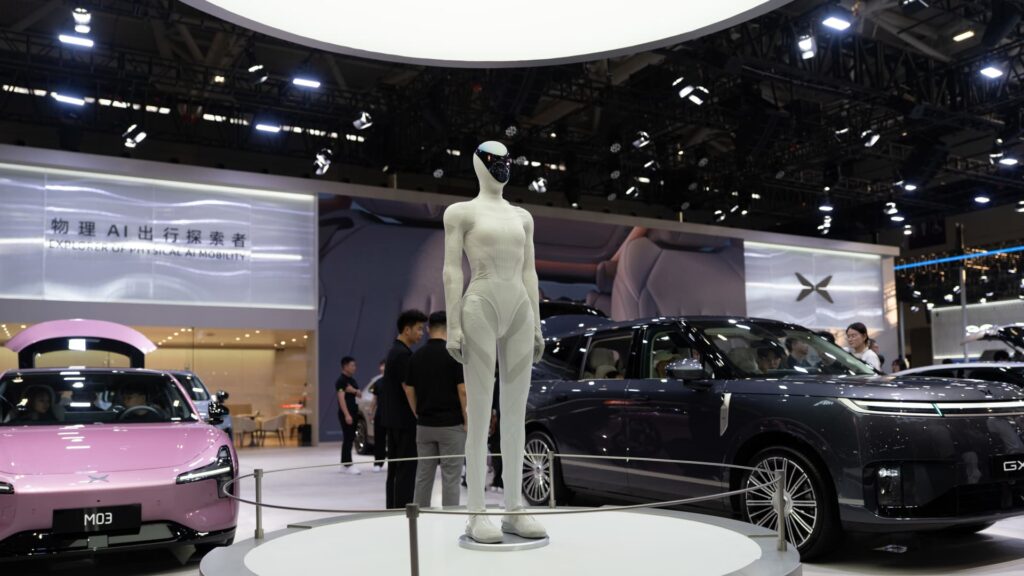
Chinese Automakers Transition from Electric Vehicles to Humanoid Robots
In a rapidly evolving technological landscape, Chinese automotive companies are pivoting from their traditional focus on electric vehicles (EVs) to explore the burgeoning humanoid robotics sector. This strategic shift comes amid a slowdown in the EV market, characterized by fierce competition and declining sales.
Despite questions about the commercial potential of humanoid robots, companies like Xpeng have forged ahead with ambitious plans for robot production. This move aligns with their efforts to reshape “capital valuation narratives,” according to Kevin Li, associate director at Counterpoint Research. The goal is to foster a perception of these companies as tech innovators and establish a new growth trajectory.
Currently, Xpeng’s stock has plummeted over 45% this year, distinguishing it as the weakest performer among major EV manufacturers. Similarly, shares of BYD have decreased by more than 13% due to declining sales. As of August, Chinese automakers comprised over half of the nearly 20 global car companies venturing into humanoid robotics through internal development, investment, or incubation, as reported by Counterpoint.
Strategic Investments and Diversification
The venture branch of EV company Nio has invested in humanoid robotics startups, including LimX Dynamics and Acorn Robot, according to PitchBook data. This diversification strategy addresses the challenges of slowing growth and diminishing profitability in China’s EV sector. The average profit margin in the country’s vehicle manufacturing industry was a mere 1.5% in the first half of 2026, per data from the China Association of Automobile Manufacturers cited by Counterpoint.
Other EV makers such as Xiaomi, Li Auto, and Geely are also exploring the robotics domain, albeit with varied strategies. Jing Yang, director of Asia-Pacific corporate ratings at Fitch Ratings, noted, “Given the slowing growth and weakening profitability in the EV market—particularly domestically—it is a natural strategic move for EV companies to diversify into new applications such as robotics.”
Despite a recent $900 million capital raise for its robotics business, Xpeng’s shares continued to decline. This funding round, the largest single investment in China’s “embodied” AI industry, valued Xpeng’s robotics division at over $6.3 billion, comparable to the $6.5 billion estimated value of its EV business, as per Citi.
Robotics: A New Frontier
While Tesla’s development of its Optimus humanoid robot in the U.S. bears similarities, Chinese automakers have unique advantages, according to Xiaoyi Lei, senior research analyst at Jefferies Hong Kong. Chinese companies like Xpeng can repurpose up to 85% of their motors, chips, and smart driving software for humanoids, enabling immediate deployment in stores and factories.
Xpeng plans to begin mass production of its robots by year-end, initially for its own facilities, and expand to the broader market in China and overseas next year. The ability to scale production is a strength of Chinese automakers, Lei observed, stating, “Chinese players are the ones actually pushing it into daily use.”
Xiaomi, which ventured into electric cars in 2024, has begun testing humanoid robots at its factory this year. BYD also has the potential to deploy robots in its factories, as noted by Counterpoint’s Li. However, he suggests that Geely and Xpeng may better leverage the benefits of diversifying beyond cars, citing Xpeng’s focus on physical AI strategy.
Challenges and Market Potential
The question remains whether humanoid robots can find a market beyond automakers’ internal operations. Lei mentioned that Jefferies has yet to see concrete external orders or clear revenue guidance from the automakers it tracks. Unitree, a leading humanoid company, experienced a stock surge upon debuting in Shanghai, but its shares have since declined. Founder Wang Xingxing cautioned that the sector’s ‘ChatGPT’ moment may still be a decade away.
Reusing automotive technology for robotics is not without challenges. Lei remarked, “The real challenge is how they are going to make the algorithm and software stack that is used to be applied to the smart driving system also viable to the humanoid scenario, which is more difficult and more challenging.”
Original Story at www.cnbc.com