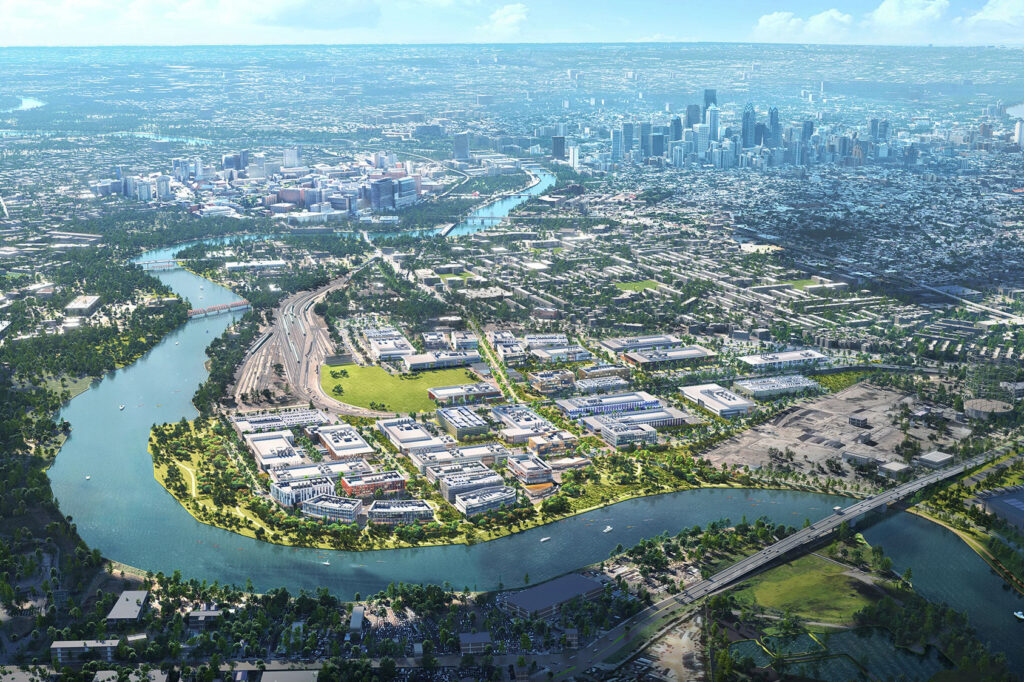
PHILADELPHIA—A recent Planning Commission presentation has reignited debate regarding Philadelphia’s Bellwether District, highlighting it as one of two possible sites for a large data center in the city.
No data center proposals have been reported by the commission or the site’s owner, HRP Group.
HRP acquired the 1,300-acre site following a 2019 fire that halted operations at a historic refinery. Partnering with the Environmental Protection Agency and Pennsylvania Department of Environmental Protection (DEP), HRP took on the task of remediating contamination to transform the land for the Bellwether District.
This clean-up continues efforts started by previous owner Sunoco, aimed only at nonresidential use. More remediation would have been required for parks or housing. A ban on environmentally sensitive uses, renewed at HRP’s acquisition, limits future flexibility.
HRP has secured two tenants: a beverage manufacturer and a nuclear-medicine business, and has constructed two warehouses. Critics express concern about potential truck traffic and its impact on nearby neighborhoods previously affected by refinery pollution.
In 2024, HRP established a $10 million community benefits agreement, following a 10-year tax break extension under the Keystone Opportunity Zone program.
HRP has not confirmed plans for a data center. Amelia Chasse Alcivar, HRP’s executive vice president, indicated no speculative building will occur without lessee demand, yet acknowledged ongoing discussions.
The district’s I-3 zoning allows “intensive, high-impact uses,” aligning with a smaller data center in north Center City. A proposal by Exelon for a new substation to support a hypothetical data center at Bellwether was reported in April.
Bruce Bohri from the Planning Commission clarified that identifying sites over 40 acres, zoned for industrial use, was not intended to promote them to developers.
Shawmar Pitts from Philly Thrive expressed skepticism about the district remaining data center-free, despite the organization’s exclusion from HRP’s benefits agreement due to desired stricter clean-up and construction prohibitions.
Donna Henry, from the Southwest Community Development Corporation, noted concern over a potential data center’s impact, though no proposals have been relayed to Bellwether’s Community Advisory Panel.
Both Henry and Marilyn Howarth from the University of Pennsylvania foresee significant public opposition to a data center proposal, citing Philadelphia’s rigorous air management regulations as a barrier.
Data center developments increasingly occur in rural areas due to urban challenges and real estate costs. Gov. Josh Shapiro recently enacted stricter guidelines on data centers, considering water demand, energy prices, and pollution concerns.
Other Options for the Site
Michael Miller from planning firm OLIN emphasized the site’s significance to Philadelphia’s urban fabric, advocating for public access and diverse long-term planning.
HRP’s Alcivar noted LEED-certified construction, solar-ready roofs, EV-equipped infrastructure, and plans for 10,000 new trees, positioning the district above the 100-year floodplain with sustainable stormwater management.
Miller, along with Drexel University’s Mira Olson and Johns Hopkins’ Peter DeCarlo, stated that the site’s complexity complicates clean-up efforts financially and legally.
Under Pennsylvania’s “Land Recycling Program,” Act 2 allows property owners like HRP to handle costly environmental remediation, overseen by DEP to ensure health and environmental safety.
DEP’s Robyn Briggs said Act 2 ensures remediation by capable parties, with DEP reviewing plans to meet regulatory standards.
Some advocated for comprehensive site remediation, seeing HRP’s acquisition as aligning with broader environmental improvements.
Others envisioned more ambitious changes, like parks or housing, but legal and financial constraints during bankruptcy proceedings limited possibilities to nonresidential use, disappointing advocates like Miller, Howarth, and Pitts.
DeCarlo supports remediation beyond industrial standards, aligning with Philly Thrive’s advocacy for better clean-up and recreational access.
The 2012 deed restriction mandates energy and chemical production use while barring sensitive construction, influencing DEP’s clean-up standards.
Despite lifting the production requirement for HRP’s acquisition, the ban on sensitive uses persists, limiting the site’s versatility.
Howarth criticized the agreement as unjust, lacking community input despite Philadelphia’s need for housing and green space.
A Tension Point
Concerns center on HRP and Sunoco’s approach to lead contamination, primarily reliant on capping soil with asphalt, a potentially acceptable method for industrial use.
Olson and Miller noted capping’s risks, with water potentially mobilizing pollutants.
Areas not capped will be remediated to a site-specific standard, which DEP deems protective for nonresidential use.
Disagreement exists among experts about lead safety levels, with calls for more thorough remediation.
Sunoco’s remediation affiliate did not comment on these concerns.
The Time for Cleanup “Would Be Now”
Some view the Bellwether District as a compromise, with HRP finalizing land clean-up for development. Experts argue the opportunity for a more comprehensive clean-up was greater in 2019 than it would be in the future.
Howarth emphasized that cleaning up to industrial standards curtailed other development options, with decisions driven by efficiency in bankruptcy court neglecting broader opportunities.
“Great ideas for the land were overlooked when DEP and EPA decided the clean-up standard,” Howarth stated, limiting future possibilities.
Original Story at insideclimatenews.org