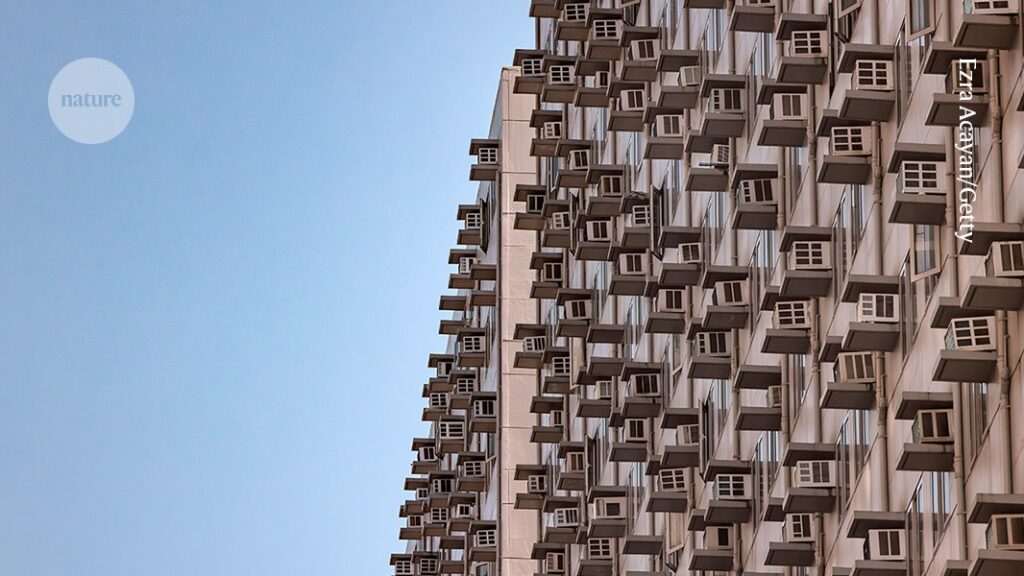
Air conditioners generate heat and are expensive to run.Credit: Ezra Acayan/Getty
With the onset of intense heatwaves across Europe and Asia, the demand for air conditioning has surged as a straightforward solution to beat the heat. While prevalent in affluent nations like the U.S., Japan, and Australia, air conditioners are not as common in European and less affluent countries. Despite their cooling benefits, these units are costly, energy-intensive, and contribute to urban heat, leading experts to suggest alternative solutions through recent advancements in building materials.
Globally, cooling systems are responsible for nearly 10% of electricity consumption, a statistic expected to rise as heatwaves become a more frequent occurrence, according to a Nature Reviews Clean Technology study. By 2050, electricity required for building cooling will surge by 210% compared to 2024, with air conditioning-related greenhouse gas emissions projected to triple.
Matthaios Santamouris, a researcher from the University of New South Wales, emphasizes that while air conditioning can be crucial for heat-vulnerable individuals, it has significant drawbacks. High temperature periods often lead to increased air conditioner use, straining the electrical grid and risking blackouts that can threaten those sensitive to heat stress.
Urban climatologist Negin Nazarian points out that air conditioning exacerbates city temperatures. Split system units, which cool individual rooms, inadvertently increase external heat by expelling it outdoors, creating a cycle where rising outdoor temperatures drive further indoor cooling needs.
For economically disadvantaged groups, the high cost of air conditioning makes it unattainable, leaving them exposed to extreme heat risks. In countries like India, Mexico, Indonesia, and Brazil, millions of families may still lack affordable access to air conditioning by 2040, despite the availability of electricity.
An alternative solution
Passive cooling strategies, which utilize materials to regulate building temperatures without significant energy use, offer a promising alternative, according to Santamouris. Innovations such as automated blinds and sun-tracking window slats are already implemented in some commercial and institutional settings to limit heat entry and reduce air conditioner dependency.
Nicole Miranda from the University of Oxford highlights advancements in passive radiative cooling materials. These materials take advantage of the ‘atmospheric window’, a range of wavelengths that escape Earth’s atmosphere into space, using specially designed paints, glasses, and gels to reflect these wavelengths and release heat.
Scientists have developed multilayered materials or those with air pockets to enhance heat reflection. For instance, paints integrating micro- or nano-sized silicon oxide and aluminum oxide spheres boost light scattering and heat release. One particular coating achieved a surface temperature reduction of 5.26°C, reflecting 97% of solar energy exposure.
Original Story at www.nature.com