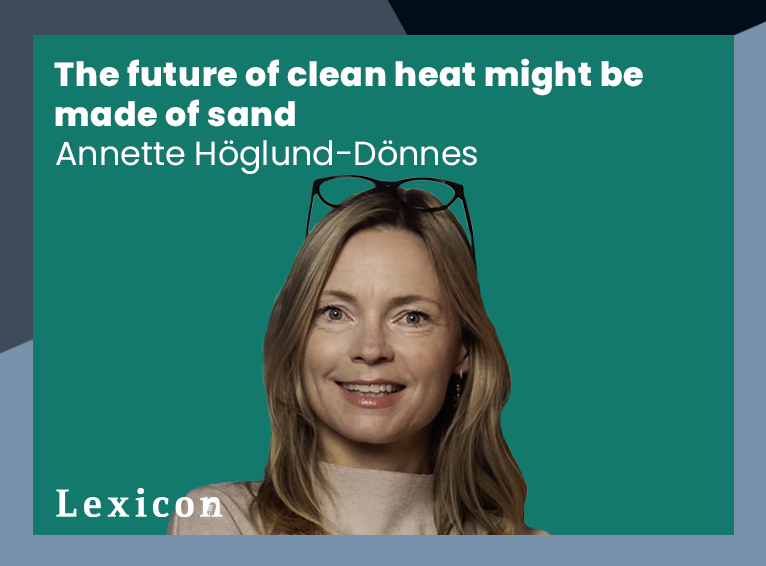
The concept of using sand to store renewable energy is gaining traction, and Polar Night Energy is at the forefront of this innovation. The company’s sand battery offers municipalities and industries a cost-effective and transformative alternative to fossil fuels. Annette Höglund-Dönnes, Chief Commercial Officer at Polar Night Energy, provides insight into this promising technology.
Understanding the Sand Battery
A sand battery functions as a vast thermal storage system. “You can think about it as a very large and well-insulated hot water tank,” Höglund-Dönnes explained. However, instead of storing energy in water, sand is used as the medium. During periods of low electricity demand or abundant renewable energy production, the generated electricity heats the air. This heated air is then circulated through tons of sand in an insulated silo, storing the heat for later use in district heating or industrial processes.
Despite its seemingly simple design, the engineering behind the sand battery is complex. “People assume it’s basic, but it’s actually a highly engineered system where heat transfer, airflow, insulation, and control systems all need to work precisely together,” Höglund-Dönnes noted.
Why Choose Sand?
Sand is a common and practical choice for this technology. “Any sand can be used,” Höglund-Dönnes mentioned, adding that even slag material from industrial processes could be utilized. Unlike lithium-ion batteries, sand does not degrade over time, providing a stable and safe storage medium. Höglund-Dönnes highlighted, “There’s no degradation. The medium itself, the sand, really doesn’t change phases or anything.” Furthermore, sand is non-toxic and non-explosive, making it a safe option for long-term energy storage.
Real-World Application
Polar Night Energy’s flagship installation in Pornainen, Finland, has demonstrated the practical viability of the sand battery. Operational since 2025, the installation successfully withstood one of Finland’s coldest winters. “We were very pleased to see that the battery performed at the upper end of what the simulations predicted,” Höglund-Dönnes stated. This real-world success is a significant milestone for the company as it scales its technology for broader commercial deployment.
Challenges of Scaling Up
Scaling the technology presented new challenges. The Pornainen installation is approximately twenty times larger than previous deployments, necessitating detailed engineering to manage the increased complexity. “The biggest surprise for us was really how much more detailed engineering we had to do at that scale,” Höglund-Dönnes commented. Despite the complexities, the simplicity of the materials—steel, sand, insulation, and readily available industrial components—remains a crucial strength.
Expanding Beyond District Heating
While district heating is a suitable initial application, Polar Night Energy envisions broader uses for its technology, particularly in industrial process heat. Industries such as food and beverage, chemicals, and pharmaceuticals currently rely heavily on fossil fuels for heat. Sand batteries could help these sectors transition gradually to renewable energy. “You wouldn’t need to take the entire step and decarbonise everything in one go,” Höglund-Dönnes said, suggesting that sand batteries could complement existing systems during this transition.
Contributing to Sustainability
The sand battery technology aligns with efforts to achieve sustainability without requiring drastic operational changes. “Thermal energy storage is one of the technologies that’s going to help industries meet those environmental targets,” Höglund-Dönnes emphasized. As governments set ambitious emissions targets, such technologies will be crucial in reducing reliance on fossil fuels.
Building Circular Energy Systems
Polar Night Energy is committed to circular economy principles, utilizing industrial waste materials as a storage medium to create local energy ecosystems. “Circularity is going to be key, no matter what we build,” Höglund-Dönnes declared. The goal is to convert local renewable electricity into heat, minimizing transportation and maximizing local use.
Looking Forward
Reflecting on the Pornainen project, Höglund-Dönnes hopes it will be remembered for its simplicity and innovation. “It’s not the complexity, it’s the simplicity. I think we’re going to look back and say, ‘Why didn’t we start sooner?’” she concluded.
Original Story at interestingengineering.com