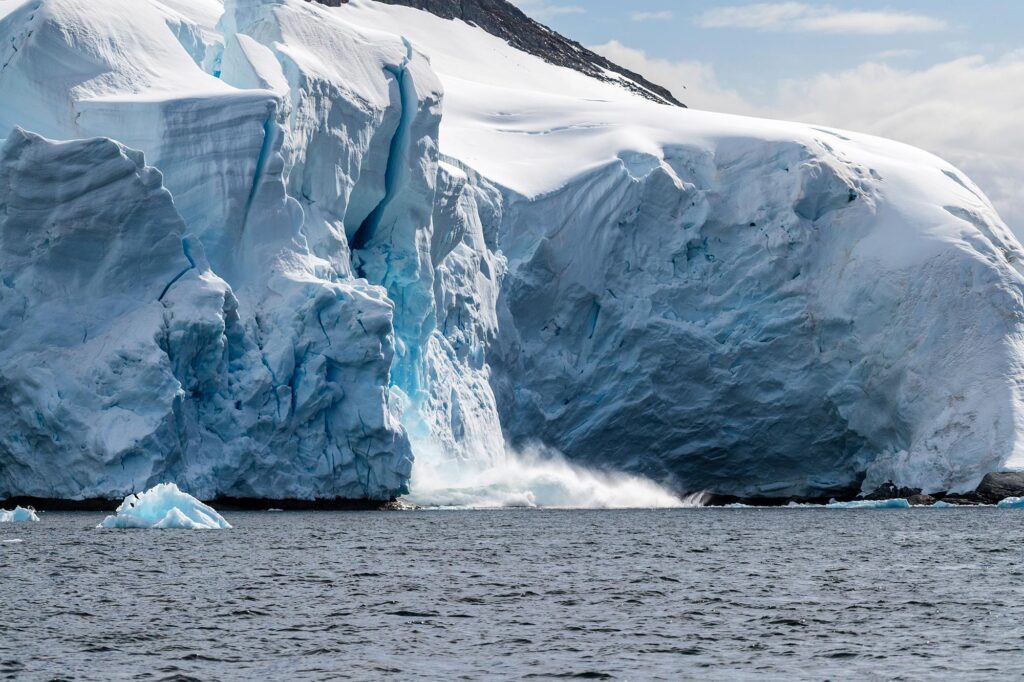
Antarctica’s Ice Sheet: Unveiling a Hidden Climate Sensitivity
Recent research has unveiled a significant transformation in Antarctica’s ice sheet, marking a key moment in its climate history. This change, traced back to around one million years ago, has made the ice sheet considerably more responsive to Earth’s shifting climate.
A study published in Nature Geoscience reveals that during the Mid-Pleistocene Transition, Earth’s climate began to experience longer and more intense ice ages. Scientists from the IBS Center for Climate Physics at Pusan National University, South Korea, led this groundbreaking research, aiming to enhance predictions of future sea-level changes.
Antarctica, home to the planet’s largest ice reservoir, plays a vital role in global sea-level regulation. Yet, understanding its historical climate response has been challenging due to limited ancient temperature and precipitation data.
Exploring Three Million Years of Climate Data
To overcome data limitations, researchers utilized an advanced paleoclimate model from the ICCP. This model recreates global climate conditions over the last three million years, providing crucial insights into Antarctic ice sheet dynamics.
Temperature and precipitation data from the simulations fed into the Penn State University ice-sheet–ice-shelf model, which examines changes in ice sheet thickness, flow, and temperature. It also considers floating ice shelves, such as those in the Ross and Weddell Seas.
Powered by one of South Korea’s fastest supercomputers, the model offered a detailed view of ice sheets’ evolution in response to changing climate conditions.
Discovering a Crucial CO2 Threshold
Post-Mid-Pleistocene Transition, the Antarctic ice sheet’s dynamics shifted dramatically. Researchers identified a critical atmospheric carbon dioxide level of approximately 240 parts per million. Falling below this threshold made the ice sheet more susceptible to oceanic and atmospheric temperature changes.
Dr. Kyung-Sook Yun, lead author of the study, noted, “After this transition, the Antarctic ice sheet reacts much more strongly to changes in climate forcing. This indicates that the system does not evolve gradually but instead becomes more responsive after crossing a particular threshold in the climate system.”
The Factors Behind Rapid Ice Growth
Several factors contributed to the enhanced ice growth in Antarctica post-transition. Colder ocean temperatures during glacial times reduced melting beneath sea-level ice sheets. Additionally, sea levels were 50-100 meters lower, lessening pressure on the bedrock beneath Antarctic ice shelves. This allowed the bedrock to rise gradually, promoting ice thickening along coastlines.
Together, these factors facilitated the formation of larger, more enduring Antarctic ice sheets during later ice age cycles.
Future Climate Change Implications
This study suggests that Antarctica may respond to climate change with less predictability than previously assumed. “Our findings suggest that the Antarctic ice sheet was more sensitive to external forcings than previously assumed. This also raises important questions about its future response to global warming,” explained Prof. Axel Timmermann, co-author of the study.
These findings underscore that ice sheets can experience abrupt behavioral shifts upon crossing certain thresholds, significantly altering their sensitivity to external changes. Understanding these transitions is crucial for improving sea-level rise forecasts in a warming world.
References:
“Increased sensitivity of the Antarctic Ice Sheet to decreasing CO2 across the Mid-Pleistocene Transition” by Kyung-Sook Yun, and Axel Timmermann, 28 May 2026, Nature Geoscience.
DOI: 10.1038/s41561-026-01979-2
“A transient coupled general circulation model (CGCM) simulation of the past 3 million years” by Kyung-Sook Yun, Axel Timmermann, Sun-Seon Lee, Matteo Willeit, Andrey Ganopolski and Jyoti Jadhav, 13 October 2023, Climate of the Past.
DOI: 10.5194/cp-19-1951-2023
Original Story at scitechdaily.com