Electric Vehicles and Their Unexpected Role in Powering Homes
In the evolving landscape of electric vehicles (EVs), a fascinating question emerges: Can your EV serve as a backup power source for your home? While the answer is nuanced, a select group of EVs is transforming this possibility into reality, offering vehicle-to-home (V2H) technology that could keep your lights on during outages.
UPDATE 20MAY2026: a new Volvo, and the return of ID.BUZZ!
Modern EVs are equipped with large, efficient batteries that can store ample energy, potentially powering a home for several days. This capability can be invaluable during emergencies or to offset high energy costs by using stored power during peak hours.
However, not all EVs can execute this function, as bi-directional charging requires specific hardware and software. This capability, known as vehicle-to-home (V2H), is currently supported by only a select few models.
Ford F-150 Lightning
Ford’s F-150 Lightning has set a benchmark by doubling as a generator in emergencies, such as ice storms and hurricanes. Capable of delivering up to 9.6 kW from its battery, it can power essential home appliances during outages. To utilize this feature, owners must install Ford’s Charge Station Pro and the Home Integration System, with a total setup cost of about $5,000, excluding installation.
Kia EV9
The Kia EV9, known for its range and charging speed, has added V2H to its list of features. When used with the Wallbox Quasar 2 bidirectional charger, it can power a typical home for up to three days. The setup costs start at $6,440, plus installation.
All GM EVs
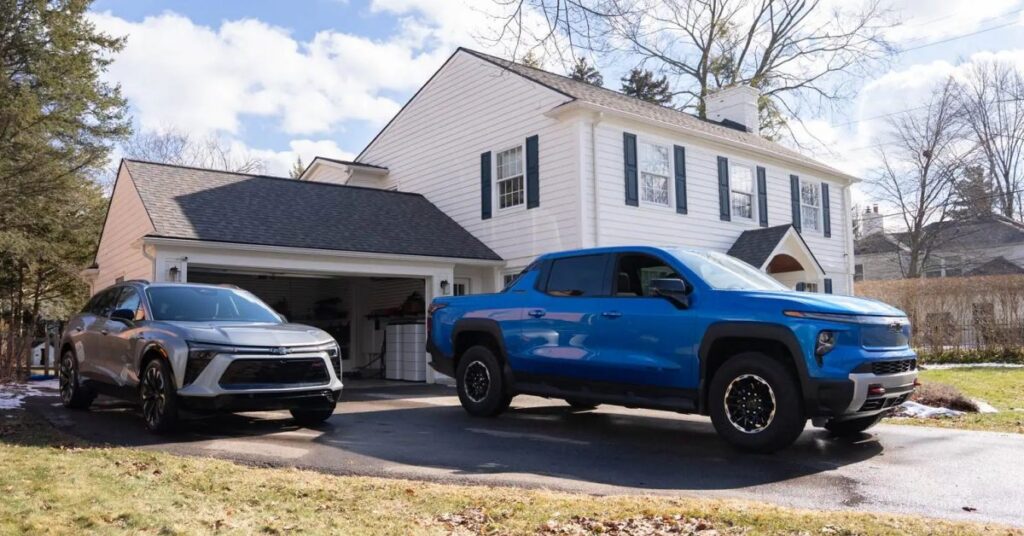
General Motors has equipped all its current EV models with the ability to return energy to the home. Using the GM Energy Home System, these vehicles can act as backup power sources, with some models like the Silverado EV providing power for up to 21 days under the right conditions. This system, which includes the Powershift Charger, is priced at $16,997, plus installation.
Nissan LEAF
The Nissan LEAF offers a limited V2H capability in the US, with outlets providing up to 1500 watts for small appliances. In other markets, the LEAF supports full V2H, enhancing home energy efficiency and serving as a backup power source.
Polestar 3
In collaboration with dcbel, Polestar is introducing V2H capabilities for the Polestar 3, starting in California. This system could potentially save users up to $1,300 annually in charging costs and provide backup power for up to 10 days.
Renault 5 E-Tech
In Europe, the Renault 5 E-Tech is part of an ecosystem enabling the vehicle to feed energy back into homes or the grid. This feature, facilitated by the Mobilize Powerbox, aims to cut charging costs and promote sustainable mobility.
Taiga Orca WX3
Canadian startup Taiga has introduced bidirectional charging in its electric watercraft, enabling them to serve as mobile energy resources. This feature allows the watercraft to recharge equipment or provide power in off-grid locations.
Tesla Cybertruck
The Tesla Cybertruck offers two options for home power backup: integration with a Tesla Powerwall or installation of additional Tesla hardware, costing approximately $3,500, plus installation.
Volvo EX90 and EX60
Volvo, in partnership with dcbel, is offering V2H and smart charging features for the EX90 and EX60 models. This system, initially available in California, provides potential savings on charging and backup power for up to a week.
Volkswagen ID.BUZZ
Volkswagen’s ID.BUZZ, slated for a 2027 release, will feature V2H capabilities in Europe, with potential future updates for North American buyers. This feature enables the vehicle to serve as a significant home energy source.
No, with an unless
While many EVs lack built-in V2H capabilities, third-party solutions like the Sigenergy V2X system offer alternatives. This system provides V2H functionality for various models, including Tesla’s non-Cybertruck vehicles, Kia EV6, and several European brands.
Original content from Electrek.
Original Story at electrek.co