A Glimpse into Hyundai’s Latest Electric Hatchback
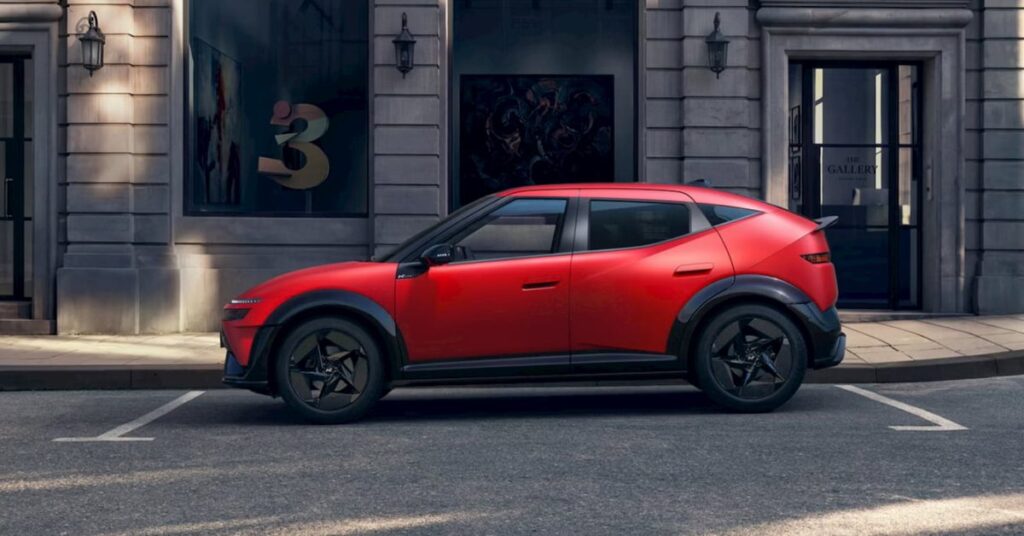
Recently, Hyundai’s newest electric vehicle, the IONIQ 3, made its first public appearance. This compact EV, following its debut at Milan Design Week, was spotted as a standard model in South Korea, revealing a fresh perspective on Hyundai’s innovative design approach.
Exploring the IONIQ 3’s Unique Design
Introduced as a more compact and affordable addition to the IONIQ lineup, the IONIQ 3 brings a new dimension to Hyundai’s electric vehicle offerings. While it shares some design elements with the IONIQ 5 and 6, such as the distinctive pixel lighting, the IONIQ 3 stands out with its “Aero Hatch” design. Hyundai describes this as “a new typology that reimagines the compact EV silhouette,” presenting a sporty and sleek profile. Notably, the vehicle features four dots at the front, symbolizing “H” in Morse Code.
Standard vs. N-Line: What Sets Them Apart?
After the IONIQ 3’s debut, curiosity grew about the standard model, as the N-Line variant was initially showcased. The standard model, as seen in a video by ShortsCar, mirrors the N-Line’s design but with milder features. It lacks the black wheel arch cladding and sporty bumper of the N-Line, yet maintains the overall shape and aesthetic. Inside, the differences are subtle, with fewer badges and extras compared to the upgraded trim.
Technological Innovations and Specifications
Marking a first for European models, the IONIQ 3 includes Hyundai’s latest Pleos Connect Infotainment system, based on Android Automotive OS. This system promises a user-friendly, customizable experience akin to operating a smartphone. The car is built on the E-GMP platform, similar to other IONIQ models, and offers two battery options: 42.2 kWh and 61 kWh. These provide ranges of up to 213 miles (344 km) and 308 miles (496 km), respectively, according to WLTP standards.
Interestingly, the IONIQ 3 operates on a 400V architecture, unlike the 800V systems in the IONIQ 5 and 9, helping to keep production costs lower. Charging from 10% to 80% takes approximately 29 minutes for the standard battery and about 30 minutes for the long-range version.
With dimensions of 4,155 mm in length, 1,800 mm in width, and 1,505 mm in height, along with a wheelbase of 2,680 mm, the IONIQ 3 is more compact than competitors like the Volkswagen ID.3 or the upcoming Chevy Bolt EV in 2027.
Market Release and Pricing Expectations
As the IONIQ 3 gears up for its market release later this year, pricing details are anticipated, with estimates suggesting a starting price of around €30,000 ($35,000) in Europe and £25,000 in the UK. The N-Line variant could cost about €10,000 ($11,700) more. For comparison, the IONIQ 5 starts at €45,550 ($53,500) in Germany, with the N-Line version priced at €58,300 ($68,500).
However, the IONIQ 3 won’t be available in the US market. Its production in Europe, specifically at Hyundai’s plant in İzmit, Turkey, and the preference for larger vehicles in the US, combined with import tariffs, make it an unlikely candidate for American roads. Nevertheless, Hyundai continues to offer competitive EV options in the US, like the IONIQ 5, with lease deals starting as low as $259 a month. Interested buyers can explore local deals on the 2026 Hyundai IONIQ 5.
Original Story at electrek.co