Invasive Plants Disrupt Soil Dynamics on Tropical Coral Islands
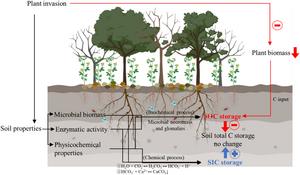
April 22, 2026 – In a recent investigation published in Biological Diversity, researchers have identified a complex alteration in soil carbon composition caused by invasive plant species on tropical coral islands. The study reveals that while the overall soil carbon content remains constant, the balance between soil organic carbon (SOC) and soil inorganic carbon (SIC) is disrupted, posing a significant risk to soil health and the broader ecosystem.
Impact of Invasive Species on Soil Carbon
Conducted by scientists from the South China Botanical Garden, Chinese Academy of Sciences, the study examined the influence of three invasive species—Cassytha filiformis, Eupatorium odoratum, and Wedelia biflora—across the Paracel Islands. The findings indicate that these invasive plants significantly reduce the biomass of native vegetation. However, the total soil carbon remains stable due to an increase in SIC that offsets the decline in SOC.
Seasonal and Species-Specific Microbial Effects
The research team analyzed soil carbon pools, microbial indicators, and environmental factors during both dry and wet seasons. The presence of invasive plants was found to decrease soil microbial-derived carbon, such as amino sugars and glomalin-related soil proteins, while increasing their relative contribution to SOC. The impact was species and season-specific: E. odoratum and W. biflora notably reduced microbial carbon during the wet season, whereas C. filiformis primarily affected it in the dry season.
Consequences of SOC Reduction
Using random forest and structural equation modeling, the researchers identified total nitrogen, total phosphorus, and soil enzymes as critical factors driving changes in SOC and SIC. The intensity of plant invasion diminished SOC but enhanced SIC through modifications in soil chemistry and microbial processes. Despite the stability in total carbon stocks, the decline in SOC compromises essential soil functions such as nutrient cycling, water retention, and microbial habitat, which SIC cannot substitute.
This research underscores that the unchanged total carbon levels conceal significant soil degradation on tropical coral islands. It advocates for targeted management of invasive species and restoration of native vegetation to safeguard SOC and sustain ecosystem resilience.
The study received backing from the National Natural Science Foundation of China and the National Key Research and Development Program of China.
Further Reading
For more details, refer to the original research by Li, Tengteng, et al. (2024), titled “Contrasting responses of soil organic and inorganic carbon pools under plant invasion in tropical coral islands,” published in Biological Diversity. Read the full study here.
Original Story at www.eurekalert.org