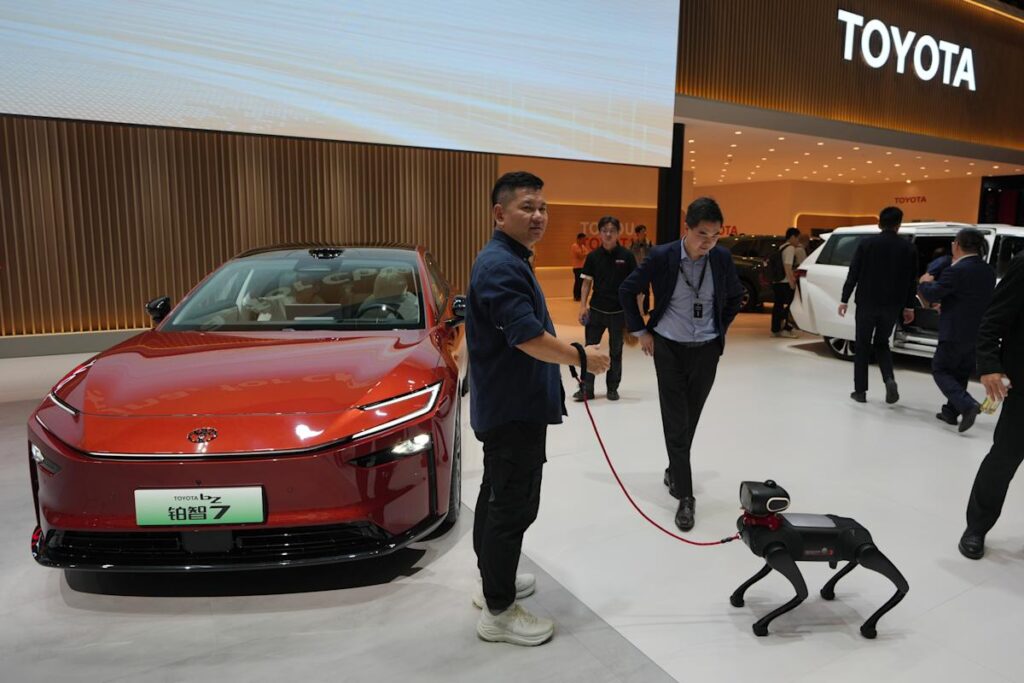
In a striking display of innovation, China’s leading automakers are unveiling their latest advancements in automotive technology at the Beijing auto show. The event highlights China’s rising influence in the global automotive market, particularly in electric vehicles and intelligent driving systems.
The biennial auto show, which opened to media recently, emphasizes China’s pioneering role in automotive technology, surpassing many global competitors. The show features over 1,450 vehicles, including 181 global premieres, and will continue until May 3.
Breakthroughs in Automotive Technology
XPeng, a Chinese electric vehicle manufacturer, is introducing its latest GX model, a six-seater SUV equipped with innovative features such as fully reclining third-row seats. The vehicle’s advanced capabilities were demonstrated by founder and CEO He Xiaopeng, who stated, “When you’re driving on the highway, you fall asleep, or if you feel unwell and can no longer control the vehicle, the system can detect the situation, pull over automatically and alert emergency services.”
BYD, another prominent Chinese EV maker, is showcasing its fast-charging “blade” EV battery, capable of reaching nearly full charge in just nine minutes, even under extremely low temperatures. Additionally, Yijing, a joint venture between Dongfeng Motor Corp. and Huawei, unveiled the X9 SUV, featuring the Qiankun intelligent driving system and a HarmonyOS operating system.
China’s battery giant, CATL, also presented a new “Shenxing” battery version that charges from 10% to 98% in a mere six-and-a-half minutes.
China’s Competitive Edge in the Global Market
The rapid advancements by Chinese automakers are setting a high bar in the industry. Tu Le, managing director of Sino Auto Insights, noted the “speed and aggressiveness of advancement” in China’s automotive sector. Chris Liu from Omdia pointed out that China’s quick pace in deploying new vehicle technologies gives consumers access to advanced features early on.
Despite facing challenges such as intense price wars and reduced government subsidies, China’s auto industry remains robust. While domestic sales of passenger vehicles fell by 23% in the first quarter of the year, exports surged by 63%, particularly to Europe, Southeast Asia, and Latin America.
According to AlixPartners, vehicle prices in China have dropped by 20% over the past two years due to market competition.
Looking Ahead: Global Impact
Although many new technologies showcased at the auto show may not be immediately exported due to regulatory challenges, they represent capabilities that could be adapted globally. While foreign automakers like Volkswagen are making efforts to regain market share in China, experts like Andreas Radics from Berylls suggest that regaining significant market share may not be feasible.
In response to growing overseas demand, Chinese automakers are increasingly building factories abroad, with predictions that overseas production could nearly triple by 2030.
Original Story at autos.yahoo.com