Unveiling the Impact of Climate Extremes: A Comprehensive Dataset Analysis
The increasing frequency and intensity of extreme weather events have become a focal point for climate researchers worldwide. A recent analysis delves into the intricacies of extreme climate events, utilizing a robust dataset to project potential impacts on natural and human systems. This study offers new insights into how various global regions might experience these climatic changes in the coming decades.
The dataset, constructed using methods outlined by Lange et al. and Zantout et al., integrates projections from the Inter-Sectoral Model Intercomparison Project (ISIMIP) Phase 3b. This integration involves the use of advanced climate models, also known as general circulation models, which simulate the physical climate system and predict changes in climate variables such as temperature and precipitation.
Climate impact models utilize outputs from these climate models to simulate effects on ecosystems and human systems. For instance, hydrological models translate climatic changes into variations in soil moisture and river discharge, while vegetation models simulate changes in plant growth and distribution. ISIMIP provides a platform for comparing these models consistently across different sectors, supporting assessments by the Intergovernmental Panel on Climate Change (IPCC).
The analysis employs five CMIP6 climate models: GFDL-ESM4, UKESM1-0-LL, IPSL-CM6A-LR, MPI-ESM1-2-HR, and MRI-ESM2-0. These models were selected based on their historical performance and structural independence. Simulations cover a historical period (1850–2014) and a future period (2015–2100) under various emission scenarios, including low (SSP1–2.6), medium-high (SSP3–7.0), and high (SSP5–8.5).
Understanding Extreme Event Exposure
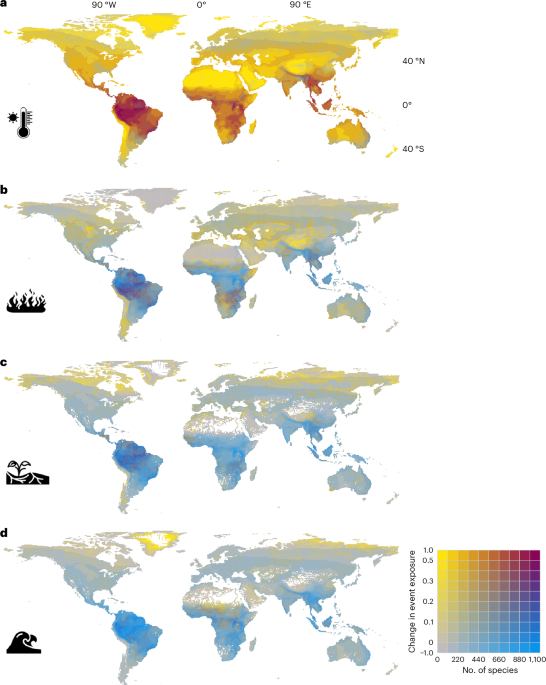
Exposure to extreme events is quantified annually, allowing for comparisons across different event types. An extreme event is identified when conditions surpass historical thresholds within a grid cell. This study uses a conservative 97.5th percentile threshold (2.5th for droughts) for classifying extreme conditions, ensuring consistency with past research.
Various climate events, such as droughts, heatwaves, and floods, have specific definitions and thresholds. For example, drought exposure is derived from soil moisture simulations by global hydrological models. Heatwaves are identified using the HeatWave Magnitude Index daily (HWMId), while river floods and wildfires are assessed through runoff and burned area simulations, respectively.
Spatial and Temporal Exposure Analysis
The study calculates event frequency by dividing the number of years with events by 30, averaging across all model combinations. For historical comparisons, exposure averages are centered on the year 2000, with future projections extending to 2085. The study also identifies areas likely to experience multiple extreme events, using thresholds for event frequency to assess changes over time.
Impact on Biodiversity and Ecoregions
Species and ecoregion exposure to climate extremes are a critical focus, with data sourced from the IUCN Red List and other databases. The analysis maps species ranges to the ISIMIP grid, examining overlap with extreme event projections. The study highlights regions with significant biodiversity that might face increased risks due to climate change.
Overall, this comprehensive analysis of extreme climate events provides vital data for understanding potential future impacts. It underscores the need for continued research and adaptation strategies to mitigate adverse effects on ecosystems and human societies.
“`
Original Story at www.nature.com